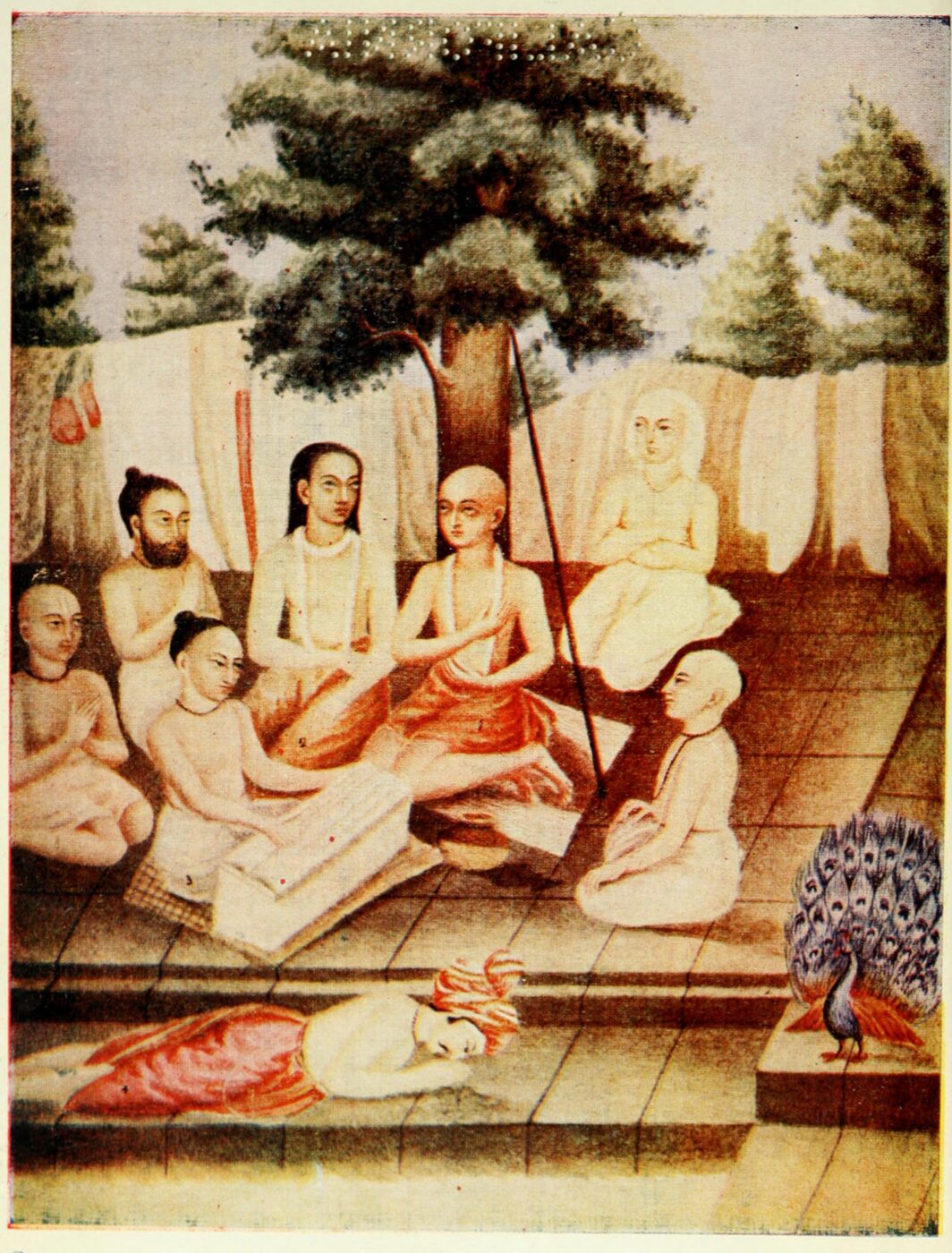
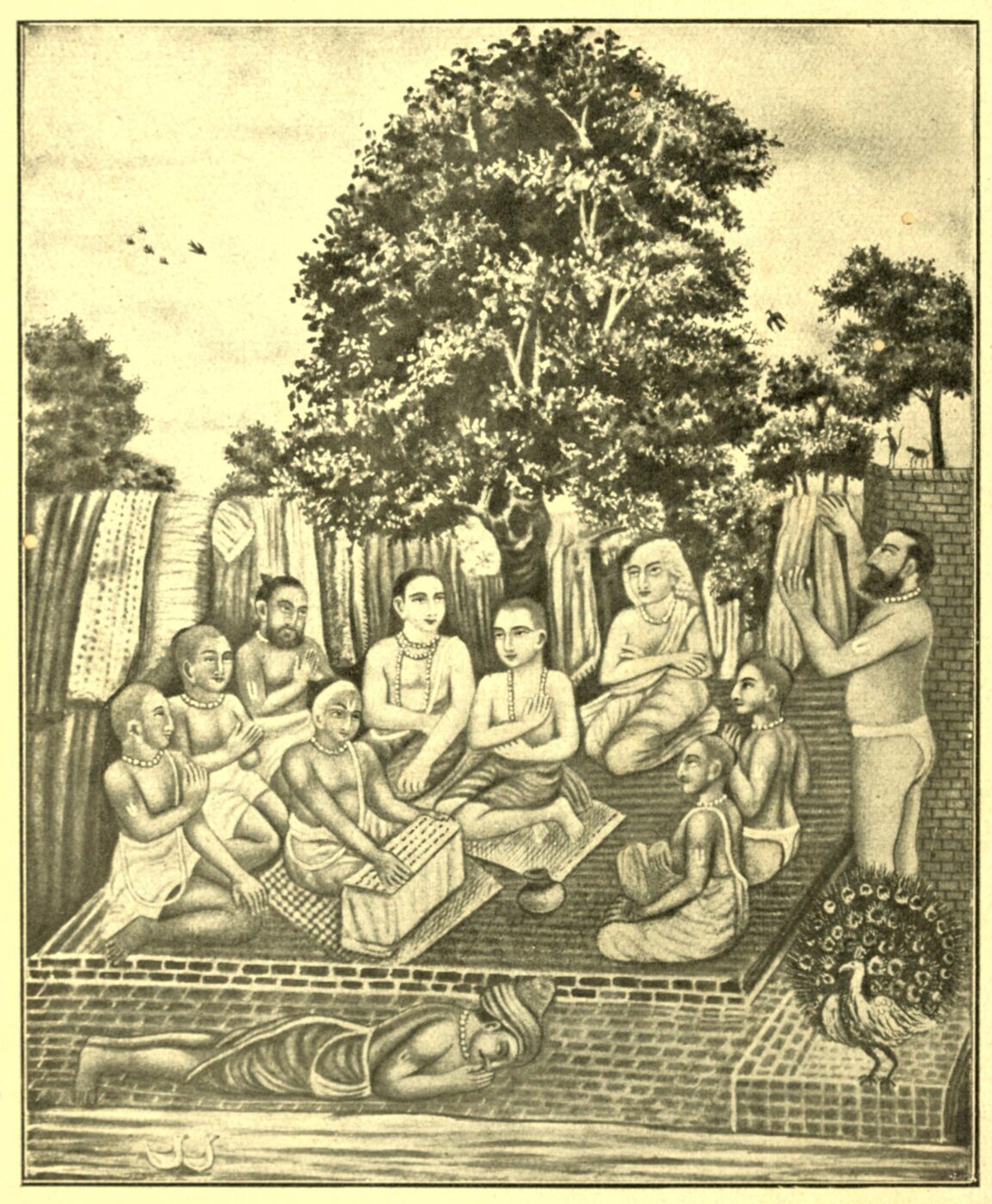
By the time He was a young pandit running His own school of Sanskrit grammar in Nabadwip, Nimai had already earned a reputation as the sharpest logician in a town famous for producing them. It was at this stage of His life — still a householder, still known simply as a brilliant and somewhat proud young scholar, with no outward sign yet of the sankirtana movement to come — that a celebrated traveling pandit named Keshava, honoured with the title Kashmiri Pandita for his mastery of poetry and rhetoric, arrived in Nabadwip.
Detail
Description
Opponent
Keshava, titled Kashmiri Pandita, a digvijayi scholar
Place
Nabadwip, on the bank of the Ganges
The challenge
A hundred extempore Sanskrit verses in praise of the Ganges
Nimai's reply
Questions revealing flaws, redundancies and unintended meanings
Outcome
Keshava conceded the next morning and gave up the pride of digvijaya
Keshava Kashmiri Pandita had already toured the length and breadth of India as a "digvijayi" — a scholar who challenges the learned assemblies of every city he visits and, undefeated, claims the title of conqueror of all directions. He had reportedly triumphed over the greatest pandits of Kashi, Kanchi and countless other seats of learning, and arrived in Nabadwip expecting, as everywhere else, an easy victory that would add the town's proud reputation for scholarship to his own tally. He composed, in Nimai's honour and as a challenge, a hundred extempore Sanskrit verses in praise of the Ganges, verses so ornamented with alliteration and double meaning that no scholar present could immediately find fault with a single syllable.
The assembled pandits of Nabadwip, unwilling to be humiliated but unable to answer Keshava on his own terms, are said to have quietly appealed to the young Nimai — already known among them as unusually gifted despite His youth — to test the visiting scholar. Nimai listened to the hundred verses once, and then, with a courtesy that gave no hint of what was coming, praised one particular verse and asked with apparent innocence whether a certain compound word in it could bear a second meaning. When Keshava, puzzled, admitted he had not intended one, Nimai proceeded — verse by verse — to reveal that many of Keshava's own celebrated lines, read with strict grammatical rigor, actually contained flaws, redundancies or unintended meanings that a truly perfect composition should never contain, doing so with such deference and precision that the older scholar could find no honest way to disagree.
What makes the encounter remembered as more than an ordinary academic contest is the manner of Nimai's victory. He never boasted, never humiliated Keshava Kashmiri Pandita in front of the crowd, and never claimed to have "defeated" him; He raised questions as a respectful junior seeking clarification, allowing the older pandit himself to recognise the flaws.
That night, so the histories relate, Keshava Kashmiri Pandita had a dream in which the goddess of the Ganges herself, whom his hundred verses had glorified, appeared to him and revealed that the young brahmana who had questioned him that day was in fact the Supreme Lord, and rebuked him gently for the vanity of digvijaya conquest. Shaken, Keshava returned the next morning, openly acknowledged Nimai's superiority, and the two are said to have parted as friends rather than rivals — Keshava Kashmiri Pandita continuing his life humbled of the very pride that had defined his career until then.
For Gaudiya Vaishnavas, the episode carries a double significance. On the historical level, it cemented, before the sannkirtana movement had even begun, Nimai's unrivalled position as the finest scholar Nabadwip — and by extension all of Bengal — could produce, a status that would later throw His voluntary abandonment of scholarly prestige for the humility of the holy name into even sharper relief. On the spiritual level, later Vaishnava commentators read the story as an early, still-veiled hint of who Nimai really was: even at the height of His fame as a logician, a moment's contact with Him was enough to reveal, in a dream, the presence of the Supreme Lord — a truth Nabadwip itself would not fully recognise until, a short time later, He returned from Gaya transformed forever.
Monochrome plate from Jadunath Sarkar's 'Chaitanya's Life and Teachings' (1922): Nimai seated on a courtyard terrace among brahmana scholars and students with palm-leaf manuscripts and a writing board, under a large tre…Wikimedia Commons · public domain
jīyāt — long live; kaiśora — situated in the kaiśora age; caitanyaḥ — Lord Caitanya Mahāprabhu; mūrti-matyā — having accepted such a body; gṛha-āśramāt — from a householder’s life; lakṣmyā — by Lakṣmī; arcitaḥ — being worshiped; atha — then; vāk-devyā — by the goddess of learning; diśām — of all directions; jayi — the conqueror; jaya-chalāt — on the plea of conquering.
Long live Lord Caitanya Mahāprabhu in His kaiśora age! Both the goddess of fortune and the goddess of learning worshiped Him. The goddess of learning, Sarasvatī, worshiped Him in His victory over the scholar who had conquered all the world, and the goddess of fortune, Lakṣmīdevī, worshiped Him at home. Since He is therefore the husband or Lord of both goddesses, I offer my obeisances unto Him.
mahattvaṁ gaṅgāyāḥ satatam idam ābhāti nitarāṁ
yad eṣā śrī-viṣṇoś caraṇa-kamalotpatti-subhagā
dvitīya-śrī-lakṣmīr iva sura-narair arcya-caraṇā
bhavānī-bhartur yā śirasi vibhavaty adbhuta-guṇā
Word for word
mahattvam — greatness; gaṅgāyāḥ — of mother Ganges; satatam — always; idam — this; ābhāti — shines; nitarām — without comparison; yat — because; eṣā — she; śrī-viṣṇoḥ — of Lord Viṣṇu; caraṇa — feet; kamala — lotus flower; utpatti — generation; subhagā — fortunate; dvitīya — second; śrī — beautiful; lakṣmīḥ — goddess of fortune; iva — like; sura-naraiḥ — by demigods and human beings; arcya — worshipable; caraṇā — feet; bhavānī — of goddess Durgā; bhartuḥ — of the husband; yā — she; śirasi — on the head; vibhavati — flourishes; adbhuta — wonderful; guṇā — qualities.
“ ‘The greatness of mother Ganges always brilliantly exists. She is the most fortunate because she emanated from the lotus feet of Śrī Viṣṇu, the Personality of Godhead. She is a second goddess of fortune, and therefore she is always worshiped both by demigods and by humanity. endowed with all wonderful qualities, she flourishes on the head of Lord Śiva.’ ”
The single verse from Kesava Kasmiri's hundred that Mahaprabhu recited back from memory as a sruti-dhara.
শাস্ত্রের বিচার ভাল–মন্দ নাহি জানি ।
সরস্বতী যে বলায়, সেই বলি বাণী ॥ ৯৪ ॥
śāstrera vicāra bhāla-manda nāhi jāni
sarasvatī ye balāya, sei bali vāṇī
Word for word
śāstrera vicāra — discussion of śāstra; bhāla-manda — good or bad; nāhi jāni — do not know; sarasvatī — mother Sarasvatī; ye balāya — whatever she speaks; sei — those; bali — I say; vāṇī — words.
“My dear sir, I do not know what is good composition and what is bad. But whatever I have spoken must be understood to have been spoken by mother Sarasvatī.”
vastutaḥ — in fact; sarasvatī — mother Sarasvatī; aśuddha — impure; śloka — verse; karāila — caused him to compose; vicāra-samaya — at the time of reviewing; tāṅra — his; buddhi — intelligence; ācchādila — covered.
Sarasvatī had in fact induced the champion to compose his verse in an impure way. Furthermore, when it was discussed she covered his intelligence, and thus the Lord’s intelligence was triumphant.
sarasvatī — mother Sarasvatī; svapne — in a dream; tāṅre — unto him; upadeśa — advice; kaila — gave; sākṣāt — directly; īśvara — the Supreme Person; kari’ — accepting; prabhuke — the Lord; jānila — he understood.
In a dream the goddess informed him of the Lord’s position, and the poetic champion could understand that Lord Caitanya Mahāprabhu is the Supreme Personality of Godhead Himself.
prāte — in the morning; āsi’ — coming back; prabhu-pade — at the lotus feet of the Lord; la-ila — took; śaraṇa — shelter; prabhu — the Lord; kṛpā — mercy; kaila — showed; tāṅra — his; khaṇḍila — cut off; bandhana — all bondage.
The next morning the poet came to Lord Caitanya and surrendered unto His lotus feet. The Lord bestowed His mercy upon him and cut off all his bondage to material attachment.