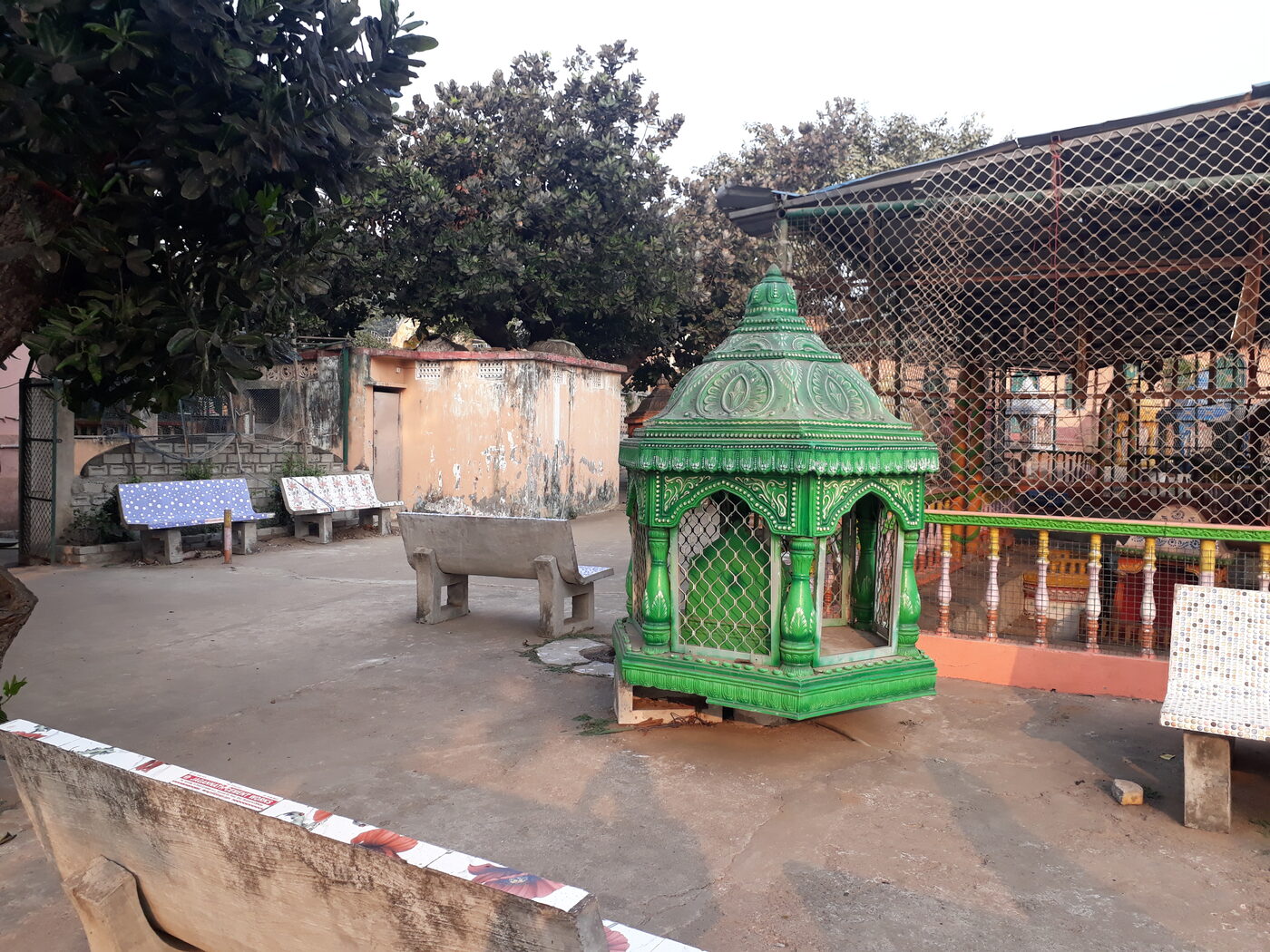
Chaitanya Mahaprabhu's manifest pastimes ended at Jagannatha Puri in 1534, in His forty-eighth year. The tradition is unusually reticent about how. Krishnadasa Kaviraja, who had every reason to describe it and who had access to those who were there, closes the Chaitanya-charitamrita without narrating the departure at all; and among the accounts that do circulate there is more than one version — some place it in the sea, some in the Gundicha temple, some speak of absorption into Lord Jagannatha. The version that has become standard in the Gaudiya line, and the one Bhaktivinoda Thakura gives, is that after eighteen years lived mostly at Kashi Mishra's house He disappeared during sankirtana in the temple of Tota Gopinatha — which is to say, in the garden where Gadadhara Pandit had served the Deity for twenty-four years, in front of the Deity Mahaprabhu had given him.
| Detail | Description |
|---|---|
| Date of disappearance | Dark moon day of Jyestha, Saka 1456, which is 1535 |
| Place | Jagannatha Puri |
| Age | About forty-eight, the Lord's own age |
| Time after Mahaprabhu | About eleven months |
| Relic | A tooth enshrined in a samadhi at Vrindavana, near the Vamsi Gopala temple |
The Months of Separation #
Whatever happened there, Gadadhara Pandit was the one left behind. Everything the sources say about the months that followed says the same thing in different words: that he did not recover, and did not try to. Narahari Chakravarti, writing later in the Bhakti-ratnakara, describes an old man sitting with his eyes closed repeating the name of Gaurasundara, his breath coming hot as flame, his body barely moving — and gives, as the only reason he was still alive at all, that he was waiting to give his mercy to Srinivasa Acharya, the young Vaishnava who would carry the Gaudiya literature back into Bengal. The Bhakti-ratnakara's judgement is that no one but the Lord could know what Gadadhara Pandit suffered in that separation.
Why Tota Gopinatha Is a Seated Deity #
He had been about the Lord's own age, and he was therefore roughly forty-eight when Mahaprabhu departed; the accounts say he aged with startling speed in the time remaining. There is a tradition attached to the Deity from this period which is dear to pilgrims and which should be reported as what it is — a local temple tradition, and a disputed one. It is said that Gadadhara had become too frail to lift his arms high enough to place a garland around Gopinatha's neck, and that the Deity, to make His servant's service possible, sat down. Tota Gopinatha is in fact a seated form of Krishna, which is rare enough that visitors notice it, and this is the explanation the temple gives.
His Disappearance at Puri #
Gadadhara Pandit survived Mahaprabhu by about eleven months. He disappeared at Puri on the dark moon day of the month of Jyestha in the Saka year 1456, which is 1535. Some accounts say that he entered his Deity, as the Lord is held to have done before him. A tooth relic of his is enshrined in a samadhi at Vrindavana, near the Vamsi Gopala temple.
Waiting to Give Mercy to Srinivasa Acharya #
It is worth pausing on the figure of Srinivasa Acharya here, because he is the hinge between two eras. Srinivasa was a young man from Bengal who had set out to meet the associates of Mahaprabhu and arrived, in every case, too late; the Bhakti-ratnakara is largely the record of those near-misses. He reached Puri to find Mahaprabhu gone and Haridasa Thakura's tomb already standing by the sea. That Gadadhara Pandit is said to have held on specifically in order to receive him is the tradition's way of saying that the transmission did not break — that the last of the Nabadwip circle deliberately handed something forward to the generation that would collect the Vrindavana literature and carry it back into Bengal.
The Gadadhara Parivara and Its Disputed Claims #
He left behind him a line. The Gadadhara parivara is one of the traditional Chaitanya lineages that has continued unbroken to the present day, alongside the Advaita parivara and the others; his disciple Bhugarbha Goswami is its best-attested source. Some within that line hold that Rupa Goswami and Sanatana Goswami themselves took initiation from Gadadhara Pandit, and adduce a verse of the Sadhana-dipika and the attribution of the Gadadharashtaka; others, including scholars sympathetic to the claim, acknowledge that the evidence is not conclusive and that the more common view assigns Rupa and Sanatana elsewhere. It is honest to leave that unresolved. What is not disputed is that a great many Bengali temples worship, on their central altar, not Gauranga alone but Gaura-Gadadhara, and that the first Deity of Srimati Radharani installed in Vrindavana is said to have been sent there by him.
Viraha and the Meaning of Those Months #
The eleven months themselves have a place in Gaudiya thought that is easy to miss. Separation — viraha — is not treated in this tradition as the failure of devotion but as its most intense condition, and the literature of the movement is largely a literature of separation: Mahaprabhu's own last years at the Gambhira are described in exactly these terms, and so are the songs of the Goswamis at Vrindavana. What Narahari Chakravarti describes of Gadadhara Pandit in 1534 and 1535 is therefore not read as a broken old man failing to cope with bereavement. It is read as the same relationship continuing in the only mode left to it. That reading may be accepted or not, but it is the reason the tradition records the eleven months at all, rather than passing over them as a sad postscript.
What the Tradition Honours in Him #
What the tradition honours in him is worth stating plainly, because it is not the usual thing. Gadadhara Pandit founded no institution. He wrote nothing that has come down under his name. He preached to no one, travelled nowhere after 1510, and had, by the ordinary measures of a religious career, nothing to show. He was Mahaprabhu's exact contemporary and neighbour, went where He went, held His hands when He tore at Himself, read to Him, cooked for Him, and stayed. When he was once given the chance to break that pattern and follow the Lord to Vrindavana, he took it instantly and was sent back, and the Lord afterwards said publicly that Gadadhara's unhappiness was the reason the journey never happened.
Gaudiya theology explains the pattern by saying that this is what the pleasure potency does. The three predominators of the Panca-tattva are worshipped; the fourth worships. The love that Chaitanya Mahaprabhu came into the world to taste had to be tasted from somewhere, and the somewhere is not a doctrine but a person, standing to one side, undemonstrative, doing small things well for a very long time. Every time the Panca-tattva mantra is chanted — and it is chanted before the maha-mantra by Gaudiya Vaishnavas everywhere — Gadadhara's name is the fourth of the five, in the same position it occupied all his life: after the Lord, before the devotees, holding neither end.