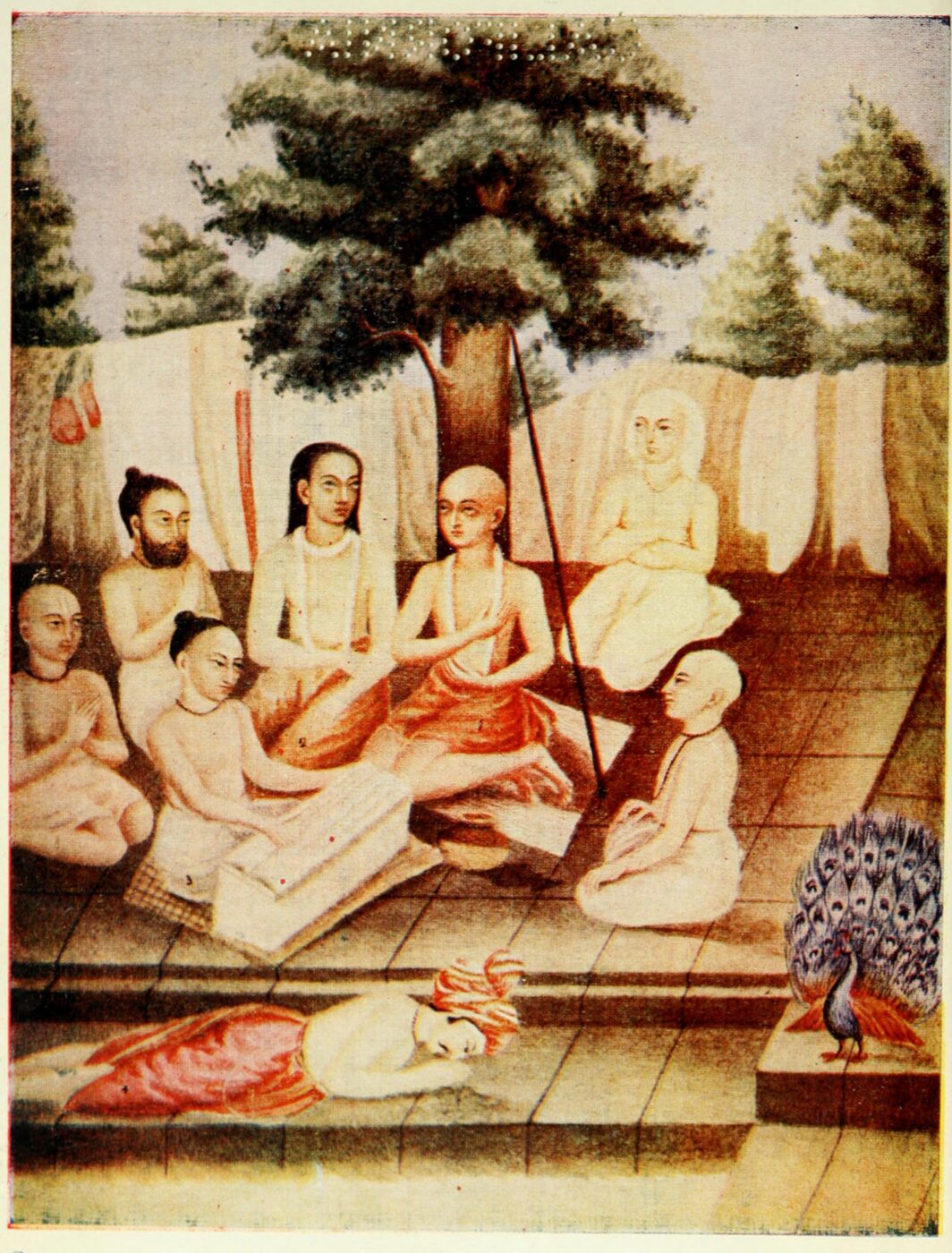
Two boys of the same age living a few doors apart on the Ganges bank will be thrown together whether they suit each other or not, and Gadai and Nimai were thrown together from the beginning. The Vaishnava biographies treat them as inseparable in childhood, and the affectionate compound by which Bengal still names them — Gadai-Gauranga — goes back to that period rather than to anything later.
Asked to Define Liberation #
What the friendship looked like in the school years is best shown by an incident Vrindavana Dasa Thakura records. Nimai was studying at the tol of Gangadasa Pandit, and by His mid-teens His reputation as a logician had made Him a nuisance to half the town. He would stop scholars in the road and challenge them, and He particularly enjoyed challenging the devotionally inclined ones, who found the whole exercise a waste of a life and would take a longer route home to avoid Him. Mukunda Datta and Srivasa Pandit were among those who ducked Him. Gadadhara, being a neighbour and a friend, could not duck Him, and so it was Gadadhara who was asked one day to define liberation, gave the standard Nyaya answer that it is the final cessation of all misery, and had the answer dismantled in front of an audience. The devotees present are said to have thought privately what a devotee that boy would make if He ever turned.
The Change After the Journey to Gaya #
He turned in 1508 or thereabouts, on the journey to Gaya. Bhaktivinoda Thakura's summary of what happened next is worth having in mind, because it is written from the point of view of the men who had known Him before: on His return to Nadia He was no longer a contending logician, a wrangling ritualist or a critical rhetorician; He fainted at the name of Krishna and behaved like a man under the power of something. Advaita Acharya, Srivasa and the others who had been Vaishnavas for years were astonished at the change. Most of Nabadwip was not astonished but embarrassed, and put it down to derangement.
Fainting at Shuklambara Brahmachari's House #
Gadadhara's position in the new order of things was settled almost at once. The Chaitanya-bhagavata describes the first occasion on which Mahaprabhu revealed His identity to the devotees, at the house of Shuklambara Brahmachari. Gadadhara came, kept quietly out of the way, and, when he saw the Lord overtaken by the holy names, fainted. What Mahaprabhu said to him on that occasion has stayed in the tradition: that Gadadhara was fortunate, because from earliest childhood his mind had been fixed on Krishna's feet, while He Himself had squandered a human birth on useless learning. Coming from the man who had just been revealed as the Supreme Lord, this is not modesty; the tradition reads it as the shaktiman acknowledging the shakti.
Nights of Kirtana in Srivasa's Courtyard #
The centre of gravity of the movement in those first years was the courtyard of Srivasa Thakura's house, a couple of hundred yards up the bank from where both of them lived, and Gadadhara was there every night of the year that the kirtana was held behind closed doors. He was present for the great revelations of that period — the night Srivasa formally bathed and worshipped Him as one installs a Deity, the night Nityananda Prabhu arrived and was shown first the six-armed form and then the two-armed cowherd of Vrindavana, and the twenty-one unbroken hours of ecstasy that Krishnadasa Kaviraja records without attempting to describe. He was not, in any of these scenes, a spectator who happened to be admitted. The devotees around him understood that his presence was part of what made them possible.
That is because in the house of Srivasa Thakura Gadadhara had a specific and rather practical office: he was the one who could bring the Lord back. Mahaprabhu's ecstatic states in that period were violent as well as beautiful, and dangerous to Himself. One night, when He was crying out to know where Krishna was, Gadadhara told Him that Krishna was hidden in His own heart — upon which the Lord began to tear at His chest to get at Him, and Gadadhara had to seize His hands and hold Him, saying that Krishna would come shortly and that He must be patient. Sachi Devi, watching, asked Gadadhara to stay always at her son's side. He effectively did so for the next twenty-six years.
Making Garlands and Sandalwood Paste #
Alongside that, his services in the Nabadwip period were the domestic and personal ones. He made garlands of forest flowers for the Lord, prepared sandalwood paste for His body, kept His room and His bed. The parallel drawn by the biographers is deliberate: as Radharani dressed and decorated Krishna in Vrindavana, so Gadadhara dressed and decorated Gauranga in Nadia. He was present, the accounts say, at everything — at the water sports on the Ganges after the deliverance of Jagai and Madhai, at the great revelations in Srivasa's courtyard, at the night procession to the house of the Kazi, and at Katwa when the Lord took sannyasa.
The Play at Chandrasekhara Acharya's House #
One episode from those years is remembered with particular affection. Chandrasekhara Acharya's house was the venue for a dramatic performance of Krishna's pastimes in which Mahaprabhu Himself took the part of Rukmini, Srivasa played Narada Muni and Haridasa Thakura the village constable. In the second act Gadadhara also appeared in a woman's dress, and Mahaprabhu remarked that Gadadhara belonged to His own family in the spiritual world — a light sentence in the middle of a piece of village theatre, which the tradition has never treated as light.
Worshipping Gaura and Gadadhara Together #
It is also from this period that the biographers date the practice, still followed across Bengal, of worshipping the two together. The tradition understands Radha and Krishna to have come to Nabadwip as Gaura and Gadadhara, and takes the groves along the Ganges where the young men sat and sang to be that pastime continuing under other names. Whether one reads this as theology or as the way a community remembers an extraordinary friendship, it explains an otherwise puzzling fact about Gaudiya iconography: that Chaitanya Mahaprabhu is very often not depicted alone.
After the Sannyasa at Katwa #
Then, in January 1510, the Lord took sannyasa at Katwa at the age of twenty-four, and the household life of Nabadwip ended for everyone. Nityananda Prabhu was eventually sent back to Bengal to preach; Advaita Acharya kept his establishment at Shantipura; Srivasa moved to Kumarahatta and came south once a year. Gadadhara went to Jagannatha Puri behind Mahaprabhu and stayed there for the rest of his life, which is the subject of another page.
Gaudiya theology reads the friendship as a structural necessity rather than a happy accident. If Chaitanya Mahaprabhu is Krishna who has taken the complexion and the interior life of Radharani in order to taste His own sweetness from the devotee's side, then the potency by which He tastes cannot be left behind in Vrindavana; she must be present, and present in a form that does not compete with Him or draw attention. Gadadhara Pandit is that presence. It is the reason Bengali temples so often worship the pair rather than the single figure, and the reason one of Mahaprabhu's names is simply Gadadhara-prananatha, the life and soul of Gadadhara. How Gadadhara came to take formal initiation, and from whom, is told here.