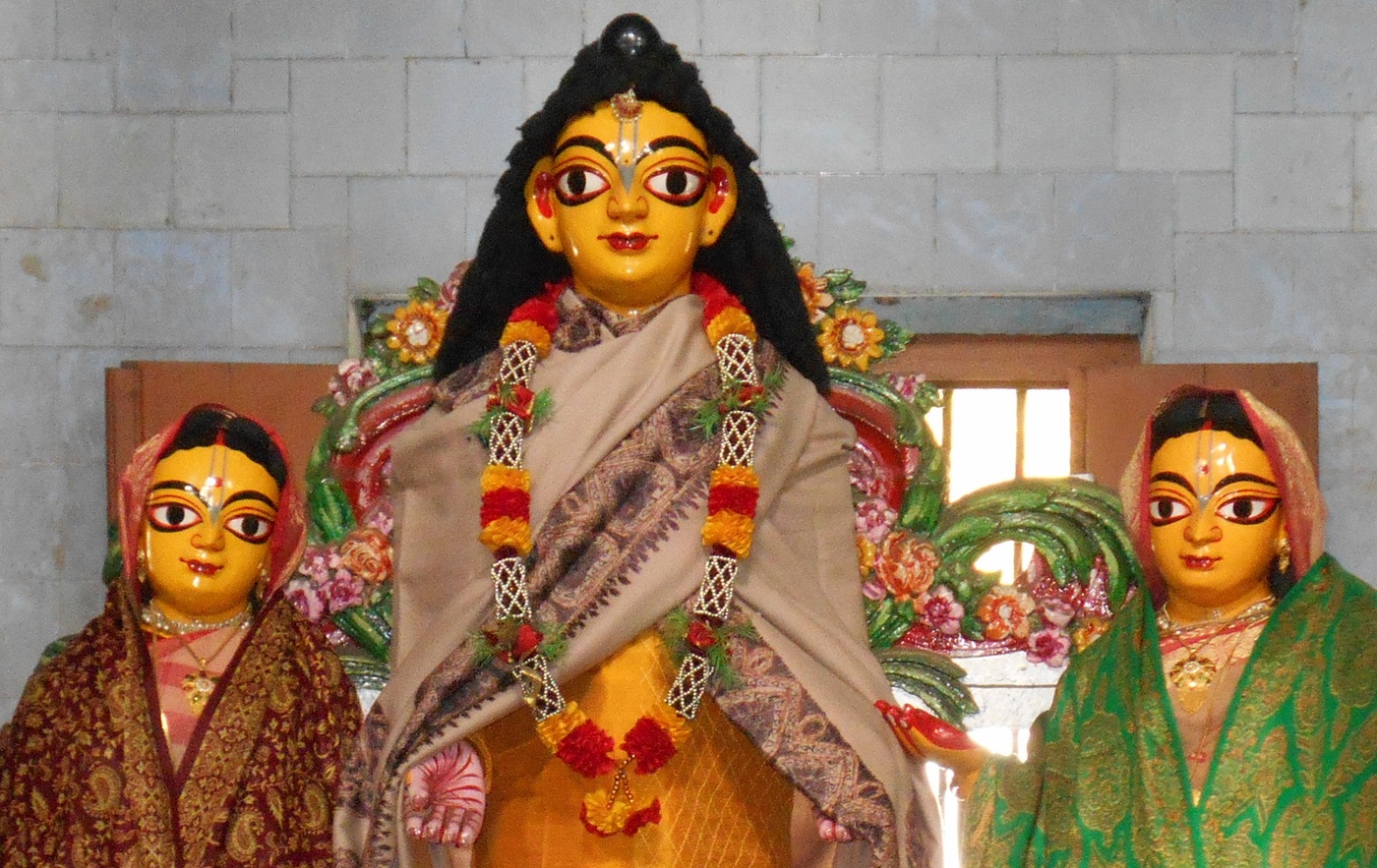
Nityananda Prabhu's own account of the wedding tells the marriage of Nityananda Prabhu to Vasudha and Jahnava, the two daughters of Suryadasa Sarakhela, in full. It covers the refusal, Vasudha's collapse, and Nityananda restoring her life on condition that the marriage go forward, drawing on the dramatic account given in the Bhakti-ratnakara and the Premavilasa. That page is the fuller and more authoritative telling of the episode from Nityananda's side, and readers wanting the complete story of the courtship should go there first. What follows instead is what happened around and after it, from Jahnava's own side.
A Vision Before the Wedding #
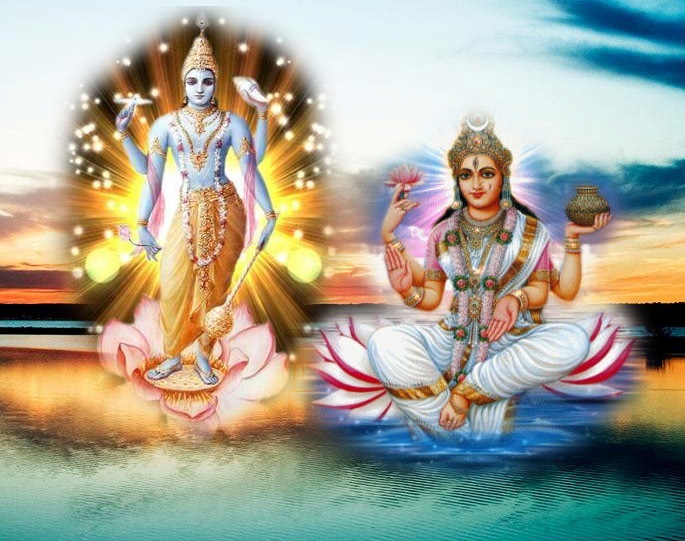
Some retellings of the Bhakti-ratnakara describe the match arising more peacefully than the dramatic account of the refusal and Vasudha's collapse. In this version, Suryadasa was turning over the question of his daughters' marriage late one night. He is said to have fallen asleep and dreamed of Nityananda Prabhu as Balarama Himself, radiant beyond description, with his own two daughters standing at his sides in their forms as Revati and Varuni. Waking in ecstasy, Suryadasa is said to have sent a Brahmin friend to Navadwip to place the proposal before Srivasa Thakura, at whose house Nityananda Prabhu was then staying. The friend carried it, through him, to Advaita Acharya as well, and both received the news with joy. The surviving texts do not let a reader be sure which is true: this vision, the more dramatic events already told on Nityananda Prabhu's own page, or some combination of both. But the different versions of the Bhakti-ratnakara agree on the outcome. Suryadasa gave both daughters to Nityananda Prabhu, and did so gladly.
The Wedding at Shaligrama #
The preliminary adhivasa rites were performed at the house of Krishnadasa Sarakhela in Shaligrama, with the brahmanas of the surrounding villages in attendance. Suryadasa then gave his two daughters to Nityananda Prabhu according to the full religious rite. From Shaligrama the new household made the customary rounds any Bengali bridegroom's family would make. They went first to Sachi Devi at Nabadwip, who received both brides with open affection, then to Advaita Acharya's house at Shantipur, where Sita Thakurani took them into her lap and blessed them. Afterward Nityananda Prabhu settled the family at Khardaha, on the Ganges north of present-day Calcutta. It remained Jahnava's own home for the rest of her life, and it became the headquarters of the entire Bengal mission.
Vasudha's Children and Jahnava's Motherhood #
Vasudha bore Nityananda Prabhu eight sons and one daughter, but seven of the sons died in infancy. The two children who survived were the daughter, Ganga Devi, and the youngest son, Virabhadra, also called Virachandra. According to the Gaura-ganoddesha-dipika, these two children are themselves identified with Kshirodakashayi Vishnu and the river Ganges. The same text identifies Ganga Devi's own husband, Madhavacharya, with King Shantanu of the Mahabharata, husband of the river-goddess Ganga in that earlier age. Vasudha herself died not long after their birth. Jahnava bore no children of her own. She raised both of them, and the sources all agree that Virabhadra became her particular favorite. When he grew, Jahnava gave him initiation, not Vasudha, his own mother by birth, and not Nityananda Prabhu himself. Virabhadra later saw her in a four-armed form, an experience that is said to have settled in his own mind that she, and no one else, was to be his diksha-guru.
Virabhadra grew into one of the most consequential figures of the second generation in his own right. Chaitanya-charitamrita calls him the greatest branch of the movement after Nityananda Prabhu, and Krishnadasa Kaviraja Goswami takes shelter of his feet before he begins to write that work at all. But that story belongs most properly to Nityananda Prabhu's own page. Here is the simple fact that matters most. A household built around two sisters married to one man produced, within a generation, two things: the hereditary Nityananda-vamsa that carried the family's worship forward in Bengal, and the woman who would soon be recognized as the head of the entire movement to which that family belonged. Her rise to that recognition is the subject of Leading the Movement After 1534.