हिन्दी में पढ़ें

Srila Jahnava Mata

Leading the Movement After 1534

How Nityananda Prabhu's widow became the acknowledged head of Gaudiya Vaishnavism, and what Srila Prabhupada said about it.

Khardaha and across Bengal, mid-to-late sixteenth century

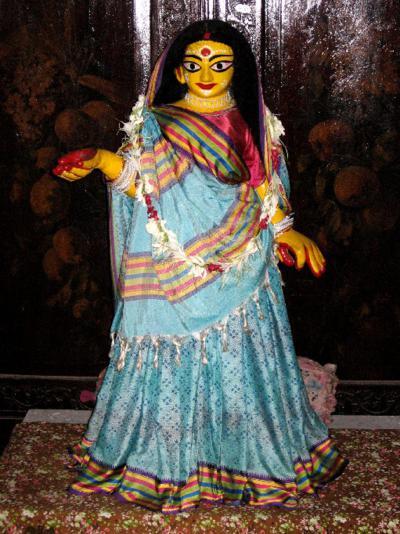
A devotional image of Jahnava Devi, who after 1534 was accepted as acharya and head of the Gaudiya Vaishnava movement.
A devotional image of Jahnava Devi, who after 1534 was accepted as acharya and head of the Gaudiya Vaishnava movement.gaudiyahistory.iskcondesiretree.com · ISKCON/BBT-affiliated devotional image
Reading tools

Chaitanya Mahaprabhu disappeared in 1534. Within a few years Nityananda Prabhu, Advaita Acharya and Srivasa Thakura had all followed him. Every figure the movement had been organized around in its first generation was gone, all within a single narrow window of years. The surviving sources describe what happened next, and it was not a succession crisis, a schism, or a period of drift. It was something closer to a quiet, near-immediate consensus: Jahnava, Nityananda Prabhu's widow, was recognized as the movement's head.

Why Her, and Why So Little Recorded Dispute #

Nothing in sixteenth-century Bengal made this an obvious outcome. Jahnava had no formal office to inherit, and no source names who gave her own formal diksha; the record simply does not say who her personal guru was. But she had standing that no one seems to have thought to question. She had a household at Khardaha that had already been the informal center of the Bengal mission for years. She had a stepson in Virabhadra, whom she had raised and personally initiated. And she had, as the Gaura-ganoddesha-dipika and Srila Prabhupada's own purport to Chaitanya-charitamrita, Adi-lila 11.21 both hold, a traditional identity as Ananga Manjari, an eternal associate of Krishna in Vraja, discussed at length on Birth and Family. She initiated a large number of disciples beyond Virabhadra alone. When she later arranged Virabhadra's own marriage to two daughters of Yadunandana Acharya, named Shrimati and Narayani, both women themselves became her initiated disciples. One of Nityananda Prabhu's own close associates, Parameshvara Dasa, one of the twelve gopalas, is named by Krishnadasa Kaviraja Goswami in the very same chapter of the Chaitanya-charitamrita as having "accompanied Srimati Jahnava-devi when she performed the festival at Khetari," and by her own order a temple of Radha-Gopinatha was installed at Atapura, in the district of Hooghly. Her authority to act this way rested not on anything she claimed for herself but on the order Sri Chaitanya Mahaprabhu gave to every one of His followers: yare dekha, tare kaha 'krishna'-upadesha, amara ajnaya guru hana tara' ei desha, "instruct everyone you meet to follow the orders of Lord Krishna... in this way become a spiritual master" (Chaitanya-charitamrita, Madhya-lila 7.128).

The clearest surviving statement of what this authority actually amounted to comes not from any sixteenth-century source but from Srila Prabhupada himself, four centuries later, and he said it twice. In a 1972 room conversation in San Diego, a disciple asked whether a woman's statement could be accepted as authoritative. Srila Prabhupada answered: "If a woman is perfect in Krishna consciousness... Just like Jahnava-devi, Lord Nityananda's wife, she was acharya. She was controlling the whole Vaishnava community," adding, when pressed for confirmation, "She was controlling the whole Gaudiya Vaishnava community." He added an important qualification in the same conversation: "It is not that woman cannot be acharya. Generally, they do not become. In very special case. But Jahnava-devi was accepted as [acharya], but she did not declare." In other words, the recognition came from the community around her, not from any claim she made for herself. The next section gives the exact standard Srila Prabhupada applied to reach that conclusion.

The Standard Prabhupada Applied #

Four years later, in Toronto, a professor asked Srila Prabhupada directly whether a woman could be guru in the line of disciplic succession. His answer again reached for the same example: "Yes. Jahnava Devi was... Nityananda's wife. She became. If she is able to go to the highest perfection of life, why it is not possible to become guru?" He then quoted the verse that, in his own reading, settles the question for any aspirant regardless of birth: yei krsna-tattva-vetta, sei guru haya, "whoever knows the science of Krishna, that person is guru" (Chaitanya-charitamrita, Madhya-lila 8.128). Chaitanya Mahaprabhu spoke that verse originally to Ramananda Raya himself, a governor born into a family the caste system of the day ranked below a brahmana, to settle the very same question about a man rather than a woman. The purport to that verse makes the point explicit: varnashrama-dharma assigns different social duties to different classes, but Krishna consciousness runs on a separate footing altogether, open to a brahmana, a sannyasi, a shudra, or a woman, as Srila Prabhupada's own later words about Jahnava Devi make clear. This is the same principle invoked, on Nityananda Prabhu's own page, to describe what Jahnava's leadership shows about the movement's own logic. Srila Prabhupada's claim is narrow and exact. He is not saying gender makes no difference to any social arrangement. He is saying the one qualification for guru is knowledge of Krishna, and that Jahnava Devi is history's own proof that this qualification was never merely theoretical.

This same standing, uncontested and by then widely known throughout Bengal, brought her to Kheturi a short time later. She went not as a guest of honor in the ordinary sense, but as the person Narottama Dasa Thakura asked to preside over the entire festival. That event is the subject of Presiding at the Kheturi Festival.

Scriptural sources for this pastime

কিবা বিপ্র, কিবা ন্যাসী, শূদ্র কেনে নয়।
যেই কৃষ্ণতত্ত্ববেত্তা, সেই 'গুরু' হয়॥

kibā vipra, kibā nyāsī, śūdra kene naya
yei kṛṣṇa-tattva-vettā, sei 'guru' haya

Word for word

kibā — whether; vipra — a brāhmaṇa; kibā — whether; nyāsī — a sannyāsī; śūdra — a śūdra; kene — why; naya — not; yei — anyone who; kṛṣṇa-tattva-vettā — a knower of the science of Kṛṣṇa; sei — that person; guru — the spiritual master; haya — is.

Whether one is a brahmana, a sannyasi or a shudra, regardless of what he is, he can become a spiritual master if he knows the science of Krishna.

From the purport: Actually the brahmana is supposed to be the spiritual master of all other varnas, or classes, but as far as Krishna consciousness is concerned, everyone is capable of becoming a spiritual master because knowledge in Krishna consciousness is on the platform of the spirit soul.

CC Madhya 8.128 Chaitanya-charitamrita

Chaitanya Mahaprabhu spoke this verse to Ramananda Raya, a governor of shudra birth, to settle the question of who may become guru. Srila Prabhupada quoted this same verse (as 'yei krsna-tattva-vetta, sei guru haya') in a 1976 Toronto interview (transcript 760618i2tor) when asked directly whether a woman could be guru in the disciplic succession, naming Jahnava Devi as his proof.

পরমেশ্বরদাস—নিত্যানন্দৈক–শরণ ।
কৃষ্ণভক্তি পায়, তাঁরে যে করে স্মরণ ॥ ২৯ ॥

paramesvara-dasa — nityanandaika-sarana
krsna-bhakti paya, tanre ye kare smarana

Word for word

paramesvara-dasa — Paramesvara dasa; nityananda-eka-sarana — completely surrendered to the lotus feet of Nityananda; krsna-bhakti paya — gets love of Krsna; tanre — him; ye — anyone; kare — does; smarana — remembering.

Paramesvara dasa, the fifth gopala of krsna-lila, completely surrendered to the lotus feet of Nityananda. Anyone who remembers his name will easily get love of Krsna.

From the purport: Purport excerpt: "He accompanied Srimati Jahnava-devi when she performed the festival at Khetari. It is stated in the Bhakti-ratnakara that by the order of Srimati Jahnava-mata, he installed Radha-Gopinatha in the temple at Atapura, in the district of Hugli."

Adi 11.29 Sri Chaitanya-charitamrita

The Chaitanya-charitamrita's own confirmation that a Deity installation was carried out on Jahnava-mata's direct order, cited on this page as evidence of her practical authority after 1534.

From the purport: If a woman is perfect in Krishna consciousness... Just like Jahnava-devi, Lord Nityananda's wife, she was acharya. She was controlling the whole Vaishnava community... She was controlling the whole Gaudiya Vaishnava community... It is not that woman cannot be acharya. Generally, they do not become. In very special case. But Jahnava-devi was accepted as [acharya], but she did not declare.

Room Conversation, June 29, 1972, San Diego Room Conversation, San Diego

Srila Prabhupada's direct answer, in conversation with disciple Atreya Rishi, to the question of whether a woman's statement could be accepted as authoritative. This is the primary source for the claim that Jahnava Devi was recognized as acharya and headed the Gaudiya Vaishnava community after 1534.

কিবা বিপ্র, কিবা ন্যাসী, শূদ্র কেনে নয় ।
যেই কৃষ্ণতত্ত্ববেত্তা, সেই ‘গুরু’ হয় ॥ ১২৮ ॥

kiba vipra, kiba nyasi, sudra kene naya
yei krsna-tattva-vetta, sei 'guru' haya

Word for word

kiba — whether; vipra — a brahmana; kiba — whether; nyasi — a sannyasi; sudra — a sudra; kene naya — why not; yei — anyone who; krsna-tattva-vetta — a knower of the science of Krsna; sei — that person; guru — the spiritual master; haya — is.

"Whether one is a brahmana, a sannyasi or a sudra -- regardless of what he is -- he can become a spiritual master if he knows the science of Krsna."

Madhya 8.128 Sri Chaitanya-charitamrita

The verse Srila Prabhupada quoted verbatim, in his 1976 Toronto interview discussed on this page, as his own scriptural basis for saying Jahnava Devi could become guru.

From the purport: Is it possible, Swamiji, for a woman to be a guru in the line of disciplic succession? Prabhupada: Yes. Jahnava devi was... Nityananda's wife. She became. If she is able to go to the highest perfection of life, why it is not possible to become guru? But, not so many. Actually one who has attained the perfection, she can become guru.

Interview with Prof. O'Connell, June 18, 1976, Toronto Interview, Toronto

Prof. O'Connell's direct question and Srila Prabhupada's answer, four years after the San Diego conversation, confirming a woman can be guru in the disciplic succession and naming Jahnava Devi as the proof. He follows this immediately with CC Madhya 8.128 in the same breath.

Srila Prabhupada on this pastime

Prabhupada: If a woman is perfect in Krsna consciousness... Just like Jahnava-devi, Lord Nityananda's wife, she was acarya. She was controlling the whole Vaisnava community. ... Prabhupada: Wife. Jahnava-devi. She was controlling the whole Gaudiya Vaisnava community. ... It is not that woman cannot be acarya. Generally, they do not become. In very special case. But Jahnava-devi was accepted as [acarya], but she did not declare.

Room Conversation — Conversation, June 29, 1972, San Diego

Srila Prabhupada's most direct statement identifying Jahnava-devi by name as acharya and head of the whole Gaudiya Vaishnava community, given in answer to a question about whether a woman's statement can be authoritative.

Nandgram Dham
Verified Scriptural
Written by
Our editorial team comprises trained devotees and researchers of the Hare Krishna Movement, Kota, who follow this same disciplic tradition in daily practice. Every biography is carefully researched, fact-checked against Vedic scriptures, and cites its sources.
Reviewed by
Temple & Scriptural Research Team
Each biography undergoes a detailed review by our senior devotees and scriptural researchers to verify factual accuracy and ensure alignment with Vaishnava philosophy and Srila Prabhupada's teachings.
Last Updated: