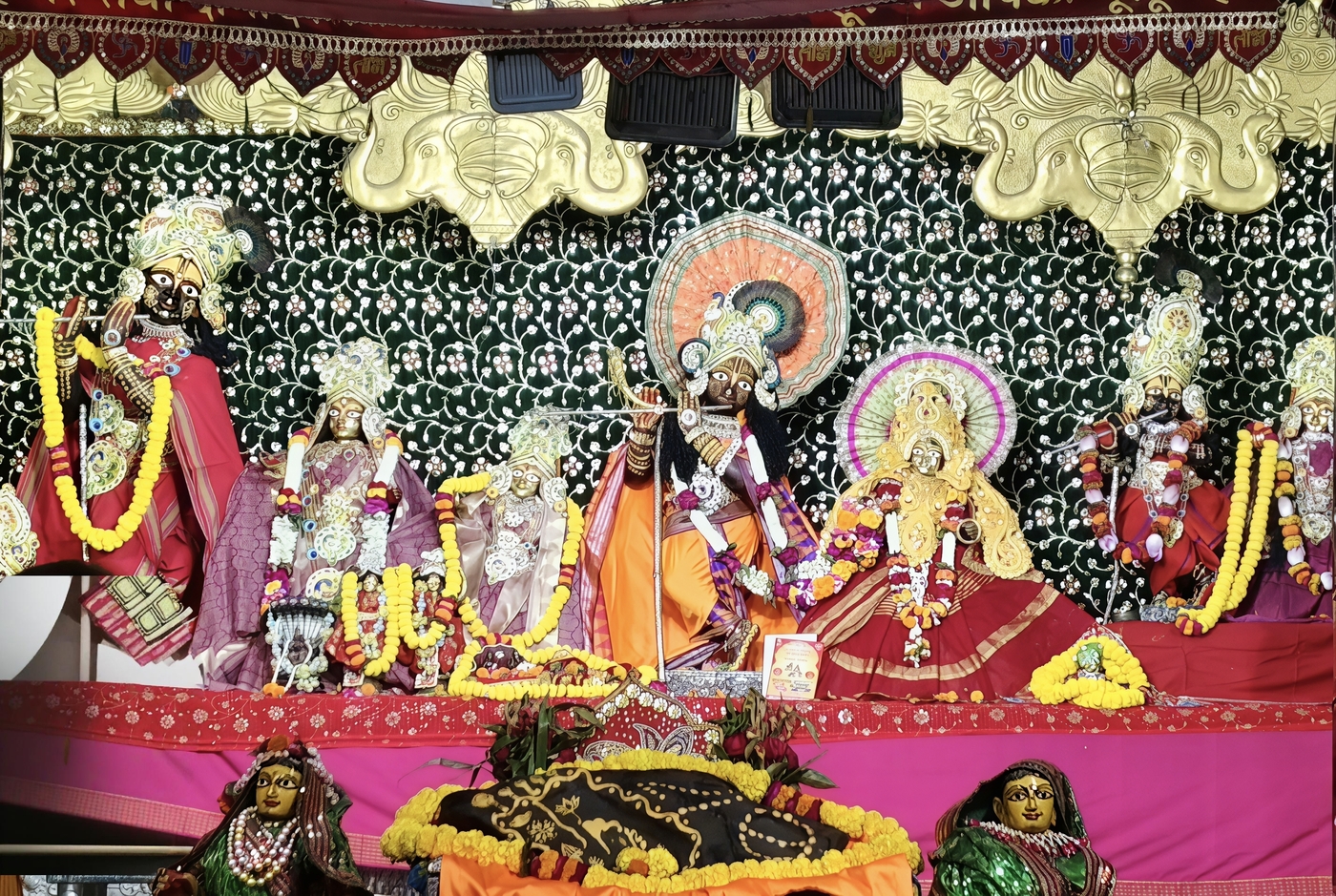
Sanatana Goswami disappeared in 1558 by the most commonly cited reckoning, and Rupa Goswami some years after; by the time of Rupa's own disappearance, tradition holds that he had already handed Jiva his manuscripts and the task of writing commentaries on them. From that point forward, as Srila Prabhupada states plainly in his purport to Chaitanya-charitamrita, "Srila Jiva Gosvami became the acharya of all the Vaishnavas in Bengal, Orissa and the rest of the world, and it is he who used to guide them in their devotional service." The youngest of the Six Goswamis had become, in effect, the last one standing, and the whole weight of leading a scattered, still-forming movement fell to him.
| Detail | Description |
|---|---|
| Became acharya | After the disappearances of Sanatana (c. 1558) and Rupa Goswami |
| Land purchased | Seva Kunja area, 1558, from Ali Kant Chaudhari, Emperor Akbar's local landlord, for 30 rupees |
| Key students sent to Bengal | Srinivasa Acharya, Narottama Dasa Thakura, Shyamananda Pandit |
| Instructing student | Krishnadasa Kaviraja Goswami, author of Sri Chaitanya-charitamrita |
| Met | Emperor Akbar, traditionally dated 1570 |
Purchasing the Ground at Seva Kunja #
A surviving deed, kept today at the Vrindavan Research Institute, records that in 1558 Jiva Goswami purchased land around Seva Kunja — the site where Rupa Goswami had based himself and where the rasa-lila pastimes of Krishna and the gopis are held to have taken place — from Ali Kant Chaudhari, Emperor Akbar's local landlord, for the price of thirty rupees. The parcel included Seva Kunja itself along with Dan Gulli, Imli Tala, Sringhar Sthali and Rasa Sthali, marked out by four boundary trees. It was around this land, and around the deity of Radha-Damodara Rupa Goswami had earlier placed in his care, that Jiva built the temple and community that would carry the Goswamis' work forward.
Host to Every Bengali Pilgrim #
Despite his position as the senior-most authority in Vrindavana, Jiva Goswami is remembered as always humble in his daily conduct. Whenever Bengali Vaishnavas made the journey to Vrindavana, he received them personally, arranged their food and lodging, and guided them on parikrama around the sacred sites his uncles had spent years recovering. This combination — undisputed doctrinal authority paired with the willingness to act as an ordinary host — is repeatedly held up in Gaudiya sources as the measure of his character.
Krishnadasa Kaviraja and the Scholars of the Next Generation #
Krishnadasa Kaviraja Goswami, who would go on to write Sri Chaitanya-charitamrita itself, names Jiva Goswami directly as one of his six instructing spiritual masters, alongside Rupa, Sanatana, Raghunatha Bhatta, Gopala Bhatta and Raghunatha dasa Goswami. Jiva is also remembered as having awarded Krishnadasa the honorific title Kaviraja, "king of poets," in recognition of his poetic work Govinda-lilamrita — a title later generations sometimes assumed was given for the Charitamrita itself, though the more precise sources tie it to this earlier composition. Three other students occupied an especially close place in Jiva's circle: Srinivasa Acharya, Narottama Dasa Thakura, and a devotee Jiva renamed Shyamananda after he arrived at Vrindavana as Duhkhi Krishnadasa. When Jiva judged these three ready, he organized what became one of the most important journeys in early Gaudiya history.
Sending the Manuscripts to Bengal #
The Goswamis' original writings — the works of Rupa, Sanatana, Gopala Bhatta, Raghunatha Dasa and Jiva himself — existed only as handwritten manuscripts, and the community in Bengal and Orissa had no direct access to them. Jiva arranged for Srinivasa, Narottama and Shyamananda to carry the collected books east, supplying a cart, bullocks and armed guards, and securing a passport from the king of Jaipur for their protection along the way. Srila Prabhupada's own purport to Chaitanya-charitamrita confirms the most dramatic detail of the journey: the manuscripts were plundered near Vishnupura in Bengal, and Jiva received word of the loss before later learning that the books had been recovered. Once safely in Bengal, the three scholars translated and preached from these texts extensively, helping to establish the sampradaya across the region for generations to come.
Meeting the Emperor #
Tradition holds that in 1570 the Mughal emperor Akbar visited Vrindavana specifically to meet its resident Goswamis, Jiva among them, and was sufficiently impressed to have a library built at the Radha-Damodara temple to preserve Vaishnava literature. When Akbar later invited Jiva to his palace for further discussion, Jiva declined, citing a personal vow never to leave Vrindavana; the emperor is said to have responded by sending a carriage and horses with an assurance that Jiva would be returned before nightfall, a promise Jiva accepted once. However this particular episode is weighed against the more securely documented land deed and the manuscript journey, it points to the same reality: by the last decades of his life, Jiva Goswami's authority extended well beyond the community of Vaishnavas he had been born into. How that long stewardship finally came to a close is told in Final Days and Disappearance.