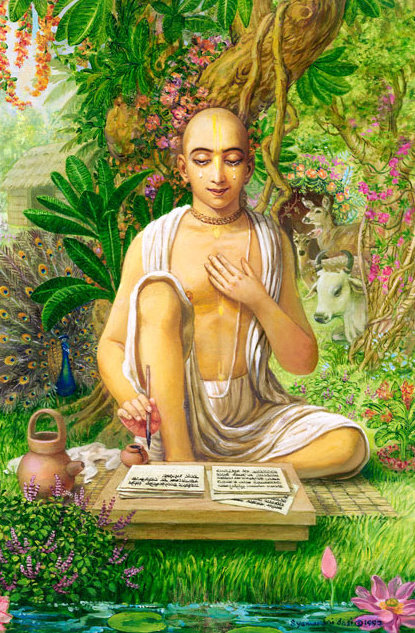
Rupa and Sanatana Goswami had already given the Gaudiya Vaishnava tradition its devotional practice, its recovered holy places, and its first compiled scriptures by the time Jiva reached full maturity as a scholar. What the tradition still lacked was a single work that could stand up, argument for argument, against the trained Vedantists, Naiyayikas and rival Vaishnava schools of sixteenth-century India — a systematic philosophical case, built from scriptural evidence alone, for who Krishna is and what devotion to Him means. That is what Jiva Goswami wrote in the Sat-sandarbha, six works, written one after another and later gathered under the single title Bhagavata-sandarbha, and it remains the closest thing Gaudiya Vaishnavism has to a formal system of theology.
| Detail | Description |
|---|---|
| Full title | Sat-sandarbha (also called Bhagavata-sandarbha), six parts |
| The six parts | Tattva, Bhagavat, Paramatma, Krishna, Bhakti and Priti Sandarbha |
| Method | Argument built almost entirely from Bhagavatam verses and other scripture |
| Auto-commentary | Sarva-samvadini, Jiva's own explanatory notes on the Sandarbhas |
| Described in | Sri Chaitanya-charitamrita, Madhya-lila 1.43 |
Tattva-sandarbha: Which Scripture to Trust #
Before any doctrine could be argued, Jiva first had to settle a question of method: which scriptures actually count as reliable evidence for spiritual truth. The Tattva-sandarbha takes up this question directly and concludes that Srimad-Bhagavatam is the single most authoritative source for understanding the Absolute Truth, clearing the ground on which every later argument in the series would stand.
Bhagavat-sandarbha and Paramatma-sandarbha: Mapping the Divine #
The second Sandarbha turns to the nature of Godhead itself, distinguishing the impersonal Brahman effulgence from the Supreme Personality's own potencies, energies and pure spiritual qualities. The third narrows the focus further, to Paramatma, the Lord's presence as the Supersoul within every living being and within the cosmos — how a single divine presence can simultaneously live within millions of souls without loss of unity, and how the universe itself unfolds from that presence.
Krishna-sandarbha: The Argument for Supremacy #
The fourth and, by most measures, most important Sandarbha is devoted to a single claim: that Krishna, not any other form of Godhead, is svayam bhagavan, the original Personality from whom Vishnu, Narayana and every other divine expansion and incarnation proceed. Jiva brings together scripture after scripture in support, backs up earlier commentators including Sridhara Svami, and works through Krishna's pastimes, His expansions, and the eternal nature of Vrindavana and Goloka to make the case. As Krishnadasa Kaviraja Goswami himself later summarized in Sri Chaitanya-charitamrita, "In Sri Bhagavata-sandarbha, Srila Jiva Gosvami has written conclusively about the ultimate end of devotional service" — and this fourth volume is where that conclusiveness is aimed most directly at establishing Krishna's own position.
Bhakti-sandarbha and Priti-sandarbha: From Doctrine to Practice #
Having established what Krishna is, the last two Sandarbhas turn to what a devotee should do about it. Bhakti-sandarbha lays out devotional service itself as a practice — its stages, its qualification, the superiority of unmotivated service over ritual duty, and the difference between an ordinary devotee and one who has matured into deep realization. Priti-sandarbha, the final volume, addresses prema, love of Godhead, as the actual goal toward which all of this practice moves, ranking it above every form of liberation and describing the direct, personal experience of meeting the Supreme Personality of Godhead face to face as devotional service's highest fruit.
A System, Not Just a Collection #
What distinguishes the Sat-sandarbha from Rupa's and Sanatana's earlier books is less its content — Jiva was working from conclusions his uncles had already lived and taught — than its structure: six volumes, each building formally on the last, moving a reader from questions of evidence to questions of God's nature to questions of practice and finally to the goal of practice itself. Jiva later wrote his own auto-commentary, the Sarva-samvadini, drawing out cross-references and answering objections across at least the first several Sandarbhas. Srila Prabhupada, centuries later, would say of the finished work that there was no philosopher in the world who could successfully argue against Jiva Goswami's six Sandarbhas — a claim examined alongside the rest of Jiva's literary output in Other Literary Works, and one that did not go unchallenged in his own lifetime, as the next chapter shows.