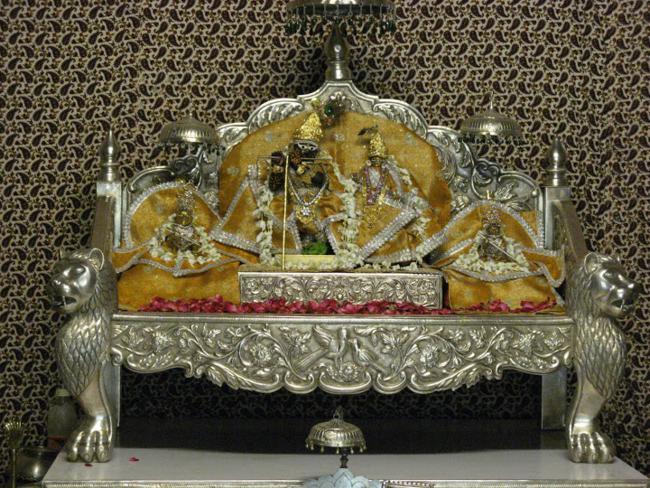
Lokanatha Gosvami lived to a great age, still absorbed in his solitary worship of Radha-Vinoda, and the accounts of his final days do not agree with one another on several important points. It is worth being direct about this rather than smoothing it over: the sources consulted for this page genuinely conflict on the month, the lunar fortnight, and even the specific place of his disappearance.
Conflicting Traditions #
One widely repeated account places his final bhajana and disappearance at Khadiravana, near a village called Khoyra Gram, beside a lake called Yugala-kunda, on Krishnastami (the eighth day of the dark fortnight) in the month of Shravana. A closely related version agrees on Khadiravana and Yugala-kunda but gives the eighth day of the bright fortnight of Shravana instead. A third account, drawn from Srila Bhakti Ballabh Tirtha Maharaj's "Sri Chaitanya: His Life and Associates," gives a specific year — Shaka 1510, corresponding to 1588-89 CE — but places the date in the month of Asharh rather than Shravana, again on the eighth day of the dark fortnight. No source reconciles these differences, and this page does not attempt to invent a resolution.
| Detail | Description |
|---|---|
| Disappearance site (one tradition) | Khadiravana, near Khoyra Gram, beside Yugala-kunda |
| Disappearance date (bright-fortnight tradition) | Ashtami, bright fortnight of Shravana |
| Disappearance date (dark-fortnight tradition) | Krishnastami, month of Shravana |
| Disappearance date (dated tradition) | Ashtami, dark fortnight of Asharh, Shaka 1510 (1588-89 CE) |
| Memorial (puspa) samadhi | Courtyard of the Radha-Gokulananda temple, Vrindavana |
One Samadhi, Two Places #
What resolves at least part of the apparent contradiction is a distinction Gaudiya Vaishnava tradition draws between a devotee's actual place of departure and a separate memorial, or *puspa-samadhi* (literally a "flower samadhi"), often established afterward at a place of particular significance to their life and worship. Several sources describe Lokanatha's puspa-samadhi as standing in a small courtyard beside the Radha-Gokulananda temple in Vrindavana proper — the very courtyard where, as this site's own page on Narottama Dasa Thakura's disappearance and legacy already describes, Narottama's own samadhi was later placed close to that of his guru. Vishvanatha Chakravarti Thakura is also buried in that same small courtyard, alongside the enshrined Deities of Vijaya-Govinda, worshiped there by Baladeva Vidyabhusana.
What Became of Radha-Vinoda #
The original Radha-Vinoda Deity that Lokanatha carried through the forests of Vraja for most of his life is, according to tradition, now worshiped in Jaipur, Rajasthan, said to have been moved there at some point to protect it during a period of danger to Vrindavana under Mughal rule — a detail reported by only one of the sources for this page and not independently confirmed elsewhere. A pratibhu-murti, a ritually authorized replica carrying the same worship value as the original, remains on the altar of the Radha-Gokulananda temple in Vrindavana to this day, in the temple Vishvanatha Chakravarti Thakura later rebuilt on the site where Lokanatha himself had once done his bhajana. The same temple, tradition holds, also came to house a Govardhana-shila that Mahaprabhu himself had given Raghunatha Dasa Goswami — carried, chanted over, and pressed to his heart for three years before he passed it on — a further sign of how thoroughly the memory and relics of Vrindavana's early renunciants came to be gathered into this one small precinct.
A Legacy Measured in One Disciple #
Lokanatha Gosvami accepted, so far as any surviving record shows, exactly one disciple in his entire life. That fact alone makes his legacy unusual among the acharyas of this tradition: rather than a lineage of many direct students, his influence on Gaudiya Vaishnavism runs almost entirely through Narottama Dasa Thakura, whose own preaching in Bengal, whose songs, and whose role in organizing the Kheturi festival went on to shape the movement for generations — a lineage that descended, in time, through Bhaktivinoda Thakura, Bhaktisiddhanta Sarasvati Thakura and Srila Prabhupada into the ISKCON temples where Narottama's songs, and indirectly Lokanatha's own example of renunciation, are still carried forward today. It is a striking legacy for a man whose defining wish, expressed again and again across every account of his life, was to be left as unrecorded as possible.