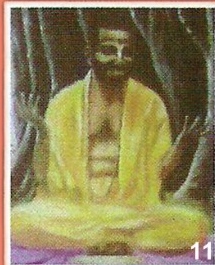
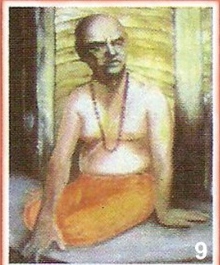
Sri Madhava Tirtha
Third Pontiff of the Uttaradi Matha
Also known as Madhava Theertha; born Vishnu Shastri
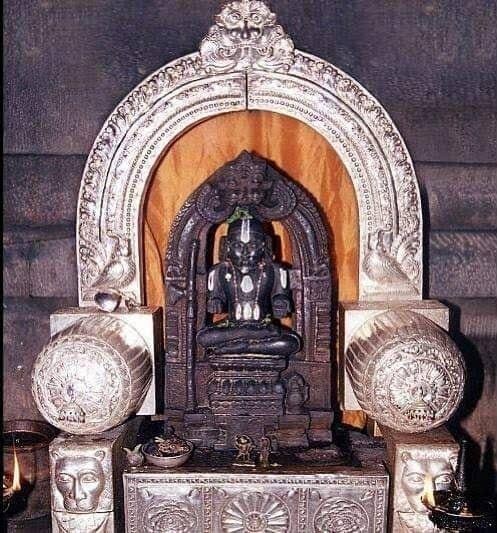
Madhava Tirtha held the Uttaradi Matha's pitha (seat) for seventeen years, from 1333 to 1350 CE. He was the third pontiff after Madhvacharya himself, following Narahari Tirtha. Before he took sannyasa, his name was Vishnu Shastri. The matha's own tradition and independent Dvaita scholarship agree that Narahari Tirtha was his guru and gave him the name Madhava Tirtha. Beyond these facts, little else about his life can be independently confirmed. That gap in the historical record is real, and it is best stated plainly rather than hidden.
| Detail | Description |
|---|---|
| Birth name | Vishnu Shastri |
| Region | Southern Karnataka (Daksinadi), per the early Gurucharya |
| Guru | Narahari Tirtha, the pontiff before him |
| Pontificate | 1333-1350 CE (seventeen years), third after Madhvacharya |
| Matha founded | Majjigenahalli Matha (also called Tambehalli Matha), near Mulbagal |
| Successor | Akshobhya Tirtha, whom he ordained and installed as pontiff |
| Samadhi | Mannur, on the river Bhima near Kalaburagi (Gulbarga) |
An Obscure Figure By His Own Tradition's Account #
B. N. K. Sharma's *History of the Dvaita School of Vedanta and Its Literature* is the standard scholarly reference for this period. Sharma is unusually direct about Madhava Tirtha. He calls him "a comparatively obscure figure in the history of his school." He notes that no genuine work of his has survived. He also points out that Jayatirtha, who wrote only a generation or two later and is the most thorough commentator the Madhva sampradaya ever produced, never once mentions him in his own writings.
A later traditional compilation does credit Madhava Tirtha with commentaries on the Rig, Yajur and Sama Vedas. Uttaradi Matha's own historical materials add one more: a commentary on the Parasara Smriti called the Parasara Madhva-vijaya. Sharma doubts these claims openly. No manuscript of any of these works has ever been found, in India or abroad, even though people specifically checked reports that copies existed in foreign libraries. Whatever his personal qualities, Madhava Tirtha does not seem to have left the kind of literary legacy that Padmanabha Tirtha or his own successors did.
The Vamsha Rama Deity #
Uttaradi Matha's own living tradition remembers Madhava Tirtha rather differently than scholarly history does. To the matha, he is the pontiff under whom it obtained its Sri Vamsha Rama deity, still worshipped today alongside the matha's other sacred images, including Sri Moola Rama and Sri Moola Sita.
A story kept in that tradition tells of a day when Madhava Tirtha was engaged in worship. Those present saw him rise, prostrate before a presence visible only to him, and receive teertha (sanctified water) from it after the puja ended. He explained afterward that Madhvacharya himself had appeared, worshipped the newly obtained deity, and blessed him. Uttaradi Matha holds this as devotional tradition rather than independently verified history. The fuller account is on The Vamsha Rama Deity and a Vision of Madhvacharya.
Founding A Matha And Passing At Mannur #
Madhava Tirtha's clearest, best-documented legacy is institutional, not literary. He founded a matha of his own, which still exists today under the name Majjigenahalli Matha (also called Tambehalli Matha), near Mulbagal in present-day Karnataka. He put his disciple Madhuhari Tirtha in charge of it. He also gave diksha to Akshobhya Tirtha and installed him as the next pontiff of the Uttaradi Matha, continuing the same line that would soon produce Jayatirtha, the tradition's greatest commentator.
Madhava Tirtha passed away in 1350 CE. Tradition holds that his remains were first laid to rest at Hampi and later moved to Mannur, on the river Bhima, where his brindavana stands to this day. His aradhana (disappearance anniversary) is kept there on Mahalaya Amavasya.
A Contested Rung In The Gaudiya List #
Within the Gaudiya Vaishnava guru-parampara list, Madhava Tirtha holds the same place that independent Dvaita-tradition sources give him: guru to Akshobhya Tirtha, disciple of Narahari Tirtha. But the two traditions do not agree on when he lived.
Srila Prabhupada's purport to Chaitanya-charitamrita, Madhya 9.245, gives a numbered list of the succession, with each teacher's year in the Shaka era:
Padmanabha, 1120; Narahari, 1127; Madhava, 1136; and Aksobhya, 1159.
Shaka 1136 works out to about 1214 CE. Independent Dvaita-tradition scholarship, backed by Uttaradi Matha's own historical records, places Madhava Tirtha's actual seventeen-year pontificate more than a century later, from 1333 to 1350 CE.
The page on Madhvacharya already shows, from the same purport and from historian Friedhelm Hardy's scholarship, that this Gaudiya guru-parampara list does not match the Madhva sampradaya's own independently recorded succession lists. Madhava Tirtha's case confirms the same pattern rather than standing as an exception to it. The fuller discussion of this question, across the whole chain from Madhvacharya to Chaitanya Mahaprabhu, is on Madhavendra Puri: Life in the Madhva Sampradaya.
Scriptural evidence
madhvācārya-sthāne āilā yāṅhā 'tattvavādī'
uḍupīte 'kṛṣṇa' dekhi, tāhāṅ haila premonmādī
Word for word
madhva-ācārya-sthāne — at the place of Madhvācārya; āilā — arrived; yāṅhā — where; tattva-vādī — philosophers known as Tattvavādīs; uḍupīte — at the place known as Uḍupī; kṛṣṇa — the Deity of Lord Kṛṣṇa; dekhi — seeing; tāhāṅ — there; haila — became; prema-unmādī — mad in ecstasy.
Caitanya Mahaprabhu next arrived at Udupi, the place of Madhvacarya, where the philosophers known as Tattvavadis resided. There He saw the Deity of Lord Krishna and became mad with ecstasy.
From the purport: Purport excerpt: "Padmanabha, 1120; Narahari, 1127; Madhava, 1136; and Aksobhya, 1159" (Shaka era years given in Srila Prabhupada's own numbered list of the disciplic succession).
The verse and its immediate narrative concern Sri Chaitanya Mahaprabhu's visit to the Udupi Deity of Krishna; Madhava Tirtha is named later in the same purport, in a numbered list giving each successive teacher's year in the Shaka era. Shaka 1136 converts to approximately 1214 CE -- more than a century earlier than the 1333-1350 CE pontificate independently attested for Madhava Tirtha by B. N. K. Sharma's academic history and by Uttaradi Matha's own historical records. This gap is the same kind this website's Madhvacharya page has already reported: a real, unresolved difference between the Gaudiya guru-parampara list's own chronology and the Madhva sampradaya's independently kept succession records, reported here honestly rather than harmonized away. Fetching note: vedabase.io returned a JS-shell page with no visible verse text when fetched directly for this page; the verse text, synonyms, translation and purport content above were cross-verified directly against prabhupadabooks.com, an official Bhaktivedanta Book Trust text mirror, for this citation.
vyāsāl labdha-kṛṣṇa-dīkṣo mādhvācāryo mahāyaśāḥ
tasya śiṣyo'bhavat padmanābhācāryo mahāśayaḥ
tasya śiṣyo naraharis tac-chiṣyo mādhava-dvijaḥ
akṣobhyas tasya śiṣyo'bhūt tac-chiṣyo jayatīrthakaḥ
Madhvacharya took initiation in the Krishna mantra from Vyasa. Madhva's disciple was Padmanabhacharya, an illustrious person, whose disciple was Narahari, who was followed by Madhava, the twice-born. Madhava's disciple was Akshobhya, who was followed by Jayatirtha.
The earliest known textual source naming Madhava Tirtha directly within the Gaudiya guru-parampara chain, placing him between Narahari Tirtha and Akshobhya Tirtha in the same order given in Srila Prabhupada's own purport to Chaitanya-charitamrita, Madhya 9.245. Quoted here via Gaudiya scholar Jagadananda Das's comparative study of the Gaudiya and Dvaita-tradition succession lists (independently fetched and verified directly from the source PDF), since no independent English translation of the full Sanskrit text is posted online. This same source elsewhere documents that the Madhva-sampradaya's own tradition regards Padmanabha, Narahari, Madhava and Akshobhya as direct disciples of Madhvacharya rather than a chain of successive gurus and disciples, the same honest distinction already noted on this page and on Madhavendra Puri's own page.
- Sri Madhava Tirtha - Sri Uttaradi Math (official parampara page)
- B. N. K. Sharma, History of the Dvaita School of Vedanta and Its Literature (1961/1981), full text via Internet Archive
- Madhava Tirtha - Wikipedia
- Madhava Tirtha - Gaudiya History (ISKCON Desire Tree)
- Sri Chaitanya-charitamrita, Madhya-lila 9.245, with purport (Bhaktivedanta Book Trust text)
- Madhavendra Puri: Life in the Madhva Sampradaya (this website)
Disciples
Frequently asked
When was Sri Madhava Tirtha born?
Sri Madhava Tirtha appeared Birth name Vishnu Shastri; pontiff 1333-1350 CE (seventeen years), per B. N. K. Sharma's academic history. Srila Prabhupada's purport to Chaitanya-charitamrita, Madhya 9.245, instead places him at Shaka 1136 (about 1214 CE) in its own numbered list of the succession, more than a century before his actual seventeen-year pontificate of 1333 to 1350 CE per independent Dvaita-tradition scholarship. in Southern Karnataka (Daksinadi), per the early Gurucharya account as reported by B. N. K. Sharma. Wikipedia's infobox instead states "North Karnataka", checked directly against Sharma's own text, which applies that description to his successor Akshobhya Tirtha in the very next paragraph, not to Madhava Tirtha himself..
Who was the guru of Sri Madhava Tirtha?
The spiritual master of Sri Madhava Tirtha was Sri Narahari Tirtha.
When and where did Sri Madhava Tirtha disappear?
Sri Madhava Tirtha disappeared 1350 CE, after seventeen years as pontiff; his tradition's aradhana (disappearance anniversary) is kept on Mahalaya Amavasya at Mannur, near Kalaburagi (historically Gulbarga), Karnataka, on the bank of the river Bhima, where his brindavana (samadhi) stands today. Tradition holds his remains were first laid to rest at Hampi and later moved to Mannur, on the river Bhima, where his brindavana is maintained to this day..
What are the main pastimes of Sri Madhava Tirtha?
The pastimes covered here include: The Vamsha Rama Deity and a Vision of Madhvacharya.