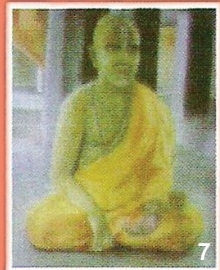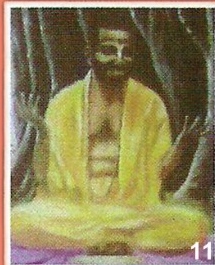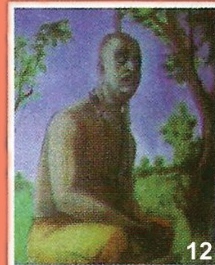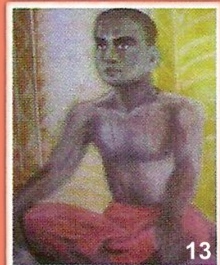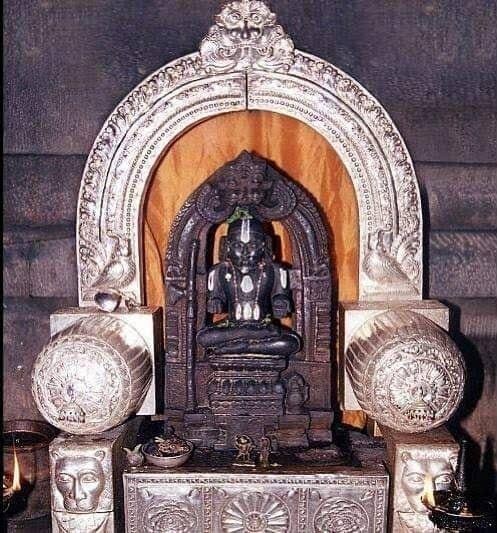
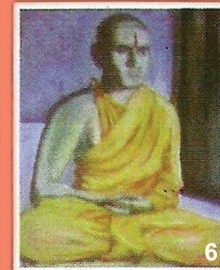
Srila Madhvacharya
Biography, Dvaita Vedanta & Teachings
Also known as Vasudeva, Purnaprajna Tirtha, Ananda Tirtha, Anandatirtha, Madhwacharya, Madhvacarya
“Even after searching through the whole of scripture, O Lord and consort of Lakshmi, I find nothing equal to You.”
From the closing verse of the Narasimha Nakha Stuti, a short Sanskrit hymn in praise of Lord Narasimha's nails, composed as an introduction to his disciple Trivikramacharya's Vayu Stuti.
Long before Sri Chaitanya Mahaprabhu, before Bilvamangala Thakura or Jayadeva Goswami, even before Madhavendra Puri, whom Gaudiya tradition calls the "seed of the bhakti creeper," there was Madhvacharya. He was born in the thirteenth century on India's south-western coast, a full three hundred years before Mahaprabhu's own appearance in Bengal, and he built, almost single-handedly, one of the four schools of Vedanta philosophy that Sanatana Dharma still honours today. He named his own teaching Tattvavada, "the doctrine of reality," though history remembers it by the name of its central claim: Dvaita, dualism. This is the teaching that God, the soul and matter are, and always will be, genuinely and eternally different from one another.
Two things are both true about Madhvacharya, and neither should be blurred into the other. First, the Gaudiya Vaishnava tradition, the tradition of Sri Chaitanya Mahaprabhu, has long called itself the "Brahma-Madhva-Gaudiya sampradaya," tracing its own guru-parampara back through a line of Madhva-sampradaya sannyasis to Madhvacharya himself. Second, Madhvacharya's own philosophy and Sri Chaitanya Mahaprabhu's Achintya-bhedabheda-tattva are not the same teaching. They are two distinct, carefully worked-out answers to the single hardest question in Vedanta: how the individual soul relates to God. Both truths matter, and both deserve to be told honestly.
| Detail | Description |
|---|---|
| Also known as | Vasudeva (childhood name), Purnaprajna Tirtha, Ananda Tirtha |
| Born | Traditionally 1238 CE at Pajaka, near Udupi, Karnataka (some sources: 1199 CE; see Life and Early Years) |
| Guru | Achyutapreksha (sannyasa-guru); by tradition, personal instruction from Vyasadeva at Badarikashrama |
| Philosophy | Dvaita Vedanta (Tattvavada): eternal, five-fold difference between God, souls and matter |
| Chief works | Brahma-sutra-bhashya, Gita-bhashya, Bhagavata-tatparya-nirnaya, and roughly thirty more, together called the Sarvamula |
| Founded | The Krishna Deity worship and the eight mathas (Ashta Matha) at Udupi, and one of the four Vaishnava sampradayas |
| Disappeared | Traditionally 1317 CE, Udupi (some sources: 1278 CE) |
At a Glance
- Born Vasudeva to a Shivalli-brahmana family; took sannyasa at about age twelve under Achyutapreksha, becoming Purnaprajna Tirtha.
- Wrote commentaries on the Brahma-sutra, the Bhagavad-gita, the ten principal Upanishads and the Bhagavata Purana, rejecting Shankaracharya's Advaita as a disguised form of Buddhism.
- Found a Deity of Krishna hidden inside a lump of gopi-chandana clay and installed it at Udupi, where worship in his system continues without a break to this day.
- Toured India more than once, debating rival philosophers and, by tradition, meeting Vyasadeva himself at Badarikashrama.
- Is honoured by the Gaudiya Vaishnava tradition as the source-acharya of its own guru-parampara, even though his Dvaita and Sri Chaitanya Mahaprabhu's Achintya-bhedabheda-tattva remain genuinely different teachings.
A Child Prodigy Named Vasudeva #
The fullest account of Madhvacharya's life comes, a little unexpectedly, from Srila Prabhupada's own purport to Chaitanya-charitamrita, Madhya 9.245. He wrote it not to teach Madhva's philosophy but simply to explain who the Tattvavadis were that Sri Chaitanya Mahaprabhu met at Udupi. That purport says Madhvacharya was born "near Udupi, which is situated in the South Kanara district of South India," in a village called Pajaka, "in a Shivalli-brahmana dynasty as the son of Madhyageha Bhatta." Most sources today place his birth in 1238 CE. But this is genuinely disputed: some historians say 1199 CE, and Srila Prabhupada's own purport gives yet a third year, 1118 CE, adding only "according to some" that 1238 is correct. No single date can honestly be called settled. Most encyclopedias use the 1238 to 1317 CE span for his life, though real and serious alternatives exist too.
As a child he was named Vasudeva, and the tradition around him, like the tradition around most saints of pre-modern India, is full of wonder-stories that should be read as devotional literature rather than as verified history: that he once turned tamarind seeds into coins to pay off his father's debts, that at the age of five he killed a snake-demon named Manimat with nothing but his toe, that he was a prodigious scholar almost from infancy. What can be said with more confidence is that he received the sacred thread as a small child and showed unusual intellectual gifts early, gifts that his father hoped would keep him at home to look after the family. Vasudeva had other plans.
Sannyasa Under Achyutapreksha #
Against his father's wishes, Vasudeva took sannyasa at about the age of twelve. He entered the Ekadandi renunciate order under a guru named Achyutapreksha and received the name Purnaprajna Tirtha, "the one whose knowledge is complete." Achyutapreksha's own monastic line traces back to the same broad tradition that Adi Shankaracharya's Advaita school claims descent from, and here is a small, telling detail: in his own later writings, Madhvacharya never once named Achyutapreksha as his guru, nor claimed descent from his monastic line. The disciple who would spend his whole life refuting Advaita Vedanta had taken sannyasa, in other words, from a teacher tied to the very tradition he set out to defeat, and he quietly left that connection out of his own account of his authority. It is a small, human echo of a larger pattern: religious lineages are not always as tidy in the historical record as they become in later retelling.
Under his new name, Purnaprajna, also called Anandatirtha, Madhvacharya began travelling and teaching, and it was not long before he broke decisively with the Advaita philosophy of his own formal sannyasa order.
Meeting Vyasadeva at Badarikashrama #
Devotional tradition holds that Madhvacharya travelled twice in his life to Badarikashrama in the Himalayas. On the first visit, tradition says, he met Srila Vyasadeva there in person, placing before him his still-unfinished commentary on the Bhagavad-gita and receiving his approval. His companion on this journey, a scholar named Satya Tirtha, is said to have written down the completed Gita-bhashya as Madhvacharya spoke it on the return journey. On the second visit, tradition says, Vyasadeva gave him the shalagrama-shila known as Ashtamurti. No independent historical method can verify this meeting; it belongs to the same devotional category as the meetings with celestial personalities recorded in the lives of many pre-modern Indian saints. But it holds a central place in how the Madhva-sampradaya itself explains the authority of his commentaries, so it deserves to be told as tradition, plainly labelled as such, rather than passed over in silence.
The Doctrine of Five Eternal Differences #
Whatever the uncertainties of his biography, Madhvacharya's achievement as a philosopher is beyond question. It is documented well beyond devotional literature, in the mainstream academic study of Indian philosophy, where he stands beside Shankaracharya and Ramanujacharya as one of the three most influential Vedanta commentators in history. His system rests on the doctrine of pancha-bheda, five eternal and irreducible differences: between God and the individual soul, between God and matter, between one soul and another, between the soul and matter, and between one piece of matter and another. Madhvacharya taught that none of these five differences is ever cancelled, not by knowledge, not by liberation, not under any circumstance. Reality is, and always remains, plural. This is why his system is called Dvaita, "dualism" or "twoness," though Madhvacharya's own preferred name for it was Tattvavada: the teaching that things are exactly what they really are, with no illusion in the way.
He carried this further than most other schools of Vedanta were willing to go, teaching a doctrine of taratamya, eternal gradation, even among liberated souls: no soul, he held, ever becomes equal to another, let alone equal to God. He also taught a controversial three-fold division of souls: those bound for liberation (mukti-yogyas), those fated to endless rebirth (nitya-samsarins), and those destined for eternal condemnation (tamo-yogyas). This last teaching is genuinely unusual within Sanatana Dharma as a whole, since most schools hold out the hope of eventual liberation for every soul, and it remains one of the most debated and distinctive features of Madhva's system among scholars of Indian philosophy.
Madhvacharya set out these teachings across roughly thirty-seven works, together called the Sarvamula, "the root of everything": commentaries on the Brahma-sutra (his Brahma-sutra-bhashya, also called the Purna-prajna-bhashya, with its long poetic supplement the Anuvyakhyana, which Srila Prabhupada's purport calls "his greatest work"), on the Bhagavad-gita (the Gita-bhashya), on ten of the principal Upanishads, on forty hymns of the Rig Veda, and on the Bhagavata Purana (the Bhagavata-tatparya-nirnaya) and the Mahabharata. Throughout, he argued that Adi Shankaracharya's Advaita Vedanta was not authentic Vedic teaching at all but "Buddhism in disguise," mayavada wearing the clothes of scripture. Even though real philosophical differences separate Madhva's teaching from the Gaudiya line, on this one point the two traditions agree completely: Sri Chaitanya Mahaprabhu and every acharya in His line likewise treat Mayavada philosophy as covered Buddhism, and share Madhvacharya's insistence, against Advaita, that the Puranas and Itihasas are as fully Vedic, and God's form as fully real, as the Upanishads themselves.
Finding the Deity of Udupi #
The most celebrated single event of Madhvacharya's life, again as told in Srila Prabhupada's purport, took place on the coast near Udupi. Sitting by the sea absorbed in meditation, he noticed a large boat carrying goods toward Dvaraka was in danger, and by signalling from the shore he helped its crew bring it safely in. The grateful merchants offered him a reward. He asked only for a lump of gopi-chandana, the sacred clay Vaishnavas use for tilaka. When the lump was broken open, it revealed inside a large Deity of Krishna, so heavy that thirty men together could not lift it. Yet Madhvacharya carried it to Udupi by himself. There he installed it, appointed eight of his own sannyasa disciples as the founding heads of eight monasteries (mathas) built around the temple, and set the pattern of worship that is still followed today at what is now called the Udupi Sri Krishna Matha. The fuller story, his travels, his debates, and the eight mathas, is told on Travels and Establishing Udupi.
Madhvacharya and the Gaudiya Vaishnava Tradition #
This point calls for real care, and deserves its own full page rather than a paragraph here. The complete account is on Dvaita Vedanta and Achintya-Bhedabheda. In short: the Gaudiya Vaishnava tradition, including Srila Prabhupada's own explicit words in lectures and conversations, understands itself as belonging to the Madhva, or Brahma, sampradaya, tracing a guru-parampara from Madhvacharya down through Lakshmipati Tirtha, Madhavendra Puri and Ishvara Puri to Sri Chaitanya Mahaprabhu Himself. This is a real, sincerely held, centuries-old understanding, not a modern invention. At the same time, Madhvacharya's Dvaita and Sri Chaitanya Mahaprabhu's Achintya-bhedabheda-tattva are different, specific answers to how the soul relates to God: Madhva teaches that the two are eternally and only different, while the Gaudiya teaching holds that they are inconceivably both different and one. Chaitanya-charitamrita's own account of Mahaprabhu's visit to Udupi records Him directly questioning parts of Tattvavada doctrine, even while praising it for at least accepting the eternal, personal form of God. Historians who have studied the Madhva sampradaya's own surviving records have raised serious, still unresolved questions about whether the specific chain of gurus the Gaudiyas describe is one the Madhva tradition itself ever recorded. All of this is told directly, with sources, on that page.
Legacy: One of Four Sampradayas #
Vaishnava tradition holds that four bona fide disciplic lines were destined to appear in the age of Kali: the Sri-sampradaya through Ramanujacharya, the Brahma or Madhva-sampradaya through Madhvacharya, the Rudra-sampradaya through Vishnusvami, and the Kumara-sampradaya through Nimbarka. Whatever one makes of the history behind that four-fold scheme, a question taken up on Legacy in the Four Sampradayas, Madhvacharya's own line is real, thriving, and quite distinct from Gaudiya Vaishnavism as it exists today. It is the living Dvaita, or Tattvavada, tradition centred at the Udupi Sri Krishna Matha and its associated mathas, still worshiping the very Deity he installed, under monks who still call themselves, as he did, Tattvavadis.
Final Days #
Tradition holds that Madhvacharya left this world, or "disappeared," at Udupi in 1317 CE at about the age of eighty, while teaching the Aitareya Upanishad, a moment told in full, with its own uncertainties honestly noted, on Final Days and Disappearance. Whatever the exact date, what he left behind is beyond question: a complete, consistent Vedanta philosophy; a living temple and monastic order that has continued for more than seven centuries without a break; and, within the Gaudiya Vaishnava tradition itself, a name honoured at the head of a guru-parampara that reveres him even while walking, on the deepest philosophical question of all, a somewhat different path than his own.
What Srila Prabhupada said
"All the acaryas, they came from Southern India. Sankaracarya, Ramanujacarya, Madhvacarya. I think Madhvacarya belonged to your province?"
Room Conversation with Indian Ambassador — Conversation, 1973-09-05, Stockholm
- Anu-Madhva-Vijaya (Prameya-Nava-Malika) — Sanskrit-English summary of Narayana Panditacharya's hagiography, tr. M. S. Katti
- B. N. K. Sharma, History of the Dvaita School of Vedanta and Its Literature
- Sarvamoola Grantha — Madhvacharya's complete works (Taraprakashana)
- Shri Krishna Matha Paryaya, Shiroor Matha, Udupi (one of the eight Ashta Mathas founded by Madhvacharya)
- Sri Chaitanya-charitamrita, Madhya-lila 9.245, purport
- Is the Gaudiya Vaishnava sampradaya connected to the Madhva line? by Jagadananda Das
- Sri Madhvacharya - Gaudiya History (ISKCON Desire Tree)
- Madhvacharya - Wikipedia
- Dvaita Vedanta - Wikipedia
- Sumadhva Vijaya - Wikipedia
- Achintya Bheda Abheda - Wikipedia
- Brahma Sampradaya - Wikipedia
- Ashta Mathas of Udupi - Wikipedia
- Narasimha Nakha Stuti - Wikipedia
Disciples
Frequently asked
When was Srila Madhvacharya born?
Srila Madhvacharya appeared Traditionally 1238 CE (some sources: 1199 CE; Srila Prabhupada's purport to Chaitanya-charitamrita gives 1118 CE, noting 1238 CE as an alternate reckoning) in Pajaka, near Udupi, South Kanara, Karnataka.
Who was the guru of Srila Madhvacharya?
Sannyasa-guru: Achyutapreksha; Spiritual instruction, according to Madhva tradition: Srila Vyasadeva at Badarikashrama.
When and where did Srila Madhvacharya disappear?
Srila Madhvacharya disappeared Traditionally 1317 CE (some sources: 1278 CE), age about eighty at Udupi, Karnataka.
What are the main pastimes of Srila Madhvacharya?
The pastimes covered here include: Life and Early Years, Founding Dvaita Vedanta, Travels and Establishing Udupi, Dvaita Vedanta and Achintya-Bhedabheda, Legacy in the Four Sampradayas, Final Days and Disappearance.