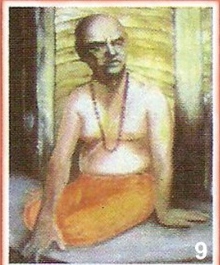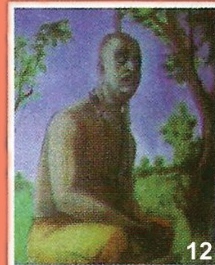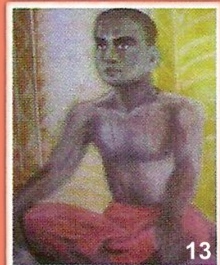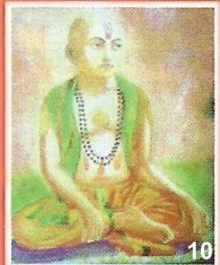
Sri Jayatirtha
Tikacharya, the Commentator of Dvaita Vedanta
Also known as Dhondopant, Dhondo Pant Raghunath, Jaya Tirtha, Tikacharya
Sri Jayatirtha holds a place in the guru-parampara that very few other names in this list can claim. Scholars of Dvaita Vedanta, even those outside the Gaudiya Vaishnava tradition, treat him as the most important philosopher the Madhva-sampradaya produced after Madhvacharya himself. He took sannyasa in his twenties under Akshobhya Tirtha, served only twenty-three years as the sixth pontiff after Madhvacharya, and in that short time wrote or is credited with more than twenty works. Almost all of them are commentaries on Madhvacharya's own writing, and together they earned him the title Tikacharya, "the Commentator." B. N. K. Sharma, in his academic *History of the Dvaita School of Vedanta and Its Literature*, the standard reference for this period, says Jayatirtha did for Dvaita philosophy something like what Vacaspati Mishra did for Shankaracharya's Advaita: his commentaries gave a young school of Vedanta the strength to stand beside the far older Advaita and Vishishtadvaita schools.
| Detail | Description |
|---|---|
| Birth name | Dhondopant, also given as Dhondo Pant Raghunath, of a Deshpande family |
| Approximate dates | Traditionally about 1345-1388 CE; pontiff 1365-1388 (23 years). Srila Prabhupada's purport to Chaitanya-charitamrita, Madhya 9.245, gives an earlier date, Shaka 1167 (about 1245 CE). This gap is looked at honestly below |
| Birthplace | Traditionally Mangalvedhe, near Pandharpur, Maharashtra. One early source instead places his family at Malkhed, Karnataka. B. N. K. Sharma leaves the question open |
| Guru | Akshobhya Tirtha, fifth pontiff after Madhvacharya |
| Title | Tikacharya, "the Commentator," for his commentaries on nearly all of Madhvacharya's writing |
| Chief works | Nyaya-sudha (on the Anu-vyakhyana) and Tattva-prakashika (on the Brahma-sutra-bhashya), among more than twenty works in all |
| Samadhi | Malkhed (ancient Manyakheta), Karnataka, on the bank of the river Kagini |
A Horseman Drawn Into Renunciation #
Stories about Jayatirtha's early life come mainly from later hagiographies called Vijayas, written generations after his death, and Sharma treats them with real caution rather than repeating them without question. By most accounts, Jayatirtha was born to a Deshpande family of military standing, under the name Dhondopant. Even his birthplace is not fully settled. The common tradition names Mangalvedhe, near Pandharpur in today's Maharashtra, but an older text called the Gurucharya instead places his family at Malkhed itself, in Karnataka, the very town where he would later live, write, and pass away. Sharma leaves the question open rather than choosing a side.
By tradition, the turning point came when Dhondopant, about twenty years old, stopped by a riverbank while out riding to water his horse, and met an ascetic on the far bank: Akshobhya Tirtha, a monk in the line going back to Madhvacharya through four disciples: Padmanabha Tirtha, Narahari Tirtha (called Nrihari Tirtha in the Gaudiya guru-parampara list), Madhava Tirtha, and Akshobhya Tirtha himself. A short exchange of questions is said to have moved the young man so deeply that he asked, on the spot, to be initiated. His father tried to take him home, and some later, more dramatic retellings even add a scene where the father forces him back into married life before he escapes again to his guru. Sharma rejects this added drama outright, calling it unthinkable "in the social and religious climate of orthodox Brahmin society in the 14th century," a story added only to make an already remarkable life sound more sensational. What the more careful sources agree on, without that embellishment, is simple: Akshobhya Tirtha ordained him, gave him the name Jayatirtha, trained him in Madhva's own Dvaita philosophy, and within a few years saw his disciple succeed him as pontiff, in 1365. The fuller story, including why Sharma rejects the more sensational version, is told on Life and Renunciation Under Akshobhya Tirtha.
Tikacharya: The Commentator Who Gave Dvaita Its Classical Form #
Jayatirtha's real importance rests on what he wrote in the twenty-three years that followed. His greatest work is the Nyaya-sudha, a vast commentary, traditionally said to run to about 24,000 verses, on Madhvacharya's own Anu-vyakhyana (itself Madhva's verse supplement to his Brahma-sutra-bhashya). It engages closely with rival Vedanta teachers such as Shankaracharya, Ramanujacharya and Bhaskara, and with the separate schools of Nyaya, Samkhya, Mimamsa and Buddhist philosophy. A traditional saying still holds that "the Sudha alone deserves to be called a real commentary," and Sharma himself, after a lifetime studying this literature, writes that "in the whole range of Sanskrit philosophical literature, there is not one other work like" it. Second in importance, and today the most widely studied commentary on Madhvacharya's Brahma-sutra-bhashya itself, is the Tattva-prakashika, a work of about 8,000 verses that later drew at least eleven further commentaries from Dvaita scholars, Sri Vyasa Tirtha's own Tatparya-chandrika chief among them.
Beyond these two, Jayatirtha wrote commentaries on nearly every other work in Madhvacharya's Sarvamula corpus, along with a few independent works of his own: chiefly the Vadavali, an early tract against Advaita's teaching that the world is unreal, and the Pramana-paddhati, the standard Dvaita textbook of logic and epistemology. This complete coverage, commenting on almost the whole body of his guru's own teacher's writing, giving it a settled technical vocabulary, and defending its grammar and reasoning against a century of Advaita criticism, is what earned him the title Tikacharya. Later tradition ranks him, together with Madhvacharya and Vyasa Tirtha, as one of the Munitraya, the "three sages" of Dvaita Vedanta. The full range of his writing is set out on Nyaya-sudha and the Commentaries on Madhva.
Samadhi at Malkhed and Three Living Mathas #
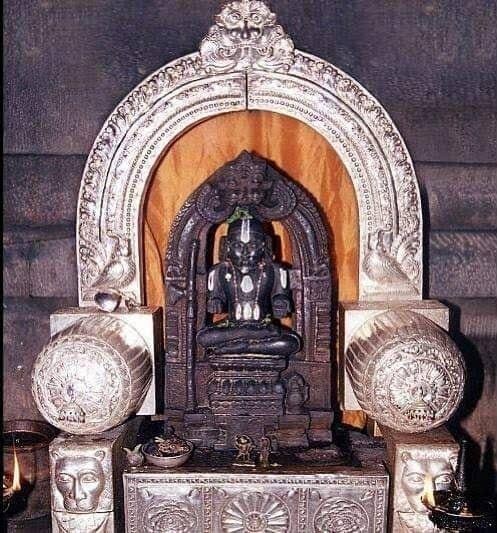
Jayatirtha passed away, by tradition, in 1388. No inscription or historical document naming him has ever been found, a genuinely curious gap for so important a writer, and one worth stating plainly rather than smoothing over. His samadhi (called a brindavana in this tradition) is kept at Malkhed, ancient Manyakheta, on the bank of the river Kagini, close to where his own guru Akshobhya Tirtha's samadhi already stood.
His influence did not end there. Over the following two centuries, the matha line after him split into what Dvaita tradition calls the Matha-traya, "the three mathas": the Uttaradi Matha, the Vyasaraja Matha (renamed generations later for its most celebrated pontiff, Vyasa Tirtha, whose own institutional line traces back through Rajendra Tirtha), and the Raghavendra Swami Matha at Mantralayam. All three still exist today, and Sharma states plainly that whatever rivalry has grown up between them over the centuries, all three "are as much historically connected with Madhva" as one another, and all three trace their line back through Jayatirtha specifically. Few figures anywhere in the Madhva-sampradaya's history stand this literally at the root of every major living branch of the tradition at once. The fuller institutional story is on Samadhi at Malkhed and the Three Mathas.
A Contested Rung in the Gaudiya List #
Within the traditional Gaudiya Vaishnava guru-parampara list, Jayatirtha's own guru is named as Akshobhya Tirtha, a claim independent Dvaita-tradition sources confirm without question. Who came after him in that same list deserves the same honest look already given to other figures in the chain, including on Rajendra Tirtha's own page and on Madhavendra Puri's Life in the Madhva Sampradaya. The traditional Gaudiya list names Jayatirtha's disciple as Jnanasindhu, followed by Dayanidhi and Vidyanidhi, before the list reaches Rajendra Tirtha. Srila Prabhupada's own purport to Chaitanya-charitamrita, Madhya 9.245, the primary Gaudiya source for the whole list, tells it differently. It names Jayatirtha's immediate successor as Vidyadhiraja Tirtha, a figure well documented in independent Dvaita-tradition sources, and reaches Rajendra Tirtha only afterward, through a separate branch under Vidyadhiraja:
madhvācārya-sthāne āilā yāṅhā 'tattvavādī'
uḍupīte 'kṛṣṇa' dekhi, tāhāṅ haila premonmādī
"Caitanya Mahaprabhu next arrived at Udupi, the place of Madhvacharya, where the philosophers known as Tattvavadis resided. There He saw the Deity of Lord Krishna and became mad with ecstasy." (Sri Chaitanya-charitamrita, Madhya 9.245)
Srila Prabhupada's purport to this verse gives his own numbered list of Madhva-sampradaya pontiffs: "Padmanabha, 1120; Narahari, 1127; Madhava, 1136; and Aksobhya, 1159; (15) Jaya Tirtha, 1167; (16) Vidyadhiraja, 1190; (17) Kavindra, 1255... (20) Vidyanidhi, 1298." Neither Jnanasindhu nor Dayanidhi appears anywhere in that purport, nor in any independent Dvaita-tradition source available for checking. This real, specific gap in the record is examined in full on Place in the Gaudiya Guru-Parampara.
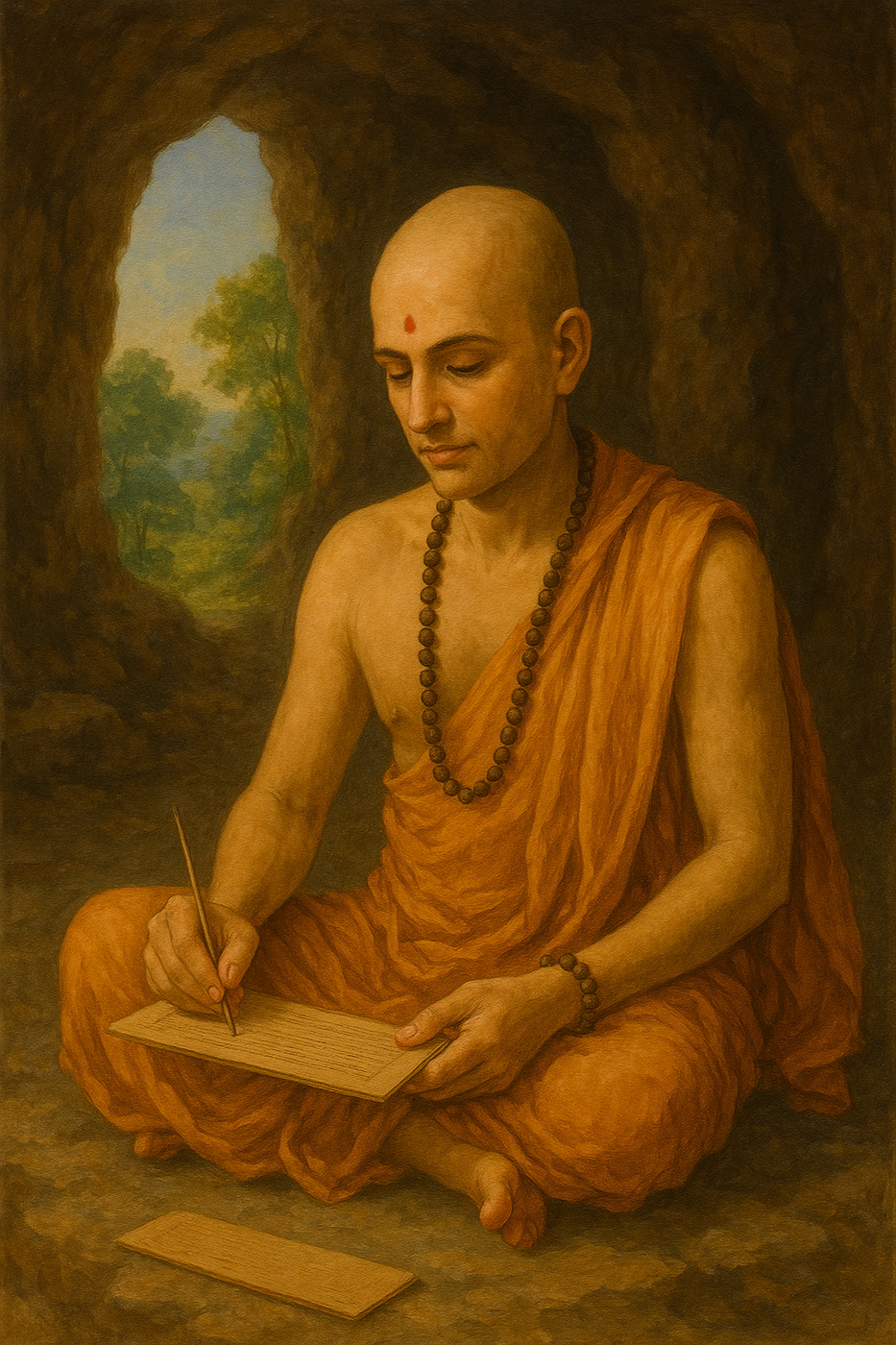
- Jayatirtha - Wikipedia
- List of works by Jayatirtha - Wikipedia
- Jayatirtha - Hindupedia, the Hindu Encyclopedia
- Jayatirtha - New World Encyclopedia
- B. N. K. Sharma, History of the Dvaita School of Vedanta and Its Literature (1961/1981), full text via Internet Archive
- Jaya Tirtha - Gaudiya History (ISKCON Desire Tree)
- Sri Chaitanya-charitamrita, Madhya-lila 9.245, purport
- Madhavendra Puri: Life in the Madhva Sampradaya (this website)
Disciples
Frequently asked
When was Sri Jayatirtha born?
Sri Jayatirtha appeared Traditionally about 1345 CE; pontiff 1365-1388 CE (23 years). Srila Prabhupada's purport to Chaitanya-charitamrita, Madhya 9.245, instead places him at Shaka 1167 (about 1245 CE) -- a real, unresolved discrepancy in Traditionally Mangalvedhe, near Pandharpur, Maharashtra; one early biographical source (the Gurucharya) instead places his family at Malkhed, Karnataka; B. N. K. Sharma's academic history leaves the question open..
Who was the guru of Sri Jayatirtha?
The spiritual master of Sri Jayatirtha was Sri Akshobhya Tirtha.
When and where did Sri Jayatirtha disappear?
Sri Jayatirtha disappeared Traditionally 1388 CE, at the close of a 23-year tenure as the sixth pontiff after Madhvacharya at Malkhed (ancient Manyakheta), Karnataka, on the bank of the river Kagini, where his samadhi (brindavana) still stands.
What are the main pastimes of Sri Jayatirtha?
The pastimes covered here include: Life and Renunciation Under Akshobhya Tirtha, Nyaya-sudha and the Commentaries on Madhva, Samadhi at Malkhed and the Three Mathas, Place in the Gaudiya Guru Parampara.