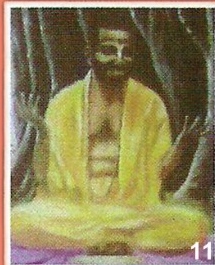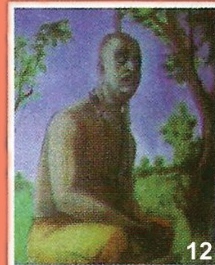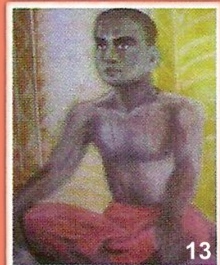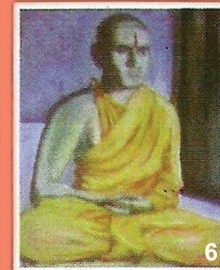
Padmanabha Tirtha
First Pontiff After Madhvacharya
Also known as Shobhana Bhatta, Sobhana Bhatta (purva-ashrama name), Padmanabhacharya, Padmanabhacarya, Padmanabha Teertha
Padmanabha Tirtha comes right after Madhvacharya in the Gaudiya Vaishnava guru-parampara. He also comes right after Madhva in the documented history of the Dvaita Vedanta school itself, and that second fact makes him unusual among the names in this parampara list. Some other links in this chain can be traced only through Gaudiya sources. But Padmanabha Tirtha's place as Madhva's own disciple and first successor is confirmed by the Dvaita tradition's own texts too, and by more than half a century of independent academic study of them, most of all B. N. K. Sharma's standard history of the school. He was already a serious scholar before he ever met Madhva. He soon became one of Madhva's most trusted early disciples. Tradition remembers him as the first person to hold the seat Madhva left behind when he departed from this world.
| Detail | Description |
|---|---|
| Purva-ashrama name | Shobhana Bhatta |
| Guru | Madhvacharya |
| Native of | Uttara-Karnataka, near the Godavari (disputed; see below) |
| Became a disciple | c. 1265 CE, on the banks of the Godavari, probably near Puntamba or Paithan |
| Position | Traditionally the first to head the pitha after Madhvacharya; first pontiff counted by the Uttaradi Matha |
| Chief works | About 15 works, including the Sattarkadipavali, Nyayaratnavali and Sannyayaratnavali, and commentaries on the Gita-bhashya and the ten Prakaranas |
| Disappeared | 1324 CE, at Nava Brindavana near Hampi |
A Scholar Named Shobhana Bhatta #
Before he took sannyasa, Padmanabha Tirtha was called Shobhana Bhatta. Every source agrees he was already a serious figure in his own right. Madhvacharya's own earliest biography, the Sanskrit poem Madhva-vijaya, describes him as a master of many branches of learning and a skilled logician. Exactly where he came from is genuinely disputed. Several early writers assumed he was a Telugu brahmana from the Andhra country. They read this from a line in the Madhva-vijaya that places him "in the region of the Godavari." B. N. K. Sharma disagreed. He pointed to other early Dvaita-tradition texts that call Shobhana Bhatta a teacher "of the good folk of Karnataka." He also pointed out that Kannada-speaking settlements are independently attested along the upper Godavari well into the thirteenth century. For these reasons, Sharma held that Shobhana Bhatta more likely belonged to Uttara-Karnataka, the northern edge of the Kannada-speaking region, rather than to Andhra proper. Neither claim can be settled beyond doubt from the sources available. Both deserve to be known, since the sources themselves do not agree.
Beaten in Debate, Won Over to Dvaita #
Shobhana Bhatta and Madhvacharya met somewhere on the banks of the Godavari, most likely near Puntamba or Paithan. This was as Madhvacharya made his way back to Udupi from his first journey to North India, probably around 1265 CE. What happened next is remembered in strikingly similar terms on both sides of the later Gaudiya-Dvaita divide: a formal philosophical contest that Shobhana Bhatta lost. Sharma reads the Madhva-vijaya as saying he tried "conclusions with Madhva" and was "worsted by him in disputation." He then asked to join the new teaching and was initiated as Padmanabha Tirtha. His was not the only conversion on that journey. A second scholar met around the same time, Svami Sastri, became a disciple under the name Narahari Tirtha, and later succeeded Padmanabha Tirtha in turn. His own page is at Narahari Tirtha.
First to Sit on the Pitha #
The Madhva-vijaya singles Padmanabha Tirtha out for real praise. Dvaita tradition remembers him as probably the senior-most of Madhva's disciples from outside the Tulu-speaking heartland around Udupi. That status made him the natural choice to lead the community after Madhva's own departure. The Uttaradi Matha counts him today as its first pontiff. Sharma's academic history places him first among the group later tradition calls the four direct disciples who carried Madhva's teaching beyond Udupi: Padmanabha Tirtha, Narahari Tirtha, Madhava Tirtha and Akshobhya Tirtha. How tidy that four-in-a-row picture really is, historically, is worth asking seriously rather than assuming settled. It is examined below.
Fifteen Works, Mostly Eclipsed #
Padmanabha Tirtha's importance to Dvaita literature is not in doubt. Sharma counts nearly fifteen works to his name. Most of them are commentaries written to unpack Madhva's own notoriously terse Sanskrit: the Sattarkadipavali on the Brahma-sutra-bhashya, the Sannyayaratnavali on the Anuvyakhyana, the Nyayaratnavali on the Vishnu-tattva-vinirnaya, the Gitabhashya-Bhavadipika on the Gita-bhashya, and commentaries on all ten of Madhva's shorter philosophical tracts, the Dasha-prakaranas. By Sharma's account, he was the earliest known commentator on several of these texts. Jayatirtha, the towering commentator who came a generation later, eventually superseded nearly everyone's earlier work. Even so, he singled Padmanabha Tirtha out for a formal tribute. He credited him as the pioneer without whose guidance Madhva's own works "would have presented serious difficulties to posterity," and gave him the title Tikakara, "the commentator." More on his specific works, and on Jayatirtha's tribute, is on Commentaries That Shaped Early Dvaita.
One Line, Read Two Ways #
Srila Prabhupada's own purport to Chaitanya-charitamrita shows that the Gaudiya guru-parampara list is not corroborated by the Madhva sampradaya's own independently kept succession records. This point is discussed fully on Life in the Madhva Sampradaya. Padmanabha Tirtha's own case sits in an interesting middle position within that larger picture. His place as Madhva's disciple and first successor genuinely is attested inside Dvaita tradition's own sources. Srila Prabhupada's own purport to Chaitanya-charitamrita, Madhya 9.245, tells substantially the same story from the Gaudiya side. The Gaudiya parampara states the chain plainly, as in the Gaura-ganoddesha-dipika:
Madhvacharya took initiation in the Krishna mantra from Vyasa. Madhva's disciple was Padmanabhacharya, an illustrious person, whose disciple was Narahari, who was followed by Madhava, the twice-born. Madhava's disciple was Akshobhya, who was followed by Jayatirtha.
But this is not quite how Dvaita tradition itself describes what came after Madhva. Independent research into the Madhva sampradaya's own records treats Padmanabha, Narahari, Madhava and Akshobhya Tirtha as four separate, direct disciples of Madhvacharya. Tradition holds that they were ordained close together in time, not initiated one by the other down a single chain running to Jayatirtha and, eventually, to Jnanasindhu. The fuller picture, including a real dispute over dates, is on One Guru, or Four Disciples?.
Entombed at Nava Brindavana #
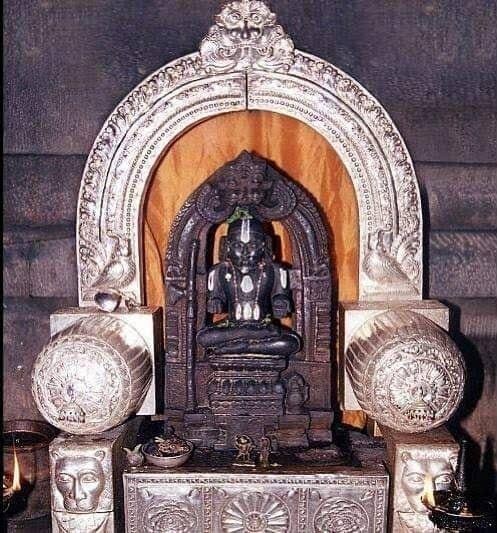
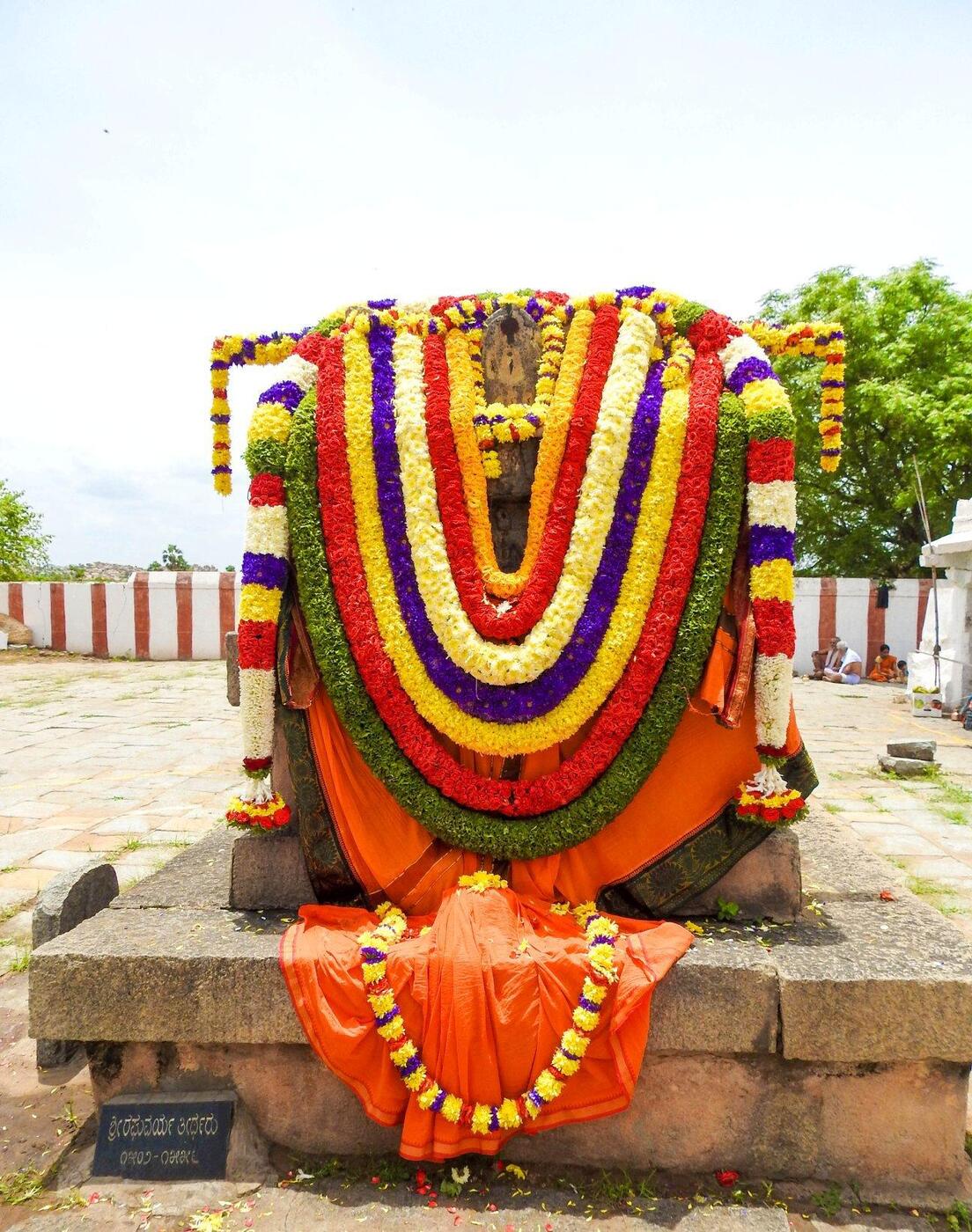
Padmanabha Tirtha is remembered as having headed the community for about seven years before his own passing in 1324 CE. He was laid to rest at Nava Brindavana, an island in the Tungabhadra river near Anegundi, close to Hampi in modern Karnataka. Over the following three centuries, this same site went on to receive the tombs of eight more Dvaita-tradition pontiffs, among them the celebrated Vyasa Tirtha. Padmanabha Tirtha's own tomb there is the oldest of the nine. The site remains an active place of pilgrimage today for the Uttaradi Matha, the Vyasaraja Matha and the Raghavendra Matha, the three institutions that all trace their own founding, ultimately, back through him to Madhvacharya.
Scriptural evidence
vyāsāl labdha-kṛṣṇa-dīkṣo mādhvācāryo mahāyaśāḥ
tasya śiṣyo'bhavat padmanābhācāryo mahāśayaḥ
tasya śiṣyo naraharis tac-chiṣyo mādhava-dvijaḥ
akṣobhyas tasya śiṣyo'bhūt tac-chiṣyo jayatīrthakaḥ
"Madhvacharya took initiation in the Krishna mantra from Vyasa. Madhva's disciple was Padmanabhacharya, an illustrious person, whose disciple was Narahari, who was followed by Madhava, the twice-born. Madhava's disciple was Akshobhya, who was followed by Jayatirtha."
The earliest known textual source for the specific Gaudiya guru-parampara chain naming Padmanabhacharya directly as Madhva's own disciple and Narahari's own guru; quoted here via Gaudiya scholar Jagadananda Das's comparative study, since no independent English translation of the full Sanskrit text is posted online. Compare the Dvaita-tradition reading of the same four names as parallel disciples rather than a chain, discussed on One Guru, or Four Disciples?
- Padmanabha Tirtha - Wikipedia
- Sri Padmanabha Tirtha - Sri Uttaradi Math
- Padmanabha Tirtha - Gaudiya History (ISKCON Desire Tree)
- Sri Madhvacarya - Disappearance (reproduces Srila Prabhupada's purport to CC Madhya 9.245) - ISKCON Desire Tree
- B. N. K. Sharma, History of the Dvaita School of Vedanta and Its Literature (1961/1981) - Internet Archive
- Is the Gaudiya Vaishnava sampradaya connected to the Madhva line? by Jagadananda Das
- Mathatraya of Tattvavada - Wikipedia
Disciples
Frequently asked
When was Padmanabha Tirtha born?
Padmanabha Tirtha appeared Not clearly recorded. Sources agree only on his purva-ashrama (pre-sannyasa) name, Shobhana Bhatta; his exact birth year does not appear in any source consulted in Uttara-Karnataka, near the upper Godavari river (some early writers, reading a line in the Madhva-vijaya, assumed he was from Andhra instead; the exact village is not recorded).
Who was the guru of Padmanabha Tirtha?
The spiritual master of Padmanabha Tirtha was Srila Madhvacharya.
When and where did Padmanabha Tirtha disappear?
Padmanabha Tirtha disappeared 1324 CE, after heading the community for about seven years. Traditional Sakabda-era Mutt tables place his succession a century earlier, around 1199-1200 CE; B. N. K. Sharma's epigraphically-supported redating to roughly 1317-1324 CE is followed here, a full century later than the traditional figures. at Nava Brindavana, an island in the Tungabhadra river near Anegundi, close to Hampi, Karnataka.
What are the main pastimes of Padmanabha Tirtha?
The pastimes covered here include: Meeting Madhvacharya on the Godavari, Commentaries That Shaped Early Dvaita, One Guru, or Four Disciples?.