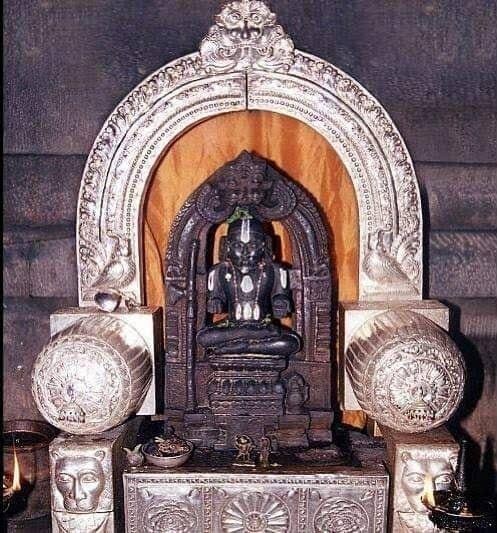
Almost everything known about Madhvacharya's childhood comes down to us through devotional biography rather than independent record, chiefly the Sanskrit poem Sumadhva-vijaya (also called Madhva-vijaya), written a generation or two after his death by Narayanacharya, whose own father Trivikramacharya had been one of Madhvacharya's direct disciples. Srila Prabhupada's purport to Sri Chaitanya-charitamrita, Madhya 9.245, written to explain who the Tattvavadis of Udupi were when Sri Chaitanya Mahaprabhu met them, draws on this same devotional tradition, and remains, for a Gaudiya Vaishnava reader, the simplest way into it.
| Detail | Description |
|---|---|
| Childhood name | Vasudeva |
| Birth (traditional) | 1238 CE, Pajaka, near Udupi, South Kanara, Karnataka |
| Birth (alternate dating) | 1199 CE per some modern scholars; 1118 CE per Srila Prabhupada's purport, which also notes the 1238 CE figure |
| Father | Madhyageha Bhatta (also given as Naduillaya), a Shivalli-brahmana |
| Sannyasa-guru | Achyutapreksha, of the Ekadandi renunciate order |
| Age at sannyasa | About twelve |
| Monastic name | Purnaprajna Tirtha; later also called Anandatirtha |
A Name, and a Disputed Date #
Vasudeva was born into a Shivalli-brahmana family at Pajaka, a small village a short distance from Udupi on India's south-western coast. Almost nothing about the exact year can be called settled. Most modern reference sources, including Wikipedia, date his birth to 1238 CE. But that is not the only date in circulation: some historians argue for 1199 CE instead, and Srila Prabhupada's own purport to Chaitanya-charitamrita states plainly that Madhvacharya "took his birth... in the year 1040 Shakabda (A.D. 1118)," adding only afterward, "according to some, he was born in the year 1160 Shakabda (A.D. 1238)." Three respectable sources, in other words, give three different birth years, and none of them can be proven against an independent historical record.
Stories of a Remarkable Child #
The devotional tradition around Vasudeva's early years is rich with the kind of wonder-stories common to the childhoods of great Indian saints, and they should be read as exactly that: pious tradition, not documented history. It is said that when his father, deep in debt, needed money, the boy turned ordinary tamarind seeds into coins in his hand. It is said that at the age of five a demon named Manimat, living nearby in the form of a snake, was killed by Vasudeva with nothing more than the toe of his left foot. His biographers say such stories were told about him because his mother would grow anxious whenever he wandered off, and he would appear before her again in a single jump, proof, to the devout mind, that he was no ordinary child. Alongside these miracles sits a more ordinary and probably more reliable detail: Vasudeva was a genuinely gifted student from a young age, mastering scripture and debate faster than his teachers expected, and it was this early brilliance that eventually drew him toward renunciation rather than the householder life his father had hoped for.
Renunciation Against a Father's Wishes #
Vasudeva received the sacred thread as a small boy, in the ordinary way of a brahmana household, and by his early teenage years had made up his mind to take sannyasa, a decision his father strongly opposed. He was around twelve years old, by most accounts, when he finally left home and accepted initiation into the renounced order from a teacher named Achyutapreksha, of the Ekadandi order of sannyasa. On initiation he received the monastic name Purnaprajna Tirtha, "the one whose knowledge is complete," and he is also known in later tradition by the name Anandatirtha.
A Guru He Never Quite Claimed #
Achyutapreksha's own monastic tradition traces back to the broad renunciate order associated with Adi Shankaracharya's line, the very Advaita Vedanta school that Madhvacharya would spend the rest of his life arguing against. Here is one of the more quietly striking facts of his biography, worth stating plainly rather than smoothing over: in his own extensive later writings, Madhvacharya never named Achyutapreksha as his guru, and never claimed descent from his monastic lineage. He studied the Upanishads under Achyutapreksha, accepted sannyasa through him, and then, once he had formed his own independent understanding of Vedanta, simply left that formal connection out of how he described his own authority. His later works instead ground his teaching directly in a devotional account of personal instruction from Vyasadeva himself, a claim examined, along with its own limits as evidence, on Founding Dvaita Vedanta.
A formal guru-lineage recorded in one generation is not always the story that later generations, or the person himself, chose to emphasize, and this pattern recurs across the lives of several acharyas. The question of how the Gaudiya Vaishnava tradition later came to describe its own connection to Madhvacharya's line raises a version of exactly this same issue, and is addressed directly on Dvaita Vedanta and Achintya-Bhedabheda.
An Early, Independent Mind #
Even as a young renunciate, Madhvacharya's teachers reportedly found him hard to keep within the boundaries of standard Advaita interpretation. He pressed questions about the reality of the world and of individual selfhood that Shankara's non-dualism was not built to answer comfortably. By the time he began travelling and teaching on his own, still a young man, he had already broken from the philosophical framework of his own formal sannyasa order and begun to develop what would become Dvaita Vedanta, or as he called it himself, Tattvavada. That development, and the works in which he set it down, are the subject of the next chapter of his life.