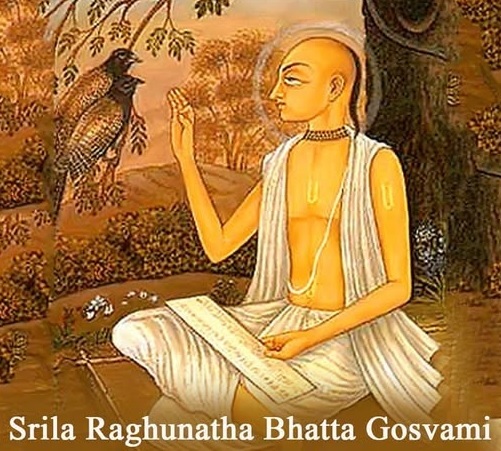
Every account of Raghunatha Bhatta Goswami's life at Vrindavana circles back to the same fact: when he recited Srimad-Bhagavatam, people stopped what they were doing to listen. Sri Chaitanya-charitamrita, written by his own contemporary Krishnadasa Kaviraja Goswami, gives the reason in a single, often-quoted line - his voice was pika-svara, as sweet as a cuckoo's, and he would carry one verse through three or four different tunes before moving to the next.
| Detail | Description |
|---|---|
| Recitation style | Each verse of Srimad-Bhagavatam recited in three or four different tunes |
| Voice quality | Described in Chaitanya-charitamrita as "sweet as a cuckoo's" |
| Regular audience | Rupa Gosvami and Sanatana Gosvami, and the Vaishnavas of Vrindavana |
| Title earned at Jagannatha Puri | Kirtana-acharya, for his cooking and his kirtana performances |
| Temperament | Never criticized any Vaishnava, however faulty their outward conduct |
Overcome Mid-Verse #
Reciting for Rupa Gosvami and Sanatana Gosvami became, in Chaitanya-charitamrita's own words, the engagement through which Raghunatha "attained perfectional love of Krishna, by which he remained always maddened." The ecstasy was not a metaphor. The text describes actual physical symptoms overtaking him as he read - tears, trembling, a voice that began to falter - until his throat closed with emotion and he simply could not continue. Whenever he read or heard about Krishna's beauty and sweetness in particular, he would become oblivious to everything around him. Tradition says his tears often fell onto the very pages of the Bhagavatam he was reading, wetting them as he sang.
Word of this spread well beyond Vrindavana. Even at Jagannatha Puri, during his years of cooking and serving Sri Chaitanya Mahaprabhu, his kirtana performances alongside his cooking had already earned him the title kirtana-acharya, a master of chanting - and gaudiyahistory's own biographical tradition adds a line worth pausing on: that even Vyasadeva, the sage credited with compiling the Bhagavatam itself, would have delighted to hear Raghunatha Bhatta recite it. Whether read as literal claim or as devotional hyperbole, it captures how unmatched his recitation was considered to be.
A Life With No Room for Criticism #
What made Raghunatha Bhatta distinctive was not only his voice but his refusal to let anything interrupt his absorption in Krishna - including gossip about other devotees. Sources describe him as a man who would neither hear nor speak of ordinary worldly matters at all, engaging in nothing but discussion of Krishna and worship of the Lord, day and night. Even when a Vaishnava's conduct gave real grounds for criticism, he declined to join in: since every Vaishnava, in his view, was sincerely serving the Lord according to their own level of realization, he preferred to overlook the fault rather than dwell on it. It is a small but telling detail, and it fits naturally alongside everything else remembered about him - a man for whom the Bhagavatam's own subject, not the failings of the people around him, was the only thing worth his attention.
Reciting the Book He Would Later Call His Deity #
This devotion to the text itself, rather than only to a worshipable image, runs through everything remembered about Raghunatha Bhatta Goswami. Later Vrindavana tradition holds that a copy of Srimad-Bhagavatam connected to him is still preserved and worshipped today, alongside the tulasi garland and wooden sandals associated with his memory, at a site in Vrindavana known as Raghunatha Bhatta Goswami's Peeth. Whether or not the Bhagavatam functioned as a literal worshipable Deity for him during his own lifetime - the surviving Chaitanya-charitamrita account describes his personal worship centering on the tulasi garland and Jagannatha-prasadam Mahaprabhu gave him, alongside his service to a separate Deity of Govinda - the reverence for the book itself as something closer to a living presence than a text is entirely consistent with a man remembered chiefly for the way he spoke it aloud.
That service to Govinda, and the years he spent building a community of devotion around both the Deity and the text, are the subject of Life and Service at Radha-kunda.