Once Narottama Dasa Thakura gave his blessing, Santosha Datta moved with the resources of a raja behind him. Within a matter of months a substantial temple complex rose at Kheturi: a large temple building, a storehouse big enough to feed the crowds that were coming, a kirtana hall, a residence hall and ashram for visiting devotees, a bathing pond and a flower garden, and a guest house besides. The complex would come to be known as the Gaurangabari temple, after the Deity of Sri Gauranga installed at its heart.
Messengers to Every Corner of Bengal #
Santosha and Narottama did not plan a small or private ceremony. Messengers went out for miles around Kheturi carrying invitations to kings, landowners, poets, pandits, singers, orators and Vaishnavas of every description. The date chosen was itself significant: the full-moon day of Phalguna, Gaura Purnima, the anniversary of Chaitanya Mahaprabhu's own appearance in this world. According to Sri Chaitanya Saraswat Math's account of the period, the festival that resulted was remembered as the greatest gathering of Gaudiya Vaishnavas since Mahaprabhu's own pastimes in Nabadwip, traditionally dated to 1574. Lists of the hundreds of devotees who attended, representing nearly every branch of the young Gaudiya movement, survive in no fewer than three separate chronicles: Prema-vilasa, Narottama-vilasa and Bhaktiratnakara.
Arrivals on the Padma #
Getting that many guests to a riverside village took real logistics, and this is where Santosha's administrative training served the festival best. He arranged boats to ferry devotees across the Padma, and bullock carts and palanquins to carry them the rest of the way, so that no one arriving from a distance faced unnecessary hardship. Jahnava Devi, the consort of Nityananda Prabhu, arrived with her own party and was received as the festival's chief guest. Shrinivasa Acharya, Shyamananda Pandit, Ramachandra Kaviraja, Vrindavana Dasa Thakura (author of Sri Chaitanya-bhagavata) and Kavi Karnapura Goswami, who would go on to write Sri Gaura-ganoddesha-dipika after witnessing these very events, were all present. Santosha, Narottama and Shrinivasa personally welcomed guests with sandalwood paste and flower garlands as they arrived, and rooms and attendants were arranged for each one.
Six Deities Installed #
On the morning of Gaura Purnima, the assembled Vaishnavas gathered at the temple to watch Shrinivasa Acharya perform the installation. One by one he placed six Deities on their thrones and announced their names: Sri Gauranga, Sri Vallabhi Kanta, Sri Vraja Mohana, Sri Krishna, Sri Radha Kanta and Sri Radha Ramana. Accounts describe the mahants moved to tears at the sight, Vedic hymns rising alongside the sound of kirtana instruments, and Jahnava Devi seated in her own place of honor as the ceremony went on for most of the day: offerings of food, lamps, sandal paste and garlands, followed by hours of sankirtana that, by tradition, drew Mahaprabhu and His own associates back into visible form among the dancing crowd.
The festival also settled matters that had nothing to do with ceremony. Because neither Narottama nor Shyamananda had been born into brahmana families, the question of whether a non-brahmana could serve as a diksha-guru had divided some Gaudiya Vaishnavas; at Kheturi the assembled acharyas resolved the question in the affirmative. Sri Chaitanya Mahaprabhu Himself taught Ramananda Raya this same principle: "Whether one is a brahmana, a sannyasi or a sudra, regardless of what he is, he can become a spiritual master if he knows the science of Krishna" (Sri Chaitanya-charitamrita, Madhya-lila 8.128). Birth settles nothing; knowledge of Krishna does. That same festival also saw the concept of the Pancha-tattva, Chaitanya, Nityananda, Advaita, Gadadhara and Srivasa together, gain the wide acceptance among Gaudiya Vaishnavas that it still holds today. As Srila Prabhupada explains in his purport on this point, "Spiritually there are no differences between these five tattvas, for on the transcendental platform everything is absolute. Yet there are also varieties in the spiritual world, and in order to taste these spiritual varieties one should distinguish between them" (Sri Chaitanya-charitamrita, Adi-lila 7.5). None of this theological work was Santosha's own to do; his part was to make the room, the food and the welcome possible for the acharyas who did it.
A Grateful Farewell #
As the festival drew to a close and devotees began departing for their own sripats, Santosha and Narottama saw them off together. Santosha distributed gold coins, cloth and waterpots as parting gifts, and touched the feet of the exalted guests one final time before they scattered back across Bengal, Odisha and beyond, carrying with them not just Narottama's songs but a shared sense, for the first time since Mahaprabhu's disappearance, that the scattered branches of his movement were one community after all.
Kheturi Since #
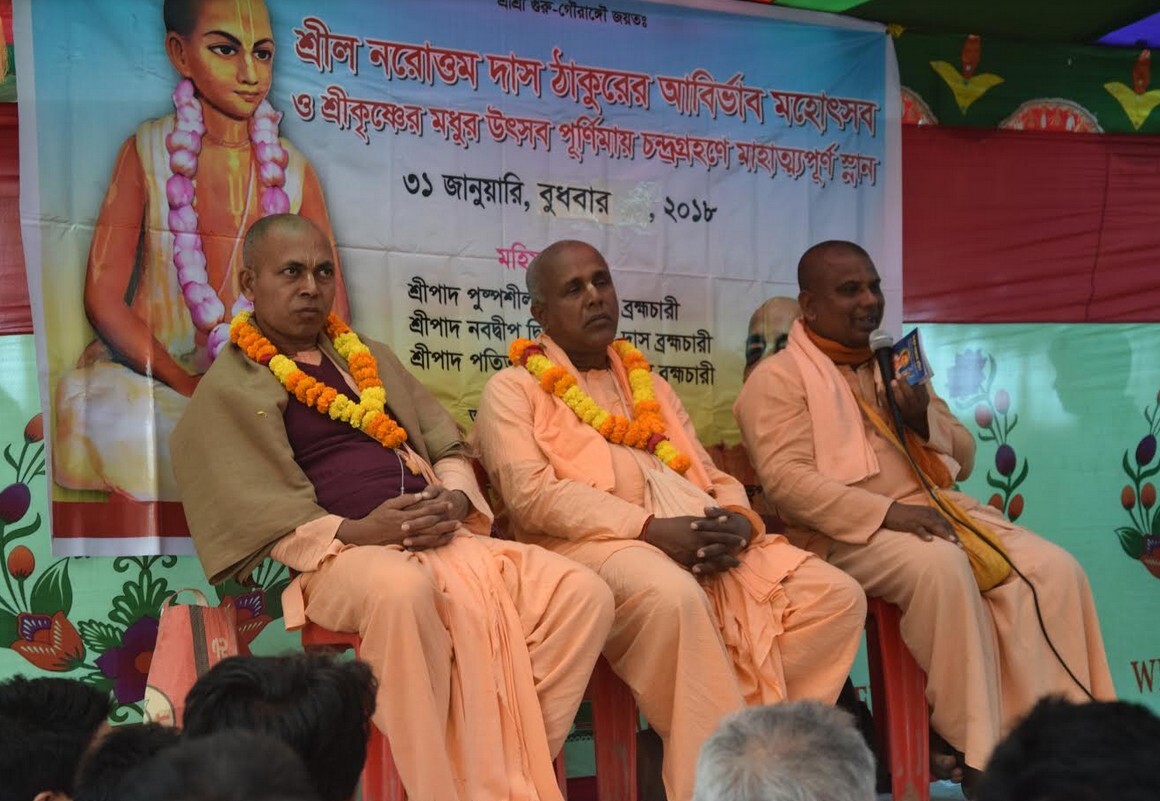
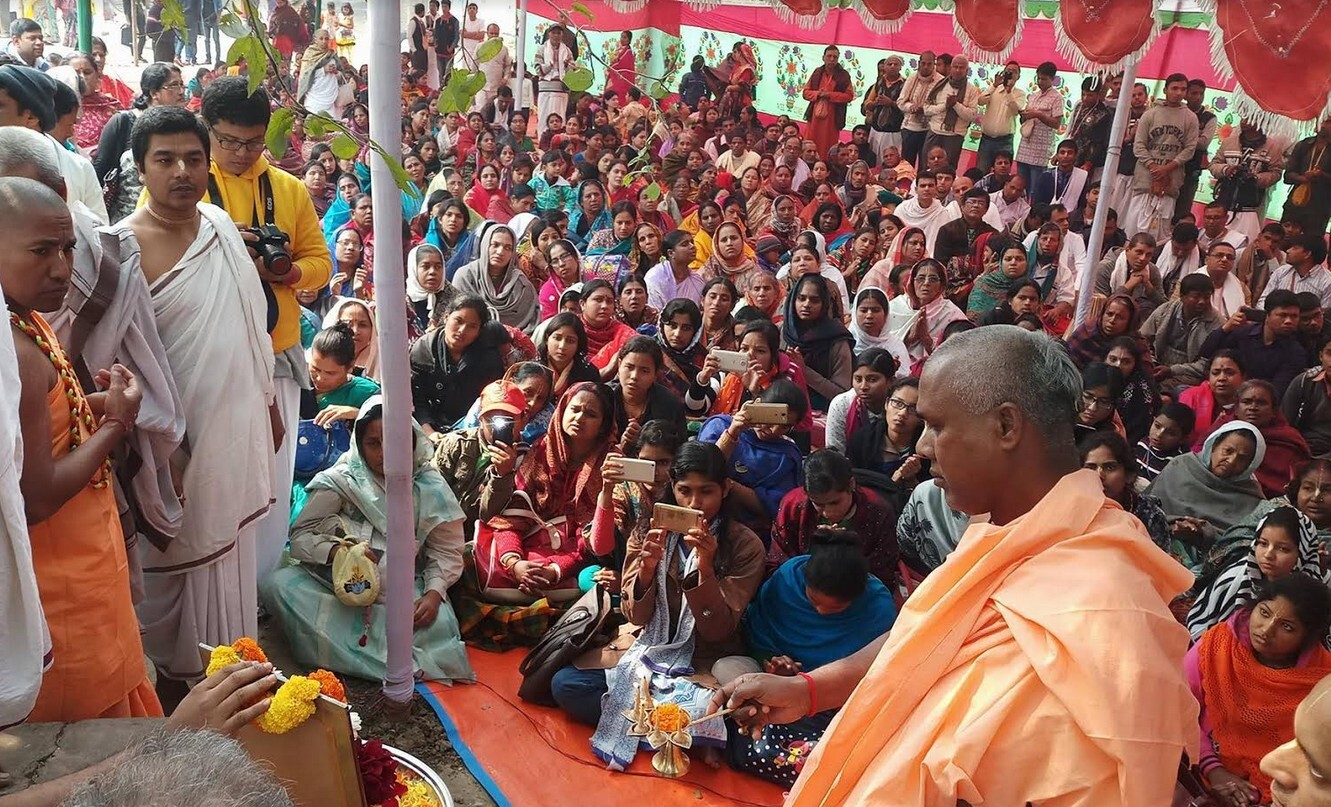
The temple Santosha built has outlasted him by more than four centuries, though not without loss: the original Deities Narottama installed there went missing during the wars that swept Bangladesh in the 1970s, and only some of Narottama's worshipable shalagram-shilas are reported to remain on the site today. In recent years ISKCON Bangladesh has begun observing an annual Narottama Purnima festival at Kheturi Dham, drawing devotees back to sing and gather on the same ground Santosha once prepared: a small echo, four and a half centuries later, of the far larger crowd he once welcomed there himself.