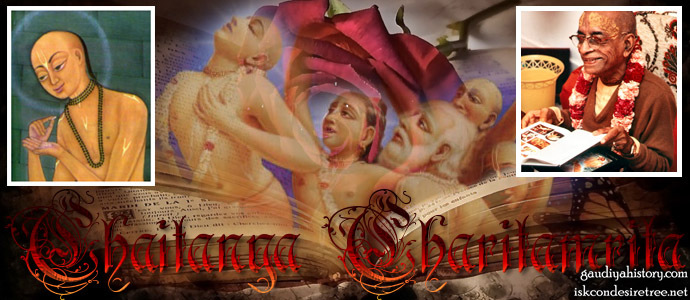
Long before he was known as Svarupa Damodara, he was Purushottama Acharya, a young scholar and singer of Navadvipa - and, by the account Krishnadasa Kaviraja Goswami himself gives, already a devotee who had taken shelter of Sri Chaitanya Mahaprabhu years before the Lord ever accepted sannyasa.
| Detail | Description |
|---|---|
| Birth name | Purushottama Acharya (also Purushottama Bhattacharya) |
| Father | Padmagarbha Acharya, son of Jayarama Chakravarti |
| Father's native village | Bhitadiya, on the bank of the Brahmaputra, in East Bengal |
| Raised at | Navadvipa, in his maternal grandfather Jayarama Chakravarti's household |
| Reputation before renunciation | A gifted scholar and singer, and already a devotee in Mahaprabhu's Navadvipa circle |
A Household Without a Father Present #
According to the genealogical details preserved in the Gaudiya Vaishnava Abhidhana, Svarupa Damodara's father, Padmagarbha Acharya, belonged to a family from Bhitadiya, a village on the Brahmaputra river in what is now Bangladesh. Padmagarbha had married into the family of Jayarama Chakravarti, a resident of Navadvipa, and by custom went to live in his father-in-law's house. Soon after his son's birth, though, Padmagarbha left his wife and infant behind and travelled to Mithila and then Kashi to pursue advanced scriptural study. The boy who would become Svarupa Damodara therefore grew up not in his father's household but in his mother's, raised among his maternal grandfather's family in Navadvipa. Nothing in the sources consulted for this page records his mother's name, and no year is given for his birth.
Scholar and Singer, Not Yet a Renunciant #
What every source agrees on, well before any question of sannyasa arises, is that Purushottama Acharya was already an unusually accomplished man. Sri Chaitanya-charitamrita later calls him, without qualification, the equal of Brihaspati - the priest of the demigods - in scriptural learning, and compares his singing to that of the Gandharvas, heaven's own musicians. Devotional retellings describe him as a locally celebrated pandit and vocalist even before he took any vow, and some modern accounts go further, suggesting a brief connection to a royal court. That particular claim about court patronage could not be confirmed against Sri Chaitanya-charitamrita, Krishnadasa Kaviraja Goswami's own summary in Madhya-lila, or any of the older biographical compilations checked for this page - so it is reported here only as a detail some later writers repeat, not as an established fact. What is well documented is simpler and, in its own way, more remarkable: this brilliant, already-accomplished young man had, by his own later testimony, already given his heart to Chaitanya Mahaprabhu while the Lord was still a householder in Navadvipa, well before the events that would make Him famous throughout Bengal.
Devotion Before the Lord's Sannyasa #
Sri Chaitanya-charitamrita states the point directly: "When Svarupa Damodara was residing at Navadvipa under the shelter of Sri Chaitanya Mahaprabhu, his name was Purushottama Acharya." This single line carries real weight. It means his bond with the Lord did not begin at Puri, and did not begin with renunciation - it began earlier, in Navadvipa, in the ordinary years before Mahaprabhu left home. Whatever else separated the two men later - the vows, the miles between Navadvipa and Jagannatha Puri, the years apart - this early attachment is what made the news of Mahaprabhu's sannyasa unbearable to him. It is also, in hindsight, the thread that connects a locally admired Navadvipa scholar to the man Gaudiya Vaishnava tradition would later name as one of Radharani's own closest companions - an identity discussed on spiritual-identity-as-lalita-sakhi.
The Break That Sent Him to Varanasi #
Everything changed in the month of Magha, when Chaitanya Mahaprabhu, then twenty-four years old, accepted the renounced order of sannyasa and prepared to leave Navadvipa for good. Purushottama Acharya, by Krishnadasa Kaviraja Goswami's own description, went "almost mad" with the pain of separation. He did not wait, hesitate, or seek permission from his own family - he left at once for Varanasi, the traditional seat of Dashanami renunciation, determined to take a vow of his own rather than remain behind as a householder scholar while his Lord walked away into sannyasa. What happened next in Varanasi - the guru who initiated him, the unusual, incomplete form of renunciation he chose, and the journey that finally reunited him with Mahaprabhu at Puri - is told in full on joining-sri-chaitanya-mahaprabhu-at-puri.
Looking back from the vantage of everything he later became - the Lord's secretary, the singer no one could equal, the keeper of a private record that would shape Sri Chaitanya-charitamrita itself - this Navadvipa chapter matters because it shows that Svarupa Damodara was never a stranger whom Mahaprabhu happened to notice at Puri. He was already, quietly, one of the Lord's own before either of them had renounced anything at all.