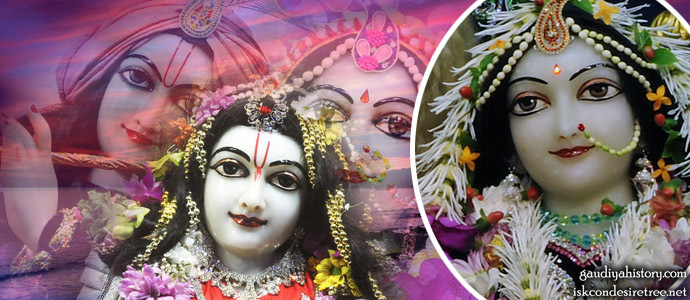
Gaudiya Vaishnava tradition holds that the devotees who surrounded Sri Chaitanya Mahaprabhu at Puri were, beneath their visible lives, residents of Krishna's own Vraja pastimes. For Svarupa Damodara, the sources agree on how close that identity places him to Radharani - but they do not agree on her exact name.
| Detail | Description |
|---|---|
| Root text | Kavi Karnapura's Gaura-ganoddesha-dipika |
| Identity given there | Vishakha-devi, one of Radha's eight principal sakhis |
| Popular alternative | Lalita-sakhi, Radha's other closest confidential friend |
| Supporting verse | A Gaura-ganoddesha-dipika verse describing Vishakha, Radha's own art-teacher in Vraja, as reborn as Svarupa Goswami |
| Parallel Puri pairing | With Ramananda Raya, likened to Lalita and Vishakha as Radha's two confidantes |
What the Gaura-ganoddesha-dipika Actually Says #
Kavi Karnapura's Gaura-ganoddesha-dipika, the traditional key that maps each of Chaitanya Mahaprabhu's associates back onto a figure from Krishna's Vraja-lila, names Svarupa Damodara as Vishakha-devi - the sakhi remembered in Vraja for having personally taught Radharani the arts. A verse quoted across multiple later biographical sources makes the claim directly: the same Vishakha who once taught Radha in Vraja has now, in Gaura-lila, become Svarupa Goswami, delighting in the moods of Radha and Krishna all over again. This is the identity a strict reading of the earliest source material actually supports, and it is the one given real textual weight in most detailed Gaudiya biographical writing on him.
Why Lalita-sakhi Is Still the Name Most People Use #
And yet, in everyday devotional speech - in pranama mantras recited for him, in short popular biographies, and even in some material published by Gaudiya institutions - Svarupa Damodara is called an incarnation of Lalita-sakhi far more often than of Vishakha. One traditional pranama mantra recited in his honor addresses him directly as an incarnation of Lalita, most dear to Chaitanya Mahaprabhu - a description that sits, unreconciled, alongside the very same tradition's citation of the Gaura-ganoddesha-dipika naming him Vishakha instead. This is not a case this page can honestly resolve. Rather than silently pick one label, it is worth naming plainly: the root verse says Vishakha; a wide and old current of popular devotion says Lalita; and no source consulted here manages to explain how the two claims fit together, or which one displaced the other in general use. The same tension surrounds Ramananda Raya, his own closest companion at Puri: Srila Prabhupada's own purport to Chaitanya-charitamrita describes Ramananda Raya as "considered an incarnation of Arjuna and by some an incarnation of Vishakhadevi" - meaning the very name Vishakha gets attached to both men, in different sources, at different times. It is a sign that this kind of double attribution was not unique to Svarupa Damodara alone.
Radha's Two Closest Friends, Reflected at Puri #
Whichever name is correct, the deeper point every source affirms without disagreement is the closeness itself. Among the eight principal sakhis of Radharani, Lalita and Vishakha are remembered as her two nearest, most trusted confidantes - present at her side in virtually every important moment of her life with Krishna. Devotional writers describe Svarupa Damodara and Ramananda Raya at Puri in exactly those terms: night after night, sharing with Mahaprabhu the innermost truths of Radha-Krishna prema in a way no one else present was equipped to follow, mirroring at Puri the role Lalita and Vishakha played for Radharani herself in Vraja. The parallel is more than a poetic flourish - it maps directly onto what both men actually did for the Lord in his final years, discussed on friendship-with-ramananda-raya.
Why the Identity Mattered to His Role #
This spiritual identity is not incidental to the rest of Svarupa Damodara's story - it is arguably the reason tradition trusts his judgment on everything else. A gatekeeper who screens poetry for rasabhasa, who alone understands a private verse Mahaprabhu recites in a fit of ecstasy, who sings exactly the right song at exactly the right moment to draw the Lord back from unconsciousness - all of this presumes an intimacy with Radha's own moods that an ordinary scholar, however brilliant, could not simply learn from books. Whether that intimacy is best explained by calling him Vishakha or Lalita, the tradition's larger claim is the same: his understanding of Mahaprabhu's ecstasies, described at length on keeper-of-the-lords-innermost-moods, came from somewhere beyond ordinary scholarship - from having, in another life entirely, already stood where only Radha's nearest friends stand.