Narada Muni
Celestial Sage and Travelling Teacher of Bhakti, Guru of Vyasadeva and Dhruva Maharaja
Also known as Devarshi Narada, Naradaji, Rishiraja, Brahmarshi Narada
“Since then, by the grace of the almighty Vishnu, I travel everywhere without restriction, both in the transcendental world and in the three divisions of the material world. This is because I am fixed in unbroken devotional service of the Lord.”
Narada Muni describing his own life to Vyasadeva, in Srimad-Bhagavatam 1.6.31.
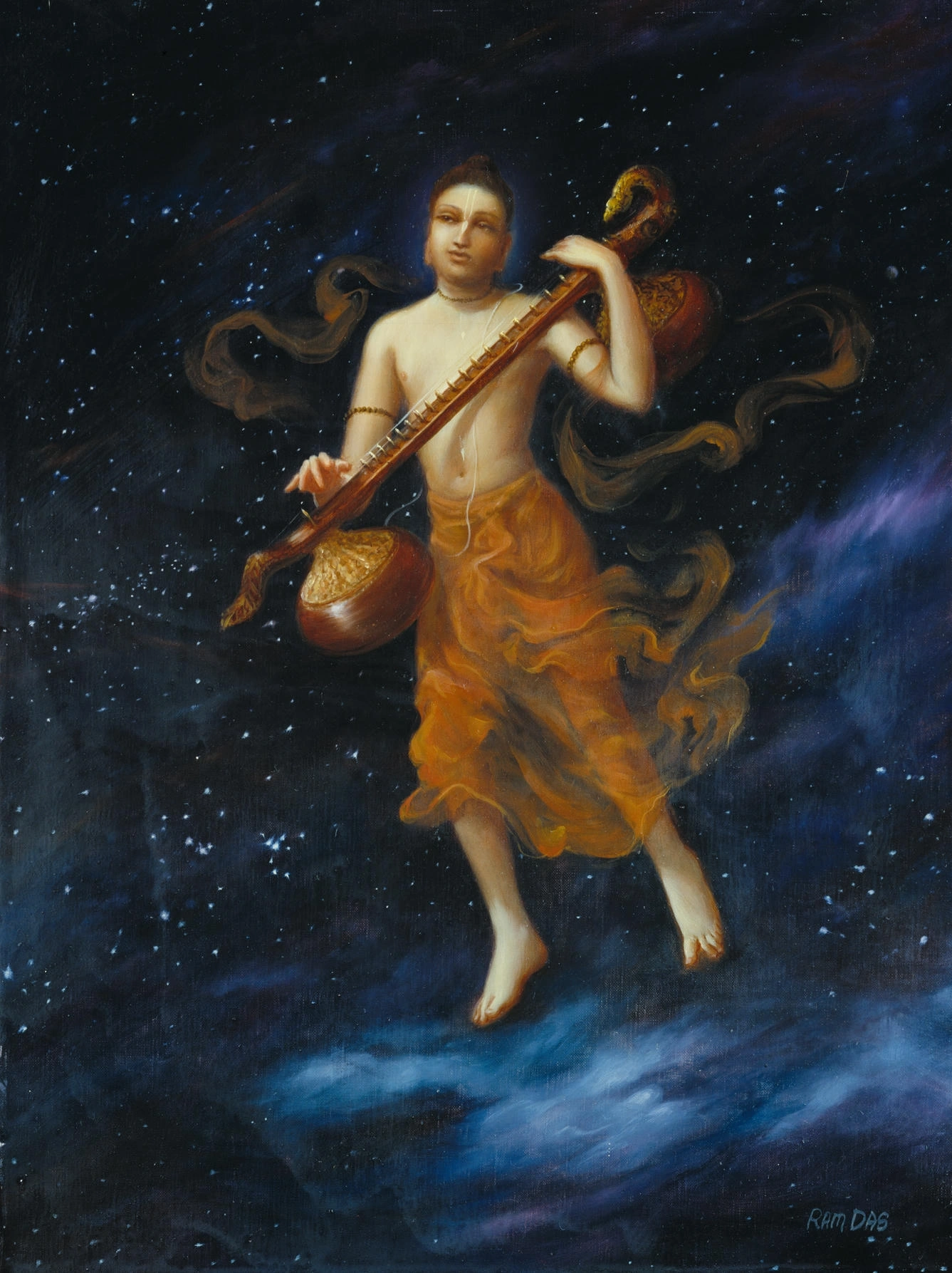
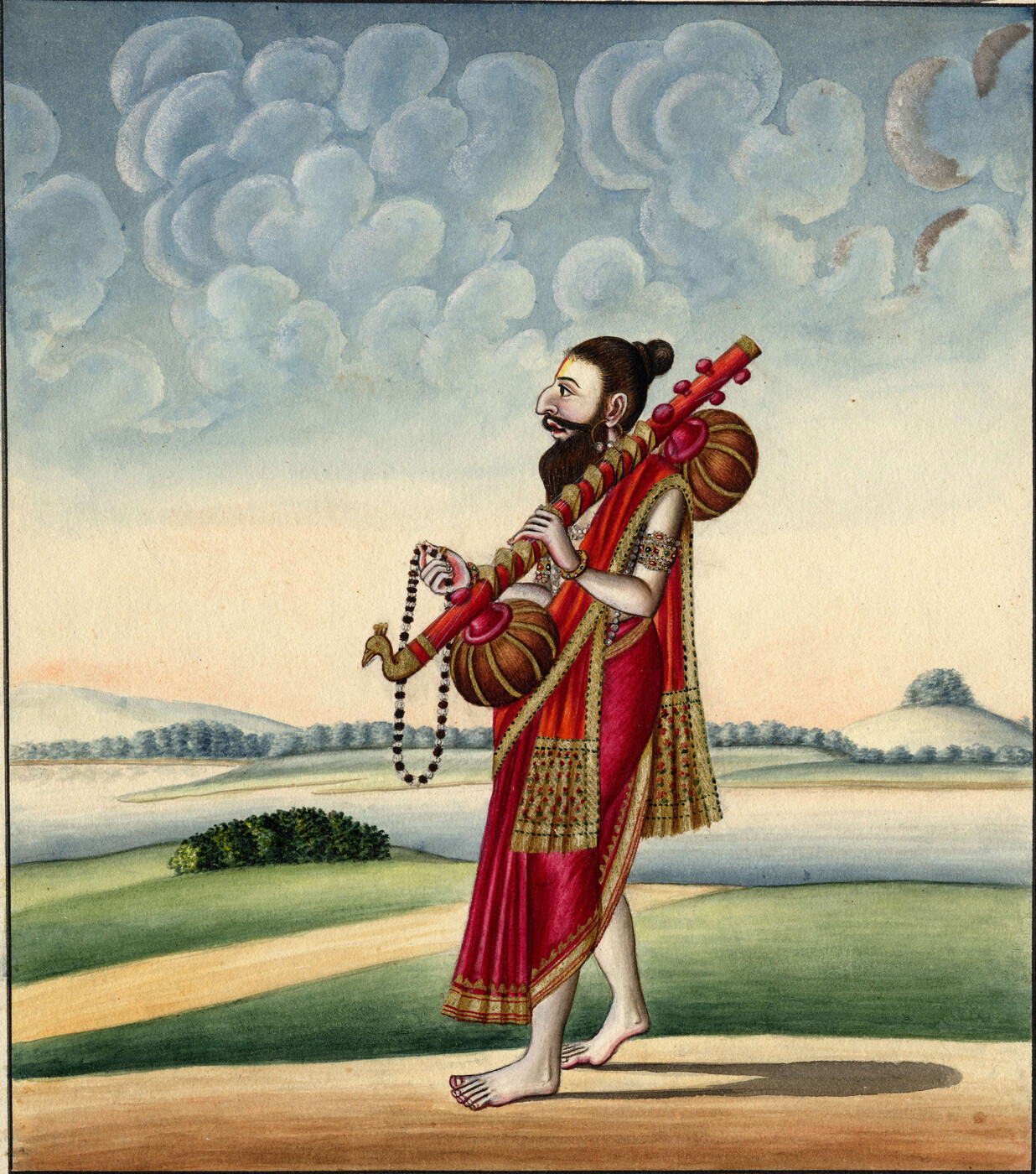
Narada Muni is one of the most widely travelled figures in the whole of Vedic literature. He is a celestial sage who moves freely through both the material universe and the spiritual sky, carrying nothing but a vina and the chanting of Krishna's names wherever he goes. Gaudiya Vaishnavas honour him as the second acharya of the Brahma-sampradaya, the disciplic line that descends from Lord Brahma through Narada to Vyasadeva and, many generations later, to Srila Prabhupada and this movement's own gurus. He is remembered above all for one act: persuading Vyasadeva, already the compiler of the Vedas and the author of the Mahabharata, to write Srimad-Bhagavatam. Srimad-Bhagavatam is the ripened fruit of all Vedic knowledge, exactly as the scripture calls itself in its own opening verses: "relish Srimad-Bhagavatam, the mature fruit of the desire tree of Vedic literatures" (Srimad-Bhagavatam 1.1.3).
| Detail | Description |
|---|---|
| Position | Second acharya of the Brahma-sampradaya; a mind-born son of Lord Brahma |
| Guru | Lord Brahma, in his present birth; unnamed wandering Vaishnava sannyasis, in a previous life |
| Instrument | A vina traditionally said, in the Linga Purana, to have been given to him by Lord Krishna |
| Best-known act | Instructing Vyasadeva to write Srimad-Bhagavatam (Srimad-Bhagavatam 1.5) |
| Famous disciples | Dhruva Maharaja, Prahlada Maharaja, Vyasadeva, and Valmiki, among many others |
| Attributed work | The Narada-bhakti-sutra |
| Principal sources | Srimad-Bhagavatam, Sri Chaitanya-charitamrita, and the purports and recorded talks of Srila Prabhupada |
Two Lives, One Unbroken Devotion #
Narada tells his own origin story to Vyasadeva late in the First Canto of Srimad-Bhagavatam, and it does not begin with Brahma at all. In an earlier age he was born the son of a poor maidservant, a boy who came to devotion only by serving wandering sages for four months of one rainy season. That story is told in full here. That single season of service carried him into his present birth as one of Brahma's mind-born sons, across an entire dissolution and re-creation of the universe. It came complete with the vina Krishna himself is said to have given him. The story of that birth, and of the vina, continues here.
A Devotee Empowered to Travel Anywhere #
Narada's devotion earned him a specific power that makes him genuinely unusual, even among great sages: unrestricted movement through every corner of the material universe and the spiritual sky alike, unbound by the modes of nature that limit every other embodied soul. Srila Prabhupada's purports describe him as the prime authority on bhakti itself: where sages like Marichi are authorities on ritual and Sanaka and Sanatana on philosophy, Narada alone specialises in generating devotion in others, wherever he travels and whoever he meets. Sri Chaitanya-charitamrita records the same idea in Chaitanya Mahaprabhu's own words: among the Lord's principal empowered incarnations, the Lord invested the specific power of devotional service, bhakti-shakti, in Narada, exactly as He invested the power of creation in Brahma.
Why Narada Never Settles Anywhere #
Srimad-Bhagavatam even explains, in specific narrative terms, why Narada is always shown travelling rather than settled in one place. Early in the present creation he twice persuaded the sons of Prajapati Daksha to renounce family life rather than father children as ordered, first ten thousand sons and then a thousand more. An infuriated Daksha finally cursed him, so that he would be unable to reside anywhere. Narada accepted the curse without protest. Vaishnava teachers have long pointed out that what Daksha meant as a punishment was actually a perfect blessing, for a devotee whose whole purpose was preaching. The full story is told here.
The Guru Who Shaped a Universe of Devotees #
That same wandering brought Narada into the lives of some of Vedic literature's most celebrated devotees. A five-year-old prince named Dhruva Maharaja was humiliated by his stepmother and resolved to outdo his own father. Narada first tried to dissuade him, but on seeing his resolve, gave him the exact mantra and meditation that made his austerities possible. The full story is told here. Long before that boy Prahlada Maharaja was even born, Narada rescued his mother Kayadhu from Indra's forces. He then used the months of her captivity to instruct the child in her womb directly. Prahlada himself later recounted this episode to Maharaja Yudhishthira's own court, told in full here. And when a forest robber named Ratnakara tried to rob Narada on the road, the sage's one question to him began a transformation that ended with the writing of the Ramayana. That story is here.
Instructing Vyasadeva to Write Srimad-Bhagavatam #
For this tradition specifically, none of Narada's episodes matters more than his conversation with Vyasadeva. Vyasadeva had already compiled the Vedas and written the Mahabharata, yet sat by the Sarasvati River profoundly dissatisfied. Narada, his own guru, diagnosed exactly what was missing: a literature that describes the Supreme Personality of Godhead directly, rather than religious duty or philosophy alone. Vyasadeva took the instruction to heart and composed Srimad-Bhagavatam as a direct result. The full conversation is told here. Without it, this tradition would not have the scripture it treats as its foundation.
His Own Words on Bhakti #
A short Sanskrit work called the Narada-bhakti-sutra is traditionally credited to Narada himself, defining what devotional service actually is and how a sincere soul can recognise genuine progress in it. Srila Prabhupada quoted from it, began an English translation of it early in his own writing career, and then set that project aside, an honestly incomplete chapter in an otherwise vast body of finished books. The full story is told here.
A Sage Who Never Stops Travelling #
Narada Muni is not a figure of the past. He is travelling still, exactly as Srimad-Bhagavatam describes, generating devotion in whoever he meets. Asked once how the chanting of Krishna's names first reached the earth, Srila Prabhupada answered that the question could not really be dated, since Narada has been present since the time of creation, and over that time has become skilled beyond counting at making devotees. Srila Prabhupada's own biographers noticed the same pattern in Prabhupada himself, comparing his tireless preaching around the world directly to Narada's. That ongoing legacy is explored here.
Scriptural evidence
निगमकल्पतरोर्गलितं फलं
शुकमुखादमृतद्रवसंयुतम् ।
पिबत भागवतं रसमालयं
मुहुरहो रसिका भुवि भावुका: ॥ ३ ॥
nigama-kalpa-taror galitaṁ phalaṁ
śuka-mukhād amṛta-drava-saṁyutam
pibata bhāgavataṁ rasam ālayam
muhur aho rasikā bhuvi bhāvukāḥ
Word for word
nigama — the Vedic literatures; kalpa-taroḥ — the desire tree; galitam — fully matured; phalam — fruit; śuka — Śrīla Śukadeva Gosvāmī, the original speaker of Śrīmad-Bhāgavatam; mukhāt — from the lips of; amṛta — nectar; drava — semisolid and soft and therefore easily swallowable; saṁyutam — perfect in all respects; pibata — do relish it; bhāgavatam — the book dealing in the science of the eternal relation with the Lord; rasam — juice (that which is relishable); ālayam — until liberation, or even in a liberated condition; muhuḥ — always; aho — O; rasikāḥ — those who are full in the knowledge of mellows; bhuvi — on the earth; bhāvukāḥ — expert and thoughtful.
O expert and thoughtful men, relish Srimad-Bhagavatam, the mature fruit of the desire tree of Vedic literatures. It emanated from the lips of Sri Sukadeva Gosvami. Therefore this fruit has become even more tasteful, although its nectarean juice was already relishable for all, including liberated souls.
From the purport: "In the two previous slokas it has been definitely proved that the Srimad-Bhagavatam is the sublime literature which surpasses all other Vedic literatures."
Narada is the one who told Vyasadeva to write this scripture. The Bhagavatam's own opening chapter calls the resulting book the ripened fruit of the entire Vedic tree, which is why this site's biography of Narada opens by naming that act as his single most important contribution to the disciplic line.
What Srila Prabhupada said
Narada, he's also shaktyavesha avatara. He was, in his previous life, he was a maidservant's son, but by the association of devotees, he rose up to this position, Narada. Narada's position is very exalted as devotee. All of the devotees... in this material world, more or less, they are all disciples of Narada. Vyasadeva is also a disciple of Narada.
Sri Chaitanya-charitamrita, Madhya-lila 20.367-384 — Lecture
Date and location are not recorded on this transcript; it continues the same 1966 New York lecture series on Chaitanya-charitamrita, Madhya-lila 20 as the dated lecture cited on the Valmiki page.
Disciples
Frequently asked
When was Narada Muni born?
Narada Muni appeared Timeless: reckoned among the mind-born sons of Lord Brahma at the dawn of the present universe in Brahmaloka, in his present birth (his previous life as a maidservant's son is not dated in the texts).
Who was the guru of Narada Muni?
The spiritual master of Narada Muni was Lord Brahma.
When and where did Narada Muni disappear?
Narada Muni disappeared None recorded: a liberated soul who has not undergone death since his present birth, and whom Vaishnava tradition holds to be still travelling today.
What are the main pastimes of Narada Muni?
The pastimes covered here include: The Previous Life of a Maidservant's Son, Birth as Brahma's Son and His Vina, Cursed by Daksha to Wander Forever, Delivering Dhruva Maharaja, Instructing Prahlada in the Womb, Transforming the Hunter Into Valmiki, Instructing Vyasadeva to Write Srimad-Bhagavatam, The Narada-bhakti-sutra, Legacy as the Travelling Teacher of Bhakti.