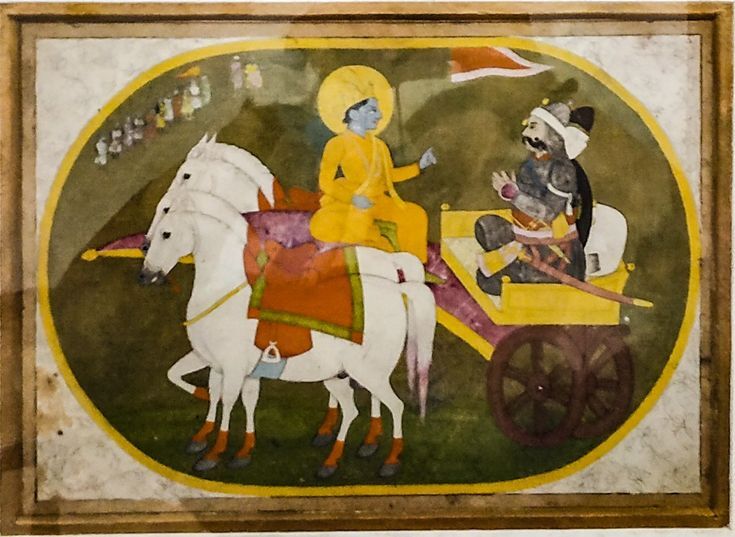
Elsewhere the case for a given figure often rests on quoting what someone else says about him. This section is different in kind, because the Bhagavad-gita is not a third party's report about Krishna. It is eighteen chapters of Krishna speaking about Himself, in His own voice, to a friend who has just watched Him drive a chariot onto a battlefield. Gaudiya Vaishnava tradition treats this as decisive because it removes the question of interpretation at its source. Whatever anyone else concludes about Krishna's position, the Gita records what Krishna Himself claimed it to be.
"There Is No Truth Superior to Me" #
In the Seventh Chapter, still early in His instruction to Arjuna, Krishna states without hedging: "O conqueror of wealth, there is no truth superior to Me. Everything rests upon Me, as pearls are strung on a thread" (Bhagavad-gita 7.7). Srila Prabhupada's purport to this verse argues directly against an alternative reading many philosophers propose: that the Absolute Truth is ultimately impersonal, and any personal form merely a provisional concession to human limitation. The purport cites Brahma-samhita's own formula in the same breath and insists "these authorities leave no doubt that the Absolute Truth is the Supreme Person, the cause of all causes." This is the identical claim examined from Brahma's side on Brahma-samhita's Testimony.
| Detail | Description |
|---|---|
| BG 7.7 | "There is no truth superior to Me": no rival Absolute above Krishna |
| BG 10.8 | "I am the source of all spiritual and material worlds": Krishna as origin of both realms |
| BG 15.18-19 | Krishna names Himself Purushottama, beyond both the perishable and the imperishable |
| BG 18.66 | The Gita's own culminating instruction: surrender directly to Krishna Himself |
| Common thread | Each statement is made by Krishna about Himself, not inferred from His actions |
"I Am the Source of All" #
The Tenth Chapter, traditionally titled Vibhuti-yoga, "The Opulence of the Absolute," contains Krishna's fullest self-description of His own position as origin. "I am the source of all spiritual and material worlds," He tells Arjuna. "Everything emanates from Me. The wise who perfectly know this engage in My devotional service and worship Me with all their hearts" (Bhagavad-gita 10.8). Srila Prabhupada's purport widens the claim beyond the immediate audience: "All Vedic literature agrees that Krishna is the source of Brahma, Shiva and all other demigods." The purport then reaches directly into the Upanishads for confirmation, quoting the Atharva-veda directly: "It was Krishna who in the beginning instructed Brahma in Vedic knowledge and who disseminated Vedic knowledge in the past." That single line ties this verse to two other threads in this account. One is the claim that Krishna, not any lesser figure, taught Lord Brahma at the dawn of creation, examined in full on The Source of This Parampara. The other is the wider Vedic testimony gathered on Vedic and Upanishadic Testimony.
Purushottama, Beyond Both the Perishable and the Imperishable #
Late in the Gita, in the Fifteenth Chapter's short but philosophically dense passage on the Purushottama-yoga, Krishna makes a still more precise claim about His own category. Vedantic philosophy generally recognizes two broad categories of existence: kshara, the perishable material world, and akshara, the imperishable individual souls. Krishna places Himself in neither category, and above both: "Because I am transcendental, beyond both the fallible and the infallible, and because I am the greatest, I am celebrated both in the world and in the Vedas as that Supreme Person" (Bhagavad-gita 15.18). The next verse states directly what is at stake in accepting or missing this claim: "Whoever knows Me as the Supreme Personality of Godhead, without doubting, is the knower of everything. He therefore engages himself in full devotional service to Me" (15.19). Srila Prabhupada's purport shows how central this single distinction is to the entire text: "Throughout the whole of Bhagavad-gita, this fact is being stressed at every step," against what he calls "so many stubborn commentators" who read the Supreme and the individual soul as ultimately identical.
The Gita's Own Conclusion #
Krishna does not leave His position as an implication to be worked out by careful reading. Near the very end of the text, having explained knowledge of Brahman, the Supersoul, the different social orders, renunciation and a dozen other paths, He states the entire teaching's bottom line in a single verse: "Abandon all varieties of religion and just surrender unto Me. I shall deliver you from all sinful reactions. Do not fear" (Bhagavad-gita 18.66). The instruction is addressed to Krishna Himself, in the first person. Nothing in it points to any higher principle beyond Him, to whom that surrender should ultimately be redirected. Gaudiya Vaishnava tradition reads this as the Gita's own final word on the question of Krishna's supreme identity. Whatever else the text has taught, about the nature of the soul, the material world, and the paths of knowledge and action, its author places Himself, without ambiguity, as the object toward which all of it ultimately points.
Why This Matters as Independent Evidence #
A skeptical reader might reasonably ask why Krishna's own claims about Himself should carry evidentiary weight rather than simply being taken as a devotional writer's rhetorical choice. Gaudiya Vaishnava tradition's answer is that the Gita's claims do not stand alone. They are corroborated independently by Srimad-Bhagavatam's direct verdict, by the Vedic and Upanishadic record, and by the systematic philosophical case Jiva Goswami later built from these same sources in his Krishna-sandarbha. The Bhagavad-gita supplies something none of those later sources can, because none of them are Krishna speaking in the first person: the claim in its most direct possible form. It is not what scripture says about Krishna, but what Krishna says about Himself.