Every proof-thread examined so far has been a citation: a verse from Brahma-samhita, from the Gita, from the Bhagavatam, from an Upanishad. Sri Chaitanya Mahaprabhu gave Rupa and Sanatana Goswami a twin mission at Prayag and Varanasi: recovering the lost places of Krishna's Vrindavana pastimes, and writing the theological literature that would give the movement its philosophical foundation. That second half of the mission produced, within a single generation, a body of formal philosophy built almost entirely from citation rather than assertion. That is precisely the method followed here.
Jiva Goswami's Sat-sandarbha #
Srila Jiva Goswami, nephew of Rupa and Sanatana and youngest of the Six Goswamis, inherited a tradition that already had its devotional practice, its recovered holy places and its first compiled scriptures. What it still lacked was a work able to stand up, argument for argument, against trained Vedantists, Naiyayikas and rival Vaishnava schools. His answer was the Sat-sandarbha, six treatises composed in sequence and later gathered as the Bhagavata-sandarbha: Tattva-sandarbha, establishing which scriptures count as reliable evidence at all; Bhagavat-sandarbha and Paramatma-sandarbha, mapping the nature of Godhead and His presence as Supersoul; Krishna-sandarbha, the fourth and pivotal volume; and Bhakti-sandarbha and Priti-sandarbha, moving from doctrine into practice and its ultimate goal.
| Detail | Description |
|---|---|
| Full work | Sat-sandarbha (Bhagavata-sandarbha), six parts, by Srila Jiva Goswami |
| Fourth part | Krishna-sandarbha: argues Krishna's supremacy over Narayana from Bhagavatam's own verses |
| Method | Argument built almost entirely from scriptural citation, not independent speculation |
| Grounding verse | Srimad-Bhagavatam 1.2.11: Brahman, Paramatma and Bhagavan as three realizations of one truth |
| Complementary work | Sri Rupa Goswami's Bhakti-rasamrita-sindhu, on why madhurya-rasa is devotion's fullest expression |
What Krishna-sandarbha Actually Argues #
The fourth Sandarbha is devoted to a single, precisely stated claim: that Krishna, not any other form of Godhead, is svayam bhagavan, the original Personality from whom Vishnu, Narayana and every other divine expansion and incarnation proceed. Jiva Goswami does not simply assert this. He assembles Bhagavatam's own verses in support, including Srimad-Bhagavatam 1.3.28 and Brahma's own confession at SB 10.14.14. He works through the eternal nature of Vrindavana and Goloka, backs up earlier commentators including Sridhara Svami, and answers, point by point, the objections a rival Vedantist committed to Narayana's supremacy might raise. Krishnadasa Kaviraja Goswami summarized the achievement directly in Sri Chaitanya-charitamrita: "In Sri Bhagavata-sandarbha, Srila Jiva Gosvami has written conclusively about the ultimate end of devotional service." This fourth volume specifically aims that conclusiveness at establishing Krishna's own position.
One grounding verse Jiva Goswami's earlier Sandarbhas rely on deserves quoting directly, because it supplies the very framework the whole argument depends on. Srimad-Bhagavatam states: "Learned transcendentalists who know the Absolute Truth call this nondual substance Brahman, Paramatma or Bhagavan" (Srimad-Bhagavatam 1.2.11). Srila Prabhupada's purport explains what this means for the case Jiva Goswami goes on to build: these are not three different truths but three depths of realization of the same one, with Bhagavan as "the last word of the Absolute Truth," Paramatma "the partial representation," and impersonal Brahman "the glowing effulgence... as the sun rays are to the sun-god." Establishing that Bhagavan is the fullest of the three features, rather than a lower or more limited one, is the necessary first step before any argument for Krishna's specific identity as Bhagavan can even begin. This is exactly why Jiva Goswami's earlier Sandarbhas lay this groundwork before Krishna-sandarbha makes its central claim.
Rupa Goswami and the Question of Why #
Systematic argument answers who Krishna is. It does not, on its own, explain why this tradition worships Vrindavana's intimate, playful Krishna, rather than the four-armed, opulent Narayana of Vaikuntha, as the fullest revelation of that same Godhead. That question belongs to Srila Rupa Goswami. His Bhakti-rasamrita-sindhu supplies Gaudiya Vaishnavism's entire vocabulary for devotional rasa, the different flavors or relationships through which a soul can love God. These are ranked from shanta (neutrality) and dasya (servitorship) through sakhya (friendship) and vatsalya (parental love) to madhurya, conjugal love. This tradition holds madhurya to be the fullest, most complete expression of loving exchange, because it contains within it every quality of the relationships that precede it. Rupa Goswami's own opening definition of the goal itself is stated in a single, tightly constructed verse: unalloyed devotional service must be free from all material desire, unobstructed by fruitive activity or philosophical speculation, and cultivated favorably, for Krishna's own sake (Bhakti-rasamrita-sindhu 1.1.11, quoted in Srila Prabhupada's purport to Bhagavad-gita 11.55).
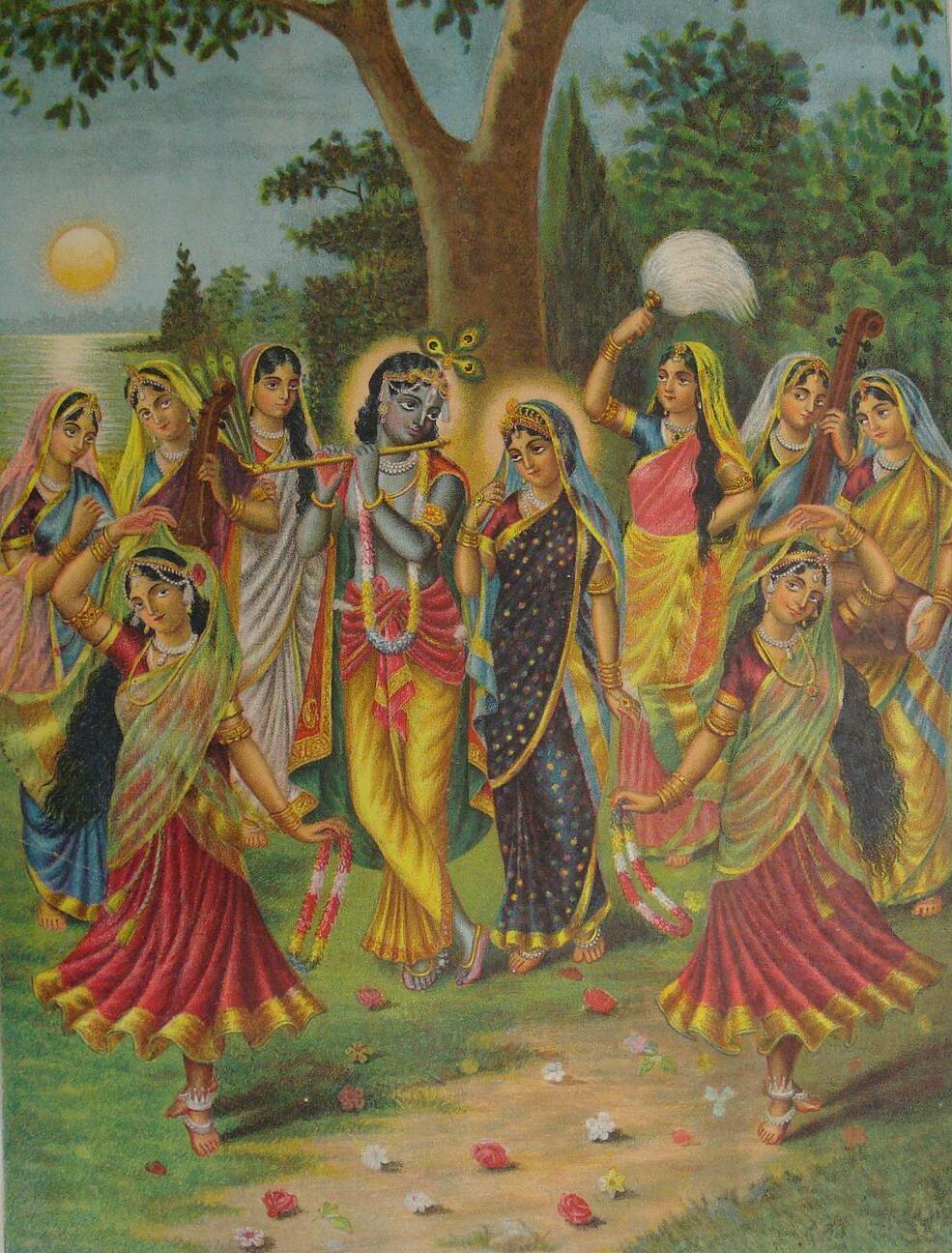
The reasoning behind ranking madhurya highest is not, in this tradition's own account, an argument that majesty (aishvarya) is false or unworthy of worship. Vaikuntha and Narayana's own opulence is fully real, examined on The Vishnu-tattva Expansions. The real reason is different: awe and reverence, however genuine, place a natural distance between worshiper and worshiped that intimacy does not. Vrindavana's cowherds, calves and gopis do not know they are addressing the origin of the universe. They know only a beloved companion, son or lover. Rupa Goswami's science of rasa holds that it is precisely this forgetfulness of majesty that allows the fullest, least self-conscious exchange of love the Supreme Person can receive.
Two Methods, One Conclusion #
What makes this thread distinct from every other proof-thread examined here is method rather than conclusion. Jiva Goswami reaches Krishna's supremacy through formal philosophical argument, verse by verse, addressed to a trained opponent. Rupa Goswami reaches the same destination through the science of devotional aesthetics, addressed to a practitioner's own heart. Gaudiya Vaishnavism has never treated these as competing approaches. Together they explain both what this tradition claims about Krishna and why it worships Him in the specific and unusual form of Vrindavana's cowherd boy. This tradition holds that the most complete recent embodiment of that worship was Sri Chaitanya Mahaprabhu Himself.