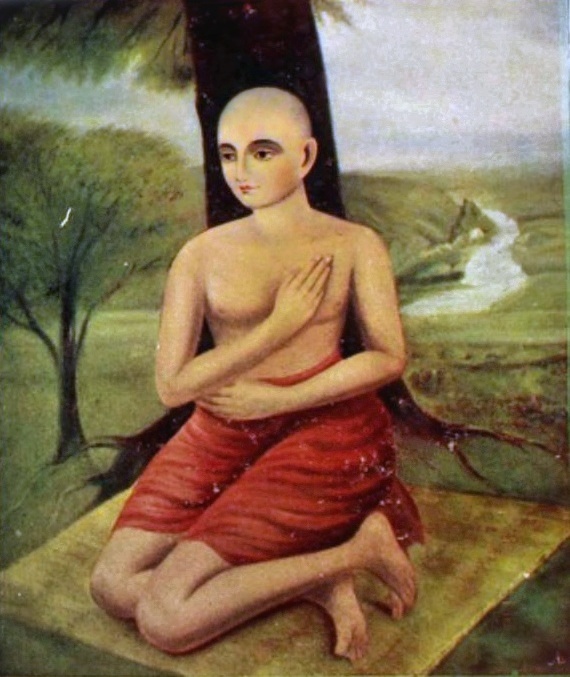
Sri Chaitanya Mahaprabhu is, by any historical account, the founder of Gaudiya Vaishnavism. He is the figure who transformed congregational chanting into the mass movement this tradition continues. But history is not the whole of how this tradition understands Him. This account would be incomplete without stating plainly what Gaudiya Vaishnavas actually believe about who He was: not a great devotee of Krishna, not a saint especially favored by Krishna, but Krishna Himself, appearing a second time, in a specific and deliberate form.
The Opening Prayer of Chaitanya-charitamrita #
Krishnadasa Kaviraja Goswami states this claim in the very first substantive verses of his biography of Mahaprabhu. Both verses were checked directly against the primary source rather than relying on any secondhand quotation. The fourth verse of Adi-lila's opening reads, in translation: "May the Supreme Lord who is known as the son of Srimati Sachi-devi be transcendentally situated in the innermost chambers of your heart. Resplendent with the radiance of molten gold, He has appeared in the Age of Kali by His causeless mercy to bestow what no incarnation has ever offered before: the most sublime and radiant mellow of devotional service, the mellow of conjugal love" (Sri Chaitanya-charitamrita, Adi-lila 1.4). The very next verse names the specific theological mechanism: "The loving affairs of Sri Radha and Krishna are transcendental manifestations of the Lord's internal pleasure-giving potency. Although Radha and Krishna are one in Their identity, previously They separated Themselves. Now these two transcendental identities have again united, in the form of Sri Krishna Chaitanya. I bow down to Him, who has manifested Himself with the sentiment and complexion of Srimati Radharani although He is Krishna Himself" (Chaitanya-charitamrita, Adi-lila 1.5).
| Detail | Description |
|---|---|
| CC Adi 1.4-5 | Krishnadasa Kaviraja's own opening invocation, identifying Mahaprabhu as Krishna in Radha's mood |
| Prophesied in | Srimad-Bhagavatam 11.5.32: the *krishna-varnam* verse |
| Reason given | To taste, and freely distribute, the sweetness of pure love of God (krishna-prema) |
| Organizing framework | The Panca-tattva: five features of the one appearance |
| Corresponding category | Panca-tattva |
A Verse Prophesying His Own Appearance #
The claim does not rest on Chaitanya-charitamrita alone. Srimad-Bhagavatam itself, composed many centuries before Mahaprabhu's appearance, contains what Gaudiya Vaishnavas read as a direct prophecy of exactly this event: "In the Age of Kali, intelligent persons perform congregational chanting to worship the incarnation of Godhead who constantly sings the names of Krishna. Although His complexion is not blackish, He is Krishna Himself. He is accompanied by His associates, servants, weapons and confidential companions" (Srimad-Bhagavatam 11.5.32). Every element of that verse maps onto Mahaprabhu's own recorded life: a golden, non-blackish complexion where Krishna's own is famously dark, worship through sankirtana, congregational chanting, rather than temple ritual, and constant companions rather than a solitary appearance. Srila Prabhupada quoted this exact verse as early as December 1966, in one of his first recorded lectures in New York. He explained that "great sages, great philosophers" had confirmed Mahaprabhu's identity from precisely these symptoms, since Chaitanya Himself "never said that 'I am avatara.'"
Why This Particular Appearance #
Gaudiya theology gives a specific reason why Krishna would appear a second time, in this particular altered form, rather than simply returning as Himself. As the object of Radharani's love, Krishna experiences being loved. But even in that original form, He cannot experience what it is to love Krishna the way Radharani does: the full intensity of Her devotion is simply not available to Him as its recipient. Chaitanya-charitamrita's own account, examined above, says that Krishna appeared "in the mood and complexion of" Radharani specifically to taste that experience directly. In the same movement, He came to distribute freely, to every soul in the Age of Kali, a mellow of devotion, madhurya-rasa, that even His own Vrindavana appearance had not offered so openly. Rupa Goswami's science of rasa, examined on The Six Goswamis and Krishna-sandarbha, supplies the technical vocabulary for exactly what that mellow is and why it ranks as devotion's fullest expression. In this account, Mahaprabhu's own appearance is the living demonstration of the doctrine Rupa Goswami later put into systematic form.
The Panca-tattva #
Krishna does not appear alone in this understanding. Chaitanya-charitamrita states directly that "these five tattvas incarnate with Lord Chaitanya Mahaprabhu, and thus the Lord executes His sankirtana movement with great pleasure" (Chaitanya-charitamrita, Adi-lila 7.4). This is the Panca-tattva, five simultaneous features of the one appearance. Later verses clarify their relationship precisely: "Spiritually there are no differences between these five tattvas, for on the transcendental platform everything is absolute. Yet there are also varieties in the spiritual world, and in order to taste these spiritual varieties one should distinguish between them" (Chaitanya-charitamrita, Adi-lila 7.5). This is the exact doctrinal basis for the category structure used to organize the biographical pages here, Panca-tattva. It works by the identical logic examined on The Vishnu-tattva Expansions: full identity of essence, genuine distinction of feature, neither collapsing into the other.
Not a Separate Claim, But the Same One #
It would be easy to read this account as introducing an entirely new theological subject alongside the rest of the case made elsewhere for Krishna's supremacy. It is not. Every proof-thread gathered elsewhere describes the same single person this tradition holds appeared again in Nabadwip: Brahma-samhita naming Krishna the cause of all causes, Krishna's own words in the Gita, Srimad-Bhagavatam's direct statement, the Vedic record, the Six Goswamis' systematic case, the vishnu-tattva doctrine explaining Krishna's expansions. Sri Chaitanya Mahaprabhu's own page tells the historical story of that appearance in full. What belongs here is only the claim itself, and the specific verses on which Gaudiya Vaishnavism has always said that claim rests.