Elsewhere, Srimad-Bhagavatam serves as a source, a scripture opened and its verses drawn out one by one as evidence for Krishna's supremacy. Here the Bhagavatam itself is the subject. Gaudiya Vaishnava tradition does not regard it merely as an unusually authoritative book about Krishna, more reliable than other scriptures but still, in the end, only a book. It holds Srimad-Bhagavatam to be Krishna's own incarnation, not appearing in a body of flesh, as at Vrindavana or Kurukshetra, but in the form of transcendental sound. This is not devotional exaggeration or a poetic figure of speech. It is stated as literal doctrine, in the Bhagavatam's own words, and what follows exists to show exactly where.
The Same Chapter, Twelve Verses Later #
The Bhagavatam's Direct Statement already examines the Third Chapter of the First Canto in detail: a list of incarnation after incarnation, building toward Srimad-Bhagavatam 1.3.28's verdict that Krishna alone is bhagavan svayam, the original Personality of Godhead, while every other incarnation named is a portion or a portion of a portion. That chapter does not end there. Twelve verses later, having finished cataloguing the incarnations, it turns to describe the very book that has just been narrating all of this. It states directly what that book itself is: "This Srimad-Bhagavatam is the literary incarnation of God, and it is compiled by Srila Vyasadeva, the incarnation of God. It is meant for the ultimate good of all people, and it is all-successful, all-blissful and all-perfect" (Srimad-Bhagavatam 1.3.40).
| Detail | Description |
|---|---|
| Reference | Srimad-Bhagavatam 1.3.40 |
| Central claim | Srimad-Bhagavatam is Krishna's own literary incarnation, compiled by Vyasadeva, himself an incarnation |
| Confirming verse | SB 1.3.43: the Bhagavatam arose "just after the departure of Lord Krishna to His own abode" |
| Doctrine | Shabda-avatara: the Supreme Lord's incarnation in the form of transcendental sound |
| Practical implication | Hearing and studying the Bhagavatam from a bona fide source is treated as direct association with Krishna |
Srila Prabhupada's own purport to this verse states the implication without qualification: "Srimad-Bhagavatam is the literary incarnation of Lord Sri Krishna and is therefore nondifferent from Him... Srimad-Bhagavatam should be worshiped as respectfully as we worship the Lord." An incarnation, in this tradition's understanding, is not a symbol of Krishna or a representation that stands in for Him in His absence. It is Krishna Himself, appearing in a different form for a particular purpose. Here the form is a book. The purpose is the one the verse itself names: the ultimate good of all people in an age when Krishna's own personal, bodily presence in Vrindavana and Dvaraka has ended.
The Bhagavatam's Own Limbs #
A separate verse, quoted from the Padma Purana, makes the same claim in an even more vivid, physical way. Rather than saying the Bhagavatam merely represents Krishna, it maps the twelve cantos directly onto Krishna's own transcendental body, limb by limb:
pādau yadīyau prathama-dvitīyau
tṛtīya-turyau kathitau yad-ūrū
nābhis tathā pañcama eva ṣaṣṭho
bhujāntaraṁ dor-yugalaṁ tathānyau
kaṇṭhas tu rājan navamo yadīyo
mukhāravindaṁ daśamaṁ praphullam
ekādaśo yasya lalāṭa-paṭṭaṁ
śiro 'pi tu dvādaśa eva bhāti
"The First and Second Cantos of the Bhagavatam are Sri Krishna's lotus feet. The Third and Fourth Cantos are His thighs. The Fifth Canto is His navel. The Sixth Canto is His chest. The Seventh and Eighth Cantos are His arms. The Ninth Canto is His throat. The Tenth Canto is His beautiful lotus face. The Eleventh Canto is His forehead. The Twelfth Canto is His head."
The same passage closes with a direct prayer to the book itself, addressed as a person:
tam ādi-devaṁ karuṇā-nidhānaṁ
tamāla-varṇaṁ suhitāvatāram
apāra-saṁsāra-samudra-setuṁ
bhajāmahe bhāgavata-svarūpam
"I bow down to that original Lord, the ocean of mercy, whose color is like that of a tamala tree, who appears in this world for the welfare of all. I worship Him as the bridge for crossing the unfathomable ocean of material existence. The Bhagavatam has appeared as His very Self."
This is not decoration. If Srimad-Bhagavatam is Krishna's own literary incarnation, as SB 1.3.40 states directly, this verse simply carries that claim to its natural conclusion. The book has a body, and that body is Krishna's own.
Two Verses That Confirm the Claim #
The chapter's very next verses make the timing of this incarnation explicit. "This Bhagavata Purana is as brilliant as the sun, and it has arisen just after the departure of Lord Krishna to His own abode, accompanied by religion, knowledge, etc. Persons who have lost their vision due to the dense darkness of ignorance in the Age of Kali shall get light from this Purana" (Srimad-Bhagavatam 1.3.43). Srila Prabhupada's purport draws the conclusion as directly as the verse itself: "We must therefore accept Srimad-Bhagavatam as the direct representation of Lord Krishna. One who can see Srimad-Bhagavatam can see also Lord Sri Krishna in person. They are identical." The sequence matters. Krishna returns to His own abode, and in that same movement, the Bhagavatam "arises." It is not a memorial of someone now absent; it is His own continuing presence in a different form.
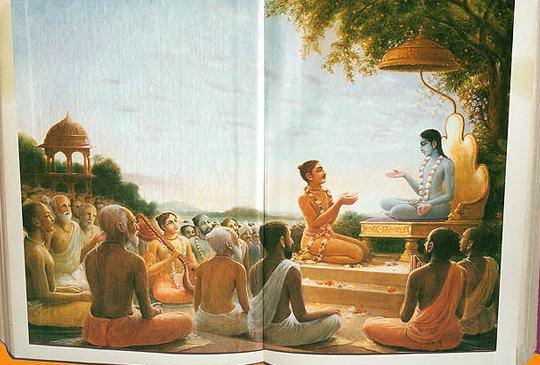
A separate verse, from the opening chapter of the First Canto, describes what kind of presence this is meant to be. Srimad-Bhagavatam is called "the mature fruit of the desire tree of Vedic literatures," made sweeter still for having "emanated from the lips of Sri Sukadeva Gosvami" (Srimad-Bhagavatam 1.1.3). This is not a fruit that fell to the ground on its own. It was carried down carefully through an unbroken chain of speakers, from Narada to Vyasadeva to Sukadeva Gosvami to Maharaja Parikshit, and from Parikshit's own assembly down to every disciplic succession since. The image the verse itself supplies is worth taking seriously: what is tasted is not information extracted from a text, but a fruit received, still intact, from a particular mouth.
Hearing as Direct Contact #
If the Bhagavatam is Krishna's own literary incarnation, then hearing it is not a preparatory exercise undertaken before some more direct encounter with Krishna becomes possible. It already is that encounter. Srimad-Bhagavatam states this of Krishna's own narrations generally: "Sri Krishna, the Personality of Godhead, who is the Paramatma [Supersoul] in everyone's heart and the benefactor of the truthful devotee, cleanses desire for material enjoyment from the heart of the devotee who has developed the urge to hear His messages" (Srimad-Bhagavatam 1.2.17). Srila Prabhupada's purport states the mechanism plainly: "Messages of the Personality of Godhead, Sri Krishna, are nondifferent from Him. Whenever, therefore, offenseless hearing and glorification of God are undertaken, it is to be understood that Lord Krishna is present there in the form of transcendental sound, which is as powerful as the Lord personally." The same purport reaches immediately for Sri Chaitanya Mahaprabhu's Siksastaka to make the identical point about Krishna's holy names specifically. It is the same doctrine, shabda as avatara, applied to two different forms of sound, examined in full on The Holy Name: Krishna's Incarnation for This Age.
What This Means in Practice #
This is why Gaudiya Vaishnava temples, this tradition included, treat Bhagavatam class with a formality closer to Deity worship than to ordinary study. The book is not opened casually. It is handled with respect and heard from, not merely read silently. Srila Prabhupada's purport to SB 1.3.40 records the standard this tradition sets for how that hearing should happen, quoting Sri Chaitanya Mahaprabhu's own private secretary: "Srila Svarupa Damodara Gosvami advised all intending visitors who came to see the Lord at Puri to make a study of the Bhagavatam from the person Bhagavatam," meaning a living, self-realized representative of the disciplic succession, not a printed page alone. This is the same principle already familiar from Vyasadeva's own page: scripture in this tradition is never received apart from the chain of speakers who carry it, because the chain itself is part of what makes the encounter genuine rather than merely informational. That is the identical chain traced back to its actual root on The Source of This Parampara.
Sri Chaitanya Mahaprabhu Himself, examined at length on Krishna Himself, is recorded as having declared exactly this status for the text: that Srimad-Bhagavatam is "the spotless sound representation of all Vedic knowledge and history." What belongs here is the specific scriptural ground for the claim. Mahaprabhu said so, but more than that, the Bhagavatam says so about itself, in the same chapter that already supplied the most load-bearing verse elsewhere on who Krishna is. Srila Prabhupada's own life's work, translating and distributing this text worldwide, rests on taking that claim at face value. Giving someone the Bhagavatam is not merely giving them information about Krishna. It is giving them Krishna.