Very little is written about how Madhava Ghosh's life ended, and that gap is left as it is rather than filled in with guesses. What does survive, an eternal spiritual identity from the Gaura-ganoddesha-dipika, a seat of worship at Dainhat, and a single Bengali song under his own signature, is gathered here.
| Detail | Description |
|---|---|
| Spiritual identity | Rasollasa, a gopi of Vraja who sings the songs of Vishakha-gopi (Gaura-ganoddesha-dipika 188) |
| Rasa | Madhurya-rasa, with Sri Radhika as ultimate shelter, per Srila Bhaktisiddhanta Sarasvati Thakura |
| Shripata | Dainhat, near Katwa, Bengal |
| Surviving composition | "Nace Pahum Abadhuta Gora," one gaura-candrika song, preserved under his own bhanita |
| Disappearance | No date or narrative recorded, unlike Govinda Ghosh or Vasudeva Ghosh |
An Eternal Identity as Rasollasa #
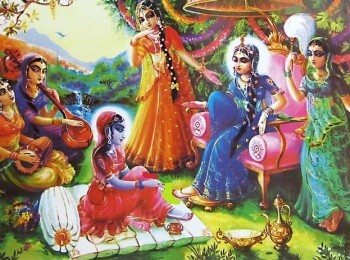
Srila Prabhupada's purport to Sri Chaitanya-charitamrita, Adi-lila 10.115, tells us something that later writers on the Ghosh brothers have repeated ever since: according to the Gaura-ganoddesha-dipika, verse 188, Govinda, Madhava and Vasudeva were, in their eternal life in Krishna's Vraja-lila, three gopis, Kalavati, Rasollasa and Gunatunga, who sing the songs composed by Vishakha-gopi. In order, Madhava is Rasollasa. Srila Bhaktisiddhanta Sarasvati Thakura placed all three brothers in madhurya-rasa, the devotional mood of a lover, among those who take Srimati Radharani as their final shelter, a description that fits naturally with being one of Vishakha's own singing companions.
This is the one place where a source names Madhava apart from his brothers instead of simply counting him third in the trio, and it is worth being careful here for exactly that reason: it comes from a single text, repeated by every later writer rather than confirmed on its own by another source. So it is presented here as what that one source says, not as a fact confirmed by many different traditions.
A Shripata at Dainhat #
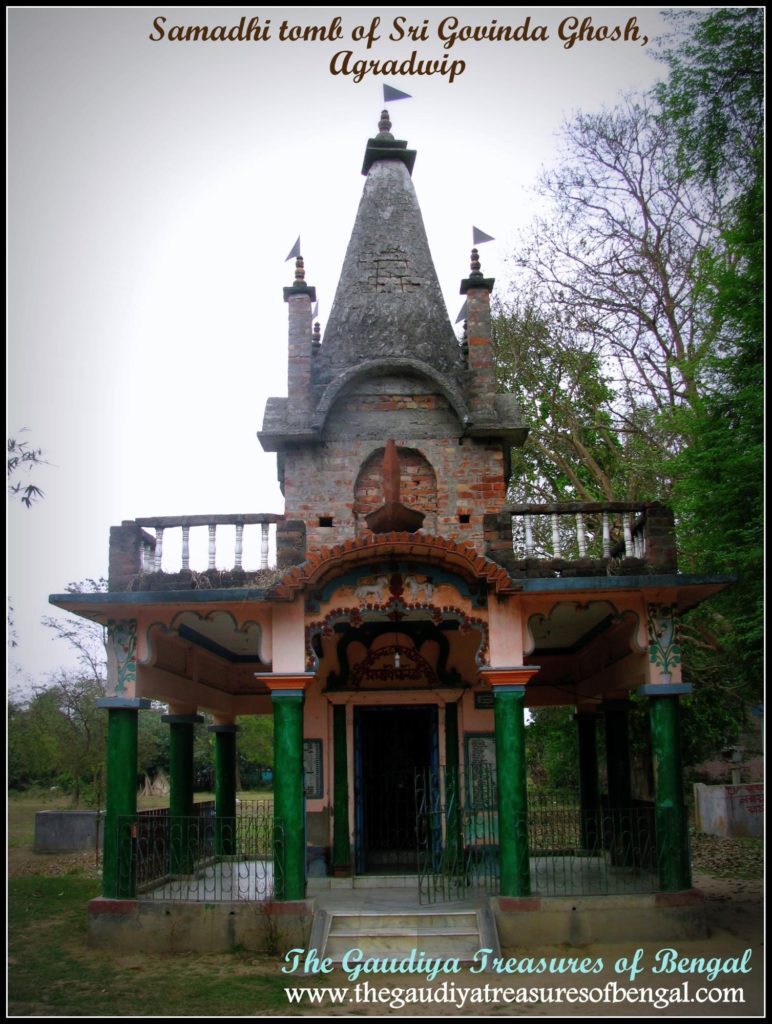
Later Gaudiya tradition places each of the three brothers at his own shripata, a seat of worship, once their traveling years were behind them: Govinda Ghosh at Agradvipa, where the Gopinatha deity he served is still worshiped; Vasudeva Ghosh at Tamluk, at the spot where Chaitanya Mahaprabhu is remembered to have once stopped on His way to Puri; and Madhava Ghosh at Dainhat, near Katwa. Beyond naming the place, the old texts do not keep any specific story about Madhava's own years there: no dated festival, no story of a deity speaking to him, nothing like the detailed funeral-rites story told of Govinda Ghosh or the samadhi-pit story told of Vasudeva Ghosh. Whatever happened at Dainhat in Madhava Ghosh's later life has simply not come down to us.
The same silence covers his disappearance itself. No date is recorded for it, unlike Govinda Ghosh's tirobhava on Krishna Trayodashi of the month of Chaitra, or Vasudeva Ghosh's on the second day of the waxing moon of Karttika. A thin page is the honest result of a thin record. It does not mean nothing was ever written, only that on this one point, nothing has come down to us.
One Song in His Own Voice #
Among everything gathered under Madhava Ghosh's name, one thing is clearly his own: a single Bengali gaura-candrika song, "Nace Pahum Abadhuta Gora" ("The Avadhuta Lord Gaura Dances"), closed with his own bhanita, his signature line. The song pictures Gauranga not as a child or a king, but as a wandering renunciant lost in the dance of kirtan, which fits a singer remembered above all for the kirtan that made Nityananda Prabhu dance. Its last line turns from describing the Lord to a personal prayer: "In his heart, Madhava Ghosha yearns to attain Lord Gaura's company." It is the one line in this whole record where Madhava Ghosh speaks for himself instead of being spoken about. And fittingly, for a life remembered mostly through a family of three, it asks for nothing more than to remain in his Lord's company.
For the fuller story of the brothers' shared beginnings and their kirtan before Sri Chaitanya Mahaprabhu, see Birth and the Ghosh Brothers of Navadvipa and Singing for Sri Chaitanya Mahaprabhu.