A Question at a Sacrifice #
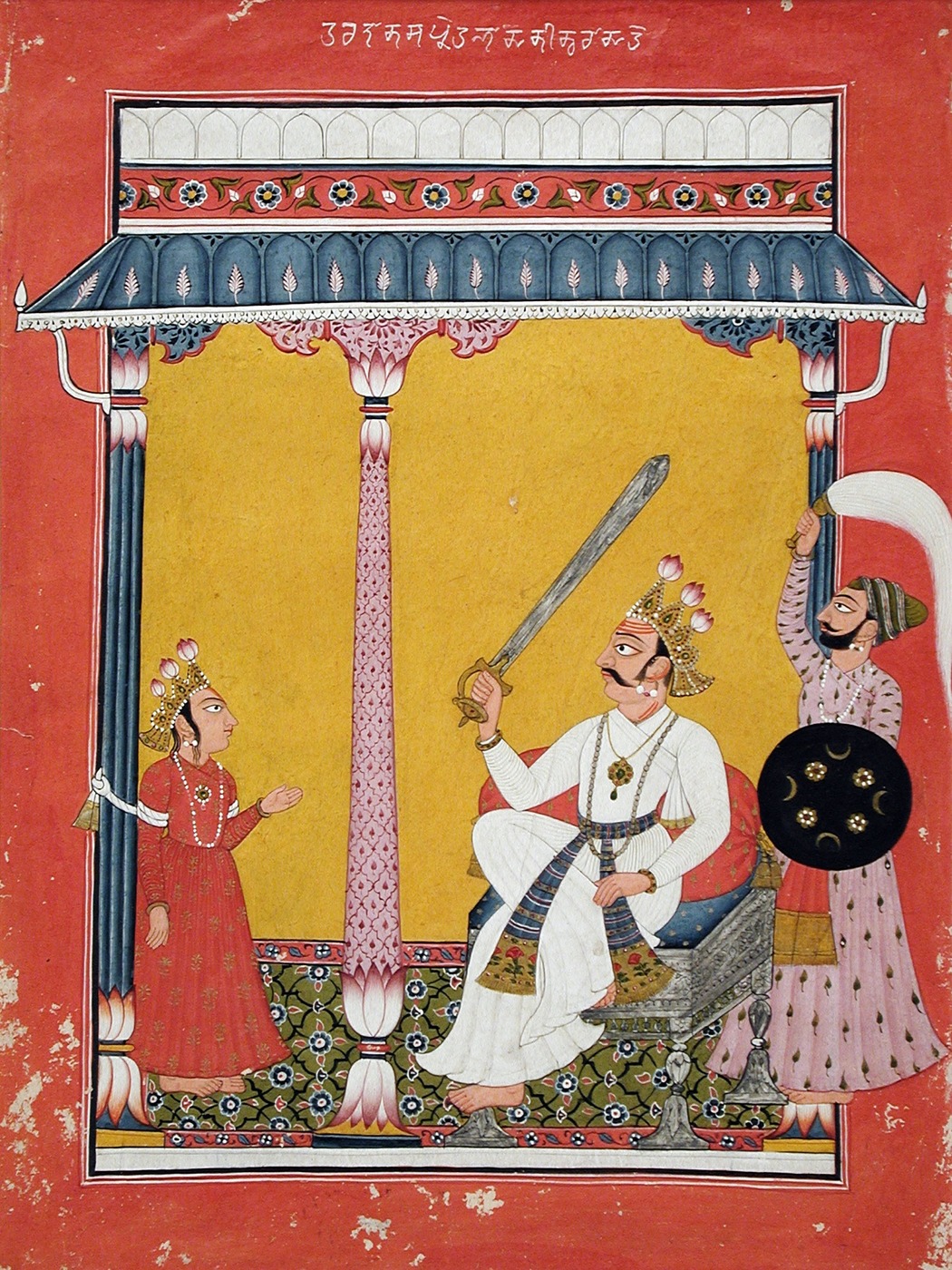
The story is told to us at one remove. Long afterward, at Maharaja Yudhishthira's Rajasuya sacrifice, the king watched the lifelong enemy of God, Shishupala, die at Krishna's hand and merge directly into the Lord's own body. Yudhishthira thought this ending was far too merciful for so hateful an enemy. He put his confusion to the sage seated nearby. Narada Muni answered him by narrating the entire history of Prahlada Maharaja. Narada explained that Yudhishthira could understand how such mercy could reach even an enemy like Shishupala only by understanding how completely the Lord protects and elevates his devotees. Prahlada Maharaja himself later retold part of that same history to his own demon classmates. It is in that retelling that we learn what Narada had done for him before he was even born.
Rescuing Kayadhu #
When the demon king Hiranyakashipu left his kingdom to perform severe austerities on Mandaracala Mountain, the demigods under Indra saw their chance and attacked the undefended capital. Hiranyakashipu's pregnant queen, Kayadhu, was taken captive. Indra intended to hold her until her child, whom he assumed would grow into another demon, was born, so that the child could be killed at birth. As Indra's forces dragged her away, crying out like a bird seized by a hawk, Narada Muni happened to be passing. He intervened immediately, telling Indra that the woman was sinless and had to be released. When Indra objected that the seed of a great demon lay within her, Narada answered with something Indra had not expected: the child in her womb was faultless, a great devotee of the Lord, and no one would be able to kill him. Respecting Narada's word, Indra released her at once.
Instruction Given, and Received, in the Womb #
Narada then brought Kayadhu to his own ashrama and kept her under his protection for the months until Hiranyakashipu's return. She served him there with devotion. Prahlada says that Narada, moved by his natural compassion for fallen souls, gave her extended instruction in bhagavata-dharma, transcendental knowledge untouched by material contamination. Kayadhu herself, Prahlada admits with a certain gentleness, forgot almost all of it in the years that followed. But the child in her womb did not. Prahlada Maharaja states plainly that Narada's mercy had blessed him directly, so he retained every word. It was this unborn instruction, not anything he later learned in his father's demon-run household, that made him the unshakeable devotee history remembers, from infancy.
What Narada Actually Taught #
Years later, Prahlada Maharaja retold the instruction to his demon classmates, summarising its core rather than every word. His summary: the spirit soul is never the same thing as the material body it happens to occupy. A body is born, grows, matures, produces by-products, dwindles, and dies: six changes that every material object undergoes, but the soul within undergoes none of them, because it is spiritual, self-illuminated, and the knower of the body rather than the body itself. He compared finding this soul within the body to the work of a skilled geologist who can see gold buried in ore where an untrained eye sees only rock: the method, he said, is a careful, patient process of setting aside everything that is not the self, "this is not it, this is not it," until only the spiritual particle remains. Srimad-Bhagavatam teaches this exact method in so many words: "One must find the soul by analysis, saying, 'This is not it. This is not it.' Thus one must separate spirit from matter" (Srimad-Bhagavatam 7.7.23). It is striking to realise this: Prahlada Maharaja, one of Vedic literature's most celebrated philosophers of the soul, was taught to think this way, in the most literal sense, before he had ever taken a single breath outside his mother's body.
It is worth sitting with the shape of this: the same sage who delivered Dhruva Maharaja delivered Prahlada Maharaja too, in a real sense, before Prahlada had even drawn a single breath.