A Dissatisfaction Vyasadeva Could Not Name #
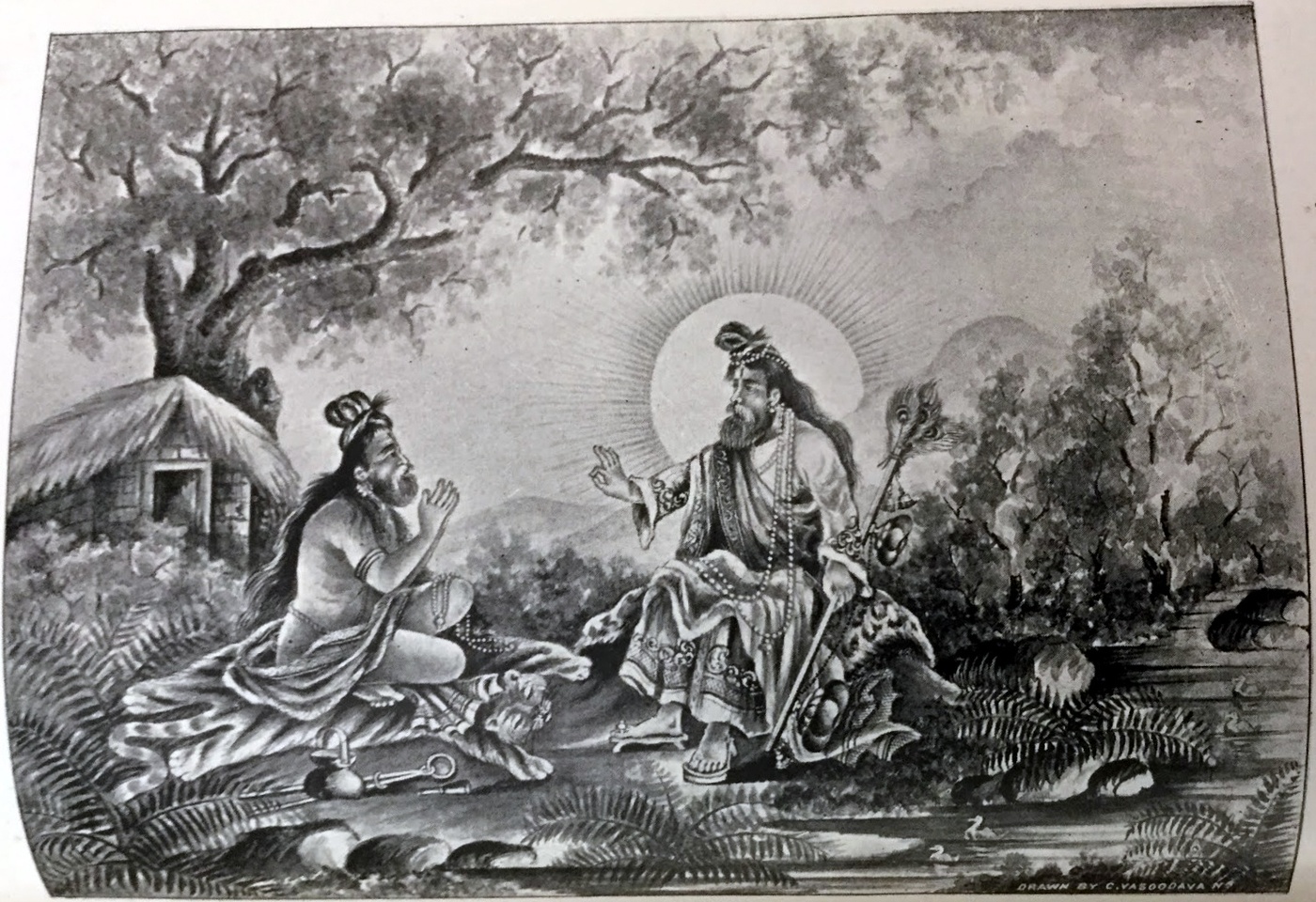
Srimad-Bhagavatam's own account of its origin opens with Vyasadeva sitting alone on the bank of the Sarasvati, deeply unhappy despite an almost unimaginable body of finished work behind him. He had arranged the Vedas into their four divisions, compiled the Puranas, and completed the Mahabharata, the vast epic meant to bring Vedic knowledge within reach of ordinary people. None of it had brought him peace. At this low point, his own guru, Narada Muni, arrived. Smiling, he asked Vyasadeva directly whether he was really satisfied identifying himself with his body and mind as the field of self-realisation. Whatever the answer, Vyasadeva plainly was not at peace.
Narada's Diagnosis #
Vyasadeva admitted Narada was right: something was missing, and he could not say what. Narada told him plainly. Vyasadeva had described religious duty, economic development, and the other goals of life at great length, but he had not adequately described the glories of the Supreme Personality of Godhead himself. Any literature, however learned, that fails to describe the Lord directly is like a place of pilgrimage for crows, of no real use to a soul actually seeking transcendence. Literature that does describe the Lord's names, forms, qualities, and pastimes, by contrast, however imperfectly composed, is heard, sung, and cherished by every honest, purified person, because it alone brings about real change in a misdirected world.
Instruction Confirmed by His Own Experience #
Narada did not stop at diagnosis. He told Vyasadeva that he was, himself, perfectly qualified to write exactly this kind of literature: his vision was pure, his vows were firm, and he could sit in trance and see the Lord's pastimes directly. He then told Vyasadeva something remarkable about his own life: Krishna himself had given him this same knowledge and devotional service in a previous birth, the story Narada tells at length elsewhere. This personal experience was exactly why he could speak with such confidence about what Vyasadeva was missing. Any writing not centred on the Lord, he warned, agitates the mind the way wind agitates a boat with nowhere to anchor. Writing that describes the Lord in trance, by contrast, gives the writer's own mind somewhere real to rest.
Narada also addressed an objection Vyasadeva had not even raised yet: that describing devotional life risked encouraging people toward activities that might not always succeed. Narada's answer was that a devotee who takes up the Lord's service and stumbles is still far ahead of someone who performs their ordinary material duties flawlessly, because a soul that has once tasted devotional life cannot help but return to it, while flawless material work simply produces more material bondage. Srimad-Bhagavatam preserves Narada's own words to Vyasadeva on this exact point: "One who has forsaken his material occupations to engage in the devotional service of the Lord may sometimes fall down while in an immature stage, yet there is no danger of his being unsuccessful. On the other hand, a nondevotee, though fully engaged in occupational duties, does not gain anything" (Srimad-Bhagavatam 1.5.17). He even offered Vyasadeva a kind of homeopathic logic for the whole project. An activity that binds a person to matter can, when redirected toward the Lord's service, become the very thing that cuts that bondage away. The same fire, he said in effect, that causes a disease can be turned into its cure.
The Result #
Vyasadeva accepted the instruction completely. Sitting in meditation on the bank of the same river, he began to see the Supreme Personality of Godhead and His energies exactly as Narada had described. From that vision he composed Srimad-Bhagavatam. This entire disciplic line, all the way down to Srila Prabhupada and this movement, holds it as its single most important text. Every acharya in this tradition who ever wrote a word about Krishna's pastimes stands, in some sense, downstream of this one conversation between a guru and his disciple on the bank of the Sarasvati.