हिन्दी में पढ़ें

Narada Muni

The Narada-bhakti-sutra

A short Sanskrit text of aphorisms on bhakti, traditionally credited to Narada himself — and a book Srila Prabhupada once began, then set aside.

Traditional attribution; exact date and authorship are not independently established

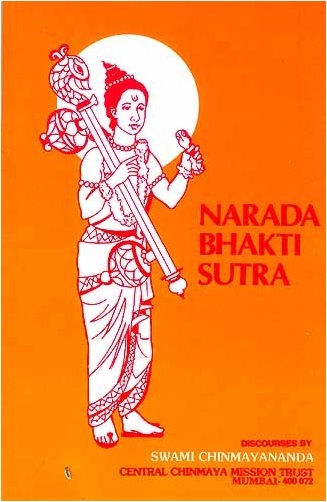
The cover of a published edition of the Narada-bhakti-sutra.
The cover of a published edition of the Narada-bhakti-sutra.Wikimedia Commons · CC BY-SA 3.0
Reading tools

Eighty-Four Sutras on the Nature of Bhakti #

Among the many compact, aphoristic Sanskrit texts called sutras that circulate within the Vedic tradition, one is traditionally attributed directly to Narada Muni: the Narada-bhakti-sutra. This short work of roughly eighty-four statements defines what bhakti actually is, how it differs from ordinary religious duty or the pursuit of liberation, what obstacles block it, and how a sincere devotee can recognise genuine progress in it. Vaishnava commentators have written at length on these short sutras over the centuries, much as later commentators expanded on Vyasadeva's own Vedanta-sutra.

Scholars disagree, as they do about many such texts, on exactly when it was composed and by whom. The attribution to Narada himself rests on tradition rather than anything independently verifiable. But its content sits comfortably within the devotional worldview this entire disciplic line teaches, and Srila Prabhupada treated it as authoritative whenever he referred to it directly. Students of Vedanta sometimes discuss it alongside a second, similar work traditionally attributed to the sage Shandilya, the Shandilya-bhakti-sutra. The two texts are usually read as companion attempts, from within two different lines of the tradition, to define bhakti with the same aphoristic precision Vyasadeva himself brought to Vedanta philosophy.

What Bhakti Actually Is #

One definition from this current of teaching became especially well known within Gaudiya Vaishnavism: that bhakti means engaging the senses in the service of Hrishikesha, the master of the senses, once a soul has become free of every material designation. Srila Prabhupada, speaking at Andhra University in 1972, introduced this exact definition as coming from the Narada-bhakti-sutra. The same verse also appears, worded almost identically, in Srila Rupa Gosvami's Bhakti-rasamrita-sindhu. There, the printed edition, and Sri Chaitanya-charitamrita's own purport quoting it, credit the verse instead to the Narada-pancharatra, a related but distinct text. Chaitanya Mahaprabhu himself quotes it this way while instructing Rupa Gosvami at Prayag: "Bhakti, or devotional service, means engaging all our senses in the service of the Lord, the Supreme Personality of Godhead, the master of all the senses" (Sri Chaitanya-charitamrita, Madhya 19.170). That small discrepancy in attribution is acknowledged honestly here rather than resolved, since both texts plainly draw on the very same current of teaching about what bhakti means at its root.

A second theme runs through nearly everything Vaishnava tradition associates with Narada's teaching on bhakti: it is *ahaituki*, causeless, and *apratihata*, unstoppable, exactly as Srimad-Bhagavatam itself defines the supreme occupation of humanity: "The supreme occupation [dharma] for all humanity is that by which men can attain to loving devotional service unto the transcendent Lord. Such devotional service must be unmotivated and uninterrupted to completely satisfy the self" (Srimad-Bhagavatam 1.2.6). It is available to absolutely anyone, regardless of birth, learning, or qualification, and blockable by nothing once it begins. It is not a coincidence that this is exactly the kind of devotion Narada himself received, without any formal qualification, as a poor and uneducated servant boy in his previous life, and exactly the kind he later gave, without hesitation, to a queen in captivity, a grieving five-year-old prince, and a highway robber.

A Book Srila Prabhupada Set Aside #

Correspondence from Srila Prabhupada's earliest years in America shows that he began an English translation of the Narada-bhakti-sutra almost as soon as he started writing to his first disciples. In February 1967 he sent Satsvarupa dasa Goswami the first installment of what he called simply "Narada Bhakti Sutras," and asked for feedback before continuing. A month later, though, he decided to finish Teachings of Lord Chaitanya first. He explained to the same disciple that the subject matter of the Narada-bhakti-sutra was already covered in that other book. So far as the surviving record shows, he never returned to it. No completed Bhaktivedanta translation of the Narada-bhakti-sutra was ever published as a separate volume. It remains a small, honest gap in an otherwise enormous body of finished books, and one more sign of how carefully Srila Prabhupada, like Narada himself, was always weighing which project would best serve Krishna consciousness in the time available to him.

Scriptural sources for this pastime

sarvopādhi-vinirmuktaṁ
tat-paratvena nirmalam
hṛṣīkeṇa hṛṣīkeśa-
sevanaṁ bhaktir ucyate

Word for word

sarva-upādhi-vinirmuktam — free from all kinds of material designations, or free from all desires except the desire to render service to the Supreme Personality of Godhead; tat-paratvena — by the sole purpose of serving the Supreme Personality of Godhead; nirmalam — uncontaminated by the effects of speculative philosophical research or fruitive activity; hṛṣīkeṇa — by purified senses freed from all designations; hṛṣīka-īśa — of the master of the senses; sevanam — the service to satisfy the senses; bhaktiḥ — devotional service; ucyate — is called.

Bhakti, or devotional service, means engaging all our senses in the service of the Lord, the Supreme Personality of Godhead, the master of all the senses. When the spirit soul renders service unto the Supreme, there are two side effects. One is freed from all material designations, and one's senses are purified simply by being employed in the service of the Lord.

From the purport: "This verse quoted from the Narada-pancaratra is found in the Bhakti-rasamrta-sindhu."

CC Madhya 19.170 Sri Chaitanya-charitamrita

Chaitanya Mahaprabhu quotes this verse to Rupa Gosvami as His own definition of bhakti. Rupa Gosvami's Bhakti-rasamrita-sindhu carries the same verse and, like the printed Chaitanya-charitamrita purport quoting it, attributes it to the Narada-pancharatra rather than the Narada-bhakti-sutra, the small attribution discrepancy this page discusses honestly.

स वै पुंसां परो धर्मो यतो भक्तिरधोक्षजे ।
अहैतुक्यप्रतिहता ययात्मा सुप्रसीदति ॥ ६ ॥

sa vai puṁsāṁ paro dharmo
yato bhaktir adhokṣaje
ahaituky apratihatā
yayātmā suprasīdati

Word for word

saḥ — that; vai — certainly; puṁsām — for mankind; paraḥ — sublime; dharmaḥ — occupation; yataḥ — by which; bhaktiḥ — devotional service; adhokṣaje — unto the Transcendence; ahaitukī — causeless; apratihatā — unbroken; yayā — by which; ātmā — the self; suprasīdati — completely satisfied.

The supreme occupation [dharma] for all humanity is that by which men can attain to loving devotional service unto the transcendent Lord. Such devotional service must be unmotivated and uninterrupted to completely satisfy the self.

SB 1.2.6 Srimad-Bhagavatam

The classic Bhagavatam statement that devotional service is ahaituki (causeless) and apratihata (unstoppable), the exact two qualities this page's discussion of Narada's teaching on bhakti names.

সর্বোপাধিবিনির্মুক্তং তৎপরত্বেন নির্মলম্ ।
হৃষীকেণ হৃষীকেশ-সেবনং ভক্তিরুচ্যতে ॥

sarvopādhi-vinirmuktaṁ
tat-paratvena nirmalam
hṛṣīkeṇa hṛṣīkeśa-
sevanaṁ bhaktir ucyate

Word for word

sarva-upādhi-vinirmuktam — free from all kinds of material designations; tat-paratvena — by the sole purpose of serving the Supreme Personality of Godhead; nirmalam — uncontaminated by speculative philosophy or fruitive activity; hṛṣīkeṇa — by purified senses; hṛṣīka-īśa-sevanam — service to the master of the senses; bhaktiḥ ucyate — is called devotional service.

Bhakti, or devotional service, means engaging all our senses in the service of the Lord, the Supreme Personality of Godhead, the master of all the senses. When the spirit soul renders service unto the Supreme, one is freed from all material designations, and one's senses are purified simply by being employed in the service of the Lord.

From the purport: Purport excerpt: "This verse quoted from the Narada-pancaratra is found in the Bhakti-rasamrta-sindhu (1.1.12)."

CC Madhya 19.170 Narada-pancharatra (quoted in Bhakti-rasamrita-sindhu 1.1.12 and Sri Chaitanya-charitamrita, Madhya-lila 19.170)

The definition-verse Srila Prabhupada attributed, in a 1972 lecture, to the Narada-bhakti-sutra, though Sri Chaitanya-charitamrita's own printed apparatus credits it to the related Narada-pancharatra.

Srila Prabhupada on this pastime

The bhakti, bhakti-marga, it is generally known as bhakti-marga or the path of devotional service. The bhakti-marga is defined by Narada Muni in Narada-bhakti-sutra.

Lecture at Andhra College — Lecture, 1972-02-21, Visakhapatnam

Srila Prabhupada introducing the classic sarvopadhi-vinirmuktam definition of bhakti as coming from the Narada-bhakti-sutra.

Today I have sent you the first installment of "Narada Bhakti Sutras". Please let me know how do you like it or if there is any difficulty to understand it. On hearing from you I shall take up the next installment.

Letter to Satsvarupa — Letter, 1967-02-24, San Francisco

Srila Prabhupada beginning an English translation project of the Narada-bhakti-sutra with his disciple Satsvarupa dasa Goswami.

I have seen the typed copies of Narada Bhakti Sutra as well as Teachings of Lord Caitanya. Both of them are nicely made. I think let us finish first Teachings of Lord Caitanya and then we take again Narada Bhakti Sutra. The subject matter discussed with Narada Bhakti Sutras is already there in the Teachings of Lord Caitanya.

Letter to Satsvarupa — Letter, 1967-03-16, San Francisco

Srila Prabhupada deciding to set the Narada-bhakti-sutra translation aside in favour of finishing Teachings of Lord Caitanya first; no completed Bhaktivedanta translation of the Narada-bhakti-sutra was published.

Nandgram Dham
Verified Scriptural
Written by
Our editorial team comprises trained devotees and researchers of the Hare Krishna Movement, Kota, who follow this same disciplic tradition in daily practice. Every biography is carefully researched, fact-checked against Vedic scriptures, and cites its sources.
Reviewed by
Temple & Scriptural Research Team
Each biography undergoes a detailed review by our senior devotees and scriptural researchers to verify factual accuracy and ensure alignment with Vaishnava philosophy and Srila Prabhupada's teachings.
Last Updated: