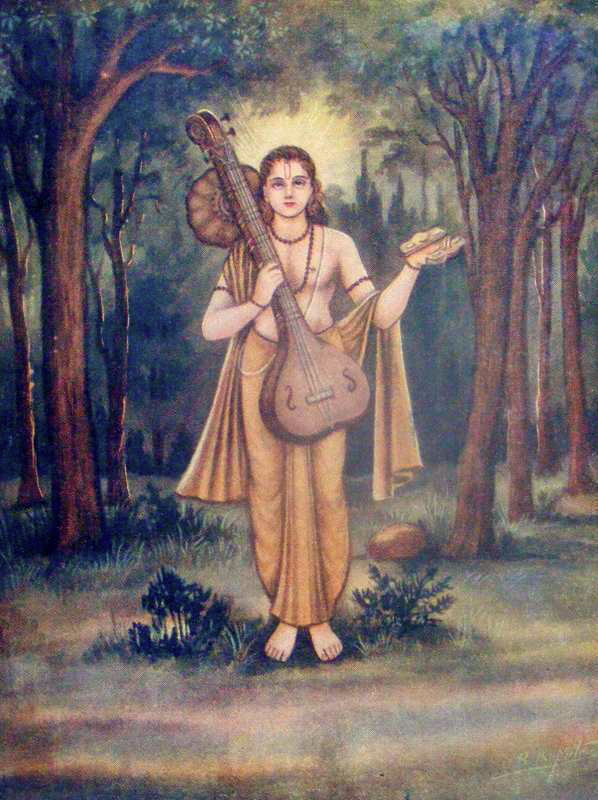
Long before he became a son of Brahma, Narada Muni lived an entirely different, human life. He describes this earlier life, not his current one, as the true beginning of his devotion. He tells the whole story himself, to Vyasadeva, late in the First Canto of Srimad-Bhagavatam.
A Maidservant's Only Son #
Narada explains that in a previous age he was born as the son of a poor maidservant. His mother worked in the house of great sages, learned brahmanas who followed the path of Vedanta. By the time he was five years old, he had no one else to look after him and no experience of the wider world. What set him apart, he says, was simply this: he was not a restless or naughty child. He kept close to his mother's work, spoke only when necessary, and had no taste for the games boys his age usually enjoy.
The Mercy of the Rainy Season #
Once, a group of these Vedantist sages stayed at that house through the four months of the rainy season, the traditional period when wandering sannyasis suspend their travels and remain in one place. The boy was assigned to serve them personally, and though such sages are famously impartial toward everyone, they extended their mercy to him anyway. With their permission he once ate the remnants of their food, and he says plainly that this single act burned away his accumulated sins and purified his heart at once: "Once only, by their permission, I took the remnants of their food, and by so doing all my sins were at once eradicated" (Srimad-Bhagavatam 1.5.25). Sitting near them through those months, he heard them describe the activities of Krishna, again and again. Each time he heard a little more, his taste for hearing about the Lord grew sharper. By the time the rains gave way to autumn he had spent two full seasons absorbed in nothing else: the chanting and discussion of Krishna's glories among men who cared for nothing else themselves.
Instructed, Then Left Alone #
When the season ended and the sages prepared to move on, they gave the boy a parting gift: confidential instruction in devotional knowledge. He says this is the same knowledge that the Lord imparts personally to those he favours. Soon afterward, tragedy struck: his mother, going out one night to milk a cow, was bitten by a snake and died. Narada took this, remarkably, as the Lord's mercy rather than a calamity. It freed him, a boy with no other family or attachment left, to walk north alone in search of nothing but Krishna consciousness.
Narada adds one detail about his mother that is easy to pass over but worth pausing on: she loved him deeply, but she was herself dependent and without means, so she could do little to actually protect or provide for him. He describes the situation with a striking image of his own: that everyone in this world is like a wooden doll in the hands of a puppeteer, moved about by a will far larger than their own affection or intention. It is not a bitter observation. It is, in context, almost a relief: if his mother's love could not shield him from what happened next, then what happened next was not her failure, and there was nothing left to do but keep walking.
One Glimpse, and a Lifetime of Longing #
Walking alone and without a plan, the boy passed through flourishing cities, quiet villages, cattle pastures, mines glittering with gold, silver, and copper, lakes crowded with lotus flowers and singing birds, and then increasingly wild country: bamboo thickets, tangles of reed and thorn, and finally dark, dangerous forest tracts where owls, jackals, and snakes were the only company. Tired, hungry, and thirsty, he eventually stopped to drink and bathe at a river. There, resting in the shade of a banyan tree, he began to meditate as the sages had taught him. As he fixed his mind on the Lord within his heart, Krishna actually appeared before him. The boy was so overwhelmed with ecstasy that he could not properly see either himself or the form in front of him. Just as suddenly, the vision withdrew. Frantic to see it again, he could not recover it no matter how he tried. Then the Lord spoke to him directly. He explained that Narada would not see that form again in this lifetime. The single glimpse was meant only to sharpen his hunger for it, since a devotee whose longing keeps growing is a devotee who cannot fall away.
Consoled by this, Narada spent the rest of that life wandering the earth, chanting the Lord's names, until death came for him: he describes it arriving as suddenly and painlessly as a flash of lightning. What happened next belongs to the story of his birth as Brahma's son. The boy who had served a handful of sages for four months of one rainy season was carried, through the dissolution and re-creation of the entire universe, into a strikingly different kind of life.