Ordered by his guru to revive the fading preaching work of Chaitanya Mahaprabhu's associates in Utkal desh, Shyamananda Pandit spent the better part of three decades building what became, by any honest measure, one of the most successful regional missions in early Gaudiya Vaishnava history, one measured not in sermons alone but in Deities installed, temples founded, and a documented "Shyamanandi" community that still exists across Odisha and southern Bengal today.
| Detail | Description |
|---|---|
| Mission field | Dandeshwar, Rohini, Nrisinghpur, Balarampur, Gopiballabhpur and wider Utkal |
| Chief disciple found here | Rasikananda Prabhu, met at Rohini |
| Deities installed in Odisha | Radha-Govinda at Gopiballabhpur; Gokula Chandra at Basantia; Madana Mohana at Nadajal |
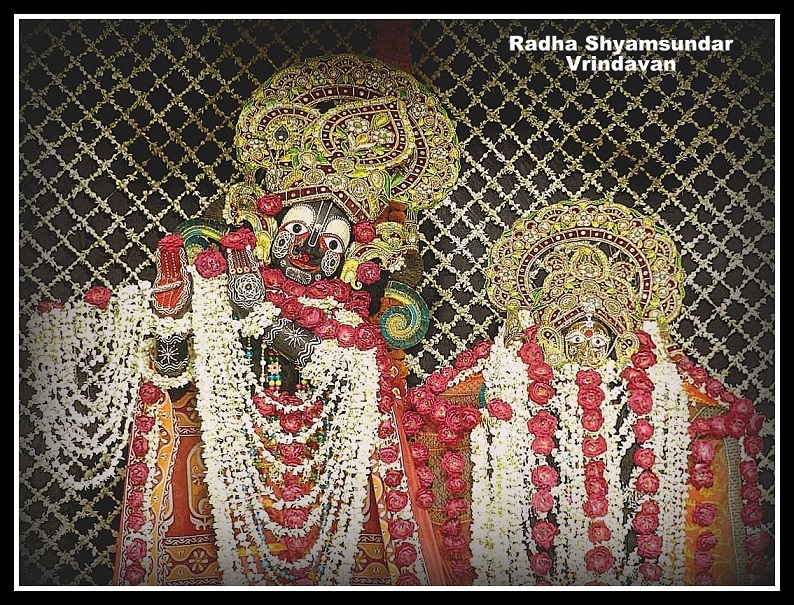
| Deities linked to him in Vrindavana | Sri Shyamsundar and, later, Radha-Shyamsundar together |
| Notable converts | Yogi Damodara; the Mughal officer nicknamed "Haribola"; the Pathan Sher Khan |
| Distinct kirtan style | Reneti (Ranihati) kirtan, from the Midnapur district |
| Literary works | Vrindavan Parikrama; Upasana Sara Samgraha; poems in Aprakashita Pada-ratnavali |
Why Odisha Needed Him #
By the time Shyamananda arrived, Odisha's Vaishnava community was in real difficulty. The generation of Chaitanya Mahaprabhu's own associates who had once made Puri a Vaishnava stronghold had mostly passed on, and the political situation had turned hostile: Pathan rule, following the collapse of Emperor Prataparudra's dynasty, brought repeated warfare with the Mughals and, at the hands of Kala Pahara and other Pathan iconoclasts, the desecration of the Jagannath temple itself. Relief came on the political side from Raja Man Singh, a Mughal general serving Akbar and, by most accounts, himself a disciple in the Gaudiya Vaishnava line, who fought a decisive campaign along the Suvarnarekha river, drove the Pathans back to Cuttack, and restored Odisha's holy places, including the temple of Jagannath, to the care of its own devotees before going on to serve as governor of Bengal. Man Singh's victory made the ground safe again; it was Shyamananda, sent by Jiva Goswami and by Hridaya Chaitanya's own order, who filled it with the spiritual substance Odisha had lost. The two are remembered together for restoring, between them, the region Mahaprabhu Himself had once made a Vaishnava headquarters.
Passing Through His Own Past #
On his way into Utkal, Shyamananda deliberately passed through his own birth village of Dharenda Bahadurpur and through Dandeshwar, where his father had once lived, preaching in both, to the visible joy of townspeople who remembered him simply as their own returning Duhkhi. From there he reached Rohini, on the Subarnarekha River, and met the young Rasikananda, son of the local zamindar. This encounter is covered in real depth, from the disciple's side, on Rasikananda Prabhu's own pages, in Discipleship Under Shyamananda Pandit. Rasikananda quickly became Shyamananda's foremost follower, and much of what Shyamananda accomplished across the rest of his life ran, in practice, through this one relationship.
He arrived to find both his parents already dead in his absence, but rather than let that grief slow him, he opened a preaching center in his own family's house at Dandeshwar and began his mission from there.
Winning Over a Proud Yogi and a Hostile Officer #
Shyamananda's preaching method, by every account, combined public kirtana and plain explanation of Chaitanya Mahaprabhu's teaching with a handful of episodes striking enough to be remembered individually. At Chakulia, a learned yogi named Damodara, a scholar versed in Sankhya philosophy, yogic perfections and Adwaita Vedanta, refused to accept Shyamananda as his guru out of pride in his own brahmana birth, until a private mystic vision showed him an effulgent brahminical thread shining on Shyamananda's own body, proof, in the yogi's own eyes, that bhakti outranked birth entirely. Damodara, his mother and his two wives all took initiation soon after. Separately, a Pathan official named Sher Khan broke up a sankirtana party's instruments not once but twice out of contempt, and when Shyamananda answered the second disruption by calling out the names of Radha and Krishna in a piercing voice, Sher Khan and his men are remembered as coughing blood on the spot, their beards and moustaches catching fire. That night he dreamed that Allah Himself struck him and declared that He was the same Supreme Lord Shyamananda worshiped in His most confidential feature, Sri Chaitanya Mahaprabhu, and that Sher Khan should take initiation from Shyamananda alone. Shaken, Sher Khan fell at Shyamananda's feet the next morning and was initiated under the name Chaitanya Dasa. A Mughal viceroy of Medinipur, so moved at a festival that he could only chant "Haribol! Haribol!" again and again, was given the name Haribola by Shyamananda on the spot. Devotion, not birth, was the one qualification Shyamananda ever tested for. This was the same principle Hridaya Chaitanya had already shown him at Ambika Kalna, now put into practice on a much larger scale.
Gopiballabhpur and the Deities of Odisha #
At Rasikananda's request, Shyamananda renamed the family Deity Rasikananda had carried with him, after his own father's death left him unwelcome among quarrelling relatives, as Gopi-vallabha Raya, and the settlement that grew up around this Deity's worship took the name Gopiballabhpur, still the headquarters of the Shyamanandi community today. Elsewhere in the region Shyamananda installed further Deities directly: Radha-Govinda at Gopiballabhpur itself, at the earnest request of wealthy local residents who built a full temple complex, kirtana hall, kitchen, guest house and gardens, to receive it; Gokula Chandra at Basantia; and, after a dramatic recovery of a Deity of Chaitanya Mahaprabhu that had been hidden away by a hostile tantric sannyasi at Tamluk, its restored worship there, previously begun by Vasudeva Ghosh. Each of these Deities anchored a local devotee community that, by tradition, has continued largely unbroken since.
Forty Years With Rasikananda, and a Reneti Kirtan of His Own #
For the next forty years Rasikananda Prabhu preached at Shyamananda's side, and between them the two converted a remarkable cross-section of Odisha's ruling and landholding families: Shyamananda himself brought in Bhimadhana Bhuiyan, the landlord of Ghatshila, along with Uddanda Roy and Rajyadhar Roy of Govindapur, while Rasikananda's own converts included Baidyanatha Bhanja, the raja of Mayurbhanj, along with the rulers of Patashpur, Panchet and Mayna. Rasik Mangal and Shyamananda Prakash, the standard biographies of this period, credit the two of them with ending animal sacrifice across large parts of non-Vaishnava Odisha in the process.
Shyamananda's movement also left behind a distinct musical inheritance. The particular blend of classical kirtana and his own devotional temperament that grew up among his followers came to be called Reneti kirtan, after the Ranihati Pargana of the Midnapur district where it originated, and is sometimes called Ranihati kirtan for the same reason; it remains one of the identifying marks of the Shyamanandi Vaishnava community today.
Shyamananda Prabhu's Literary Works #
Preaching and pilgrimage left Shyamananda little time for writing, but a handful of works are attributed to him. Vrindavan Parikrama describes the important holy places of Vraja; the now-rare Upasana Sara Samgraha outlines the science of devotional service along lines Jiva Goswami had taught him; and Aprakashita Pada-ratnavali collects poems in his name describing one of Radhika's secret meetings with Krishna. Rasikananda Prabhu himself later composed a Sanskrit epic on his teacher's life, Shyamananda Shatakam, still valued among Shyamanandi Vaishnavas today.
Vrindavana's Own Radha-Shyamsundar #
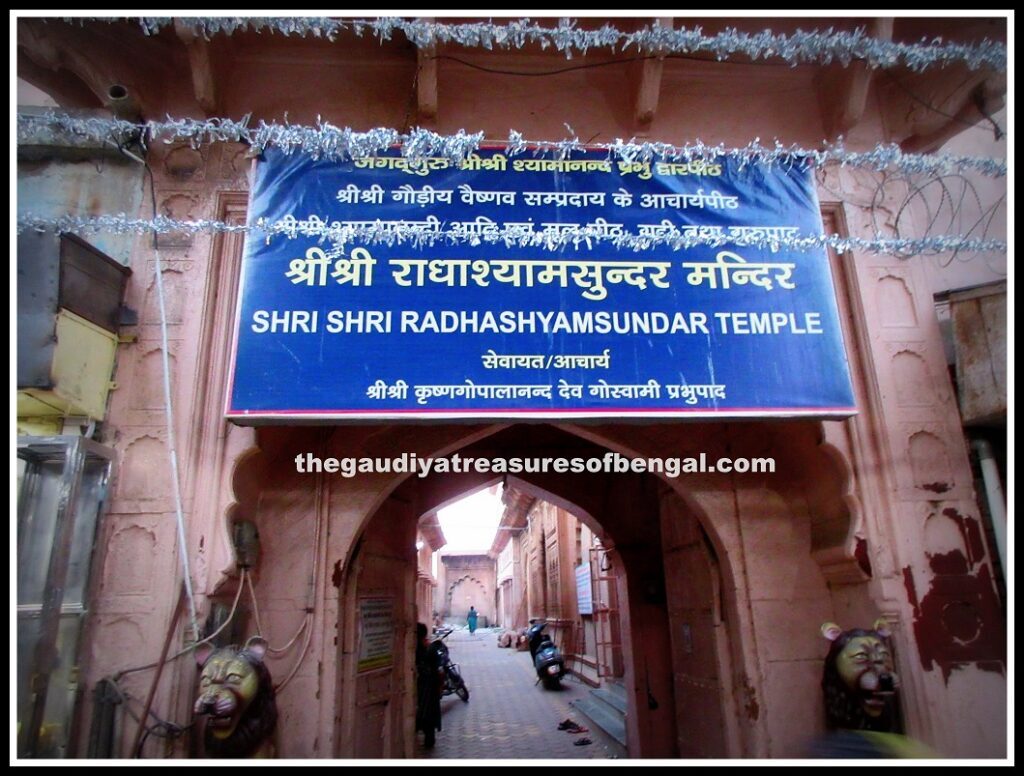
Shyamananda's Odisha mission was not his only lasting monument. In Vrindavana, at the very spot on the bank of the Kanana-Kunja where he had received Srimati Radharani's mercy and the anklet-shaped tilaka, he installed the Deity Sri Shyamsundar in his own underground bhajana-kutir at Seva Kunja, a Deity given, tradition holds, directly by Radharani Herself on Vasanta Panchami (23 January) 1578 AD, worshiped at first in Nidhuvan before finding its lasting home at Seva Kunja. Years later, in 1580 by one traditional account (Vasanta Panchami, 31 January, by a more precise dating), a self-manifest Deity of Radharani, called Lali, was discovered in the treasury of the King of Bharatpur; the king brought Her to Shyamananda, who arranged Her ceremonial marriage to Shyamsundar on Vasanta Panchami. The temple that grew from this pairing, Sri Sri Radha-Shyamsundar, still stands today as one of the seven historic original temples of Vrindavana and one of the two principal dwar-peeths (seat-temples) of the wider Gaudiya-Madhva sampradaya; larger Deities were installed there in 1719 by Baladeva Vidyabhusana, a scholar who, as it happens, also descended from Shyamananda's own disciplic line through Rasikananda, a connection told more fully on Final Days and Legacy.
Reunited With His Old Friends at Kheturi #
Amid these decades of Odisha preaching, Shyamananda also traveled back to Bengal at least once for a festival that became a landmark in its own right: the installation of six Deities organized by Narottama Dasa Thakura at Kheturigram, presided over by Jahnava Devi and attended by Vaishnavas from across Bengal, Odisha and Vrindavana. There Shyamananda was reunited with his old companions from their Vrindavana years, Narottama Dasa Thakura and Shrinivasa Acharya, and the three, later remembered together as the first generation of acharyas after the Six Goswamis, helped draw together communities of Chaitanya's followers who had drifted apart since His disappearance. The fullest account of that festival, and what it accomplished, is on Narottama's own page, The Kheturi Festival.