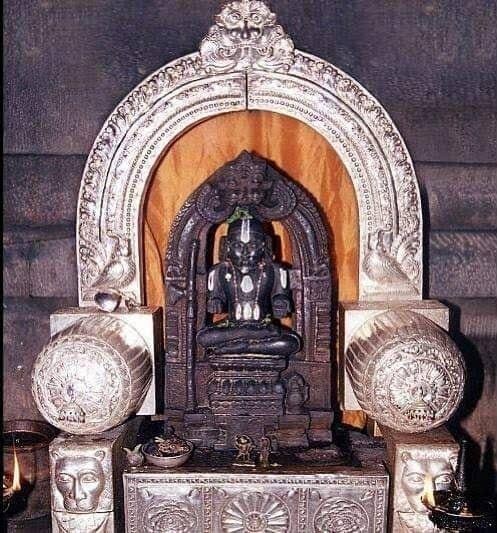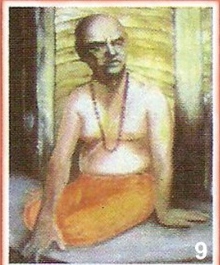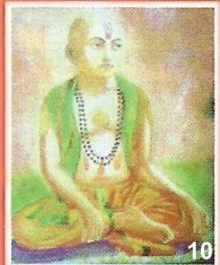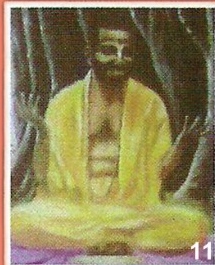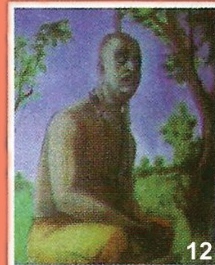
Srila Sridhara Swami
Jagad-guru & Bhavartha-dipika Author
Also known as Sridhara Svami, Shridhara Swami, Sridhara Swamipada, Sridhar Swami
“Sridhara Swami is the spiritual master of the entire world because by his mercy we can understand Srimad-Bhagavatam. I therefore accept him as a spiritual master.”
Sri Chaitanya Mahaprabhu, rebuking the scholar Vallabha Bhatta for claiming to have surpassed Sridhara Swami's commentary — Sri Chaitanya-charitamrita, Antya-lila 7.133.
Almost every serious student of Srimad-Bhagavatam, in any Vaishnava line, comes across the same name in the footnotes sooner or later: Sridhara Swami. He wrote the oldest surviving commentary that covers the whole Bhagavatam from beginning to end. It is called the Bhavartha-dipika, and he finished it roughly a century before Sri Chaitanya Mahaprabhu was even born. His place in this history is not only that his commentary came first. Mahaprabhu Himself studied it and depended on it, and on one recorded occasion He grew genuinely angry when a proud scholar tried to set it aside. Sridhara Swami's own life story is thin; the historical record kept very little about him as a person. But his place in how this whole tradition reads its own central scripture is enormous, and it is well documented.
| Detail | Description |
|---|---|
| Best known as | Author of the Bhavartha-dipika, the first complete commentary on Srimad-Bhagavatam |
| Approximate dates | Roughly 1350-1450 CE (most scholars place him nearer 1400 CE), about a century before Sri Chaitanya Mahaprabhu |
| Probable birthplace | A village near Remuna, in the Baleshwar (Balasore) district of present-day Odisha (other, less favored ideas point to Gujarat, South India or Varanasi) |
| Guru | Paramananda Puri, named in the opening invocation of the Bhavartha-dipika itself; not well documented beyond that |
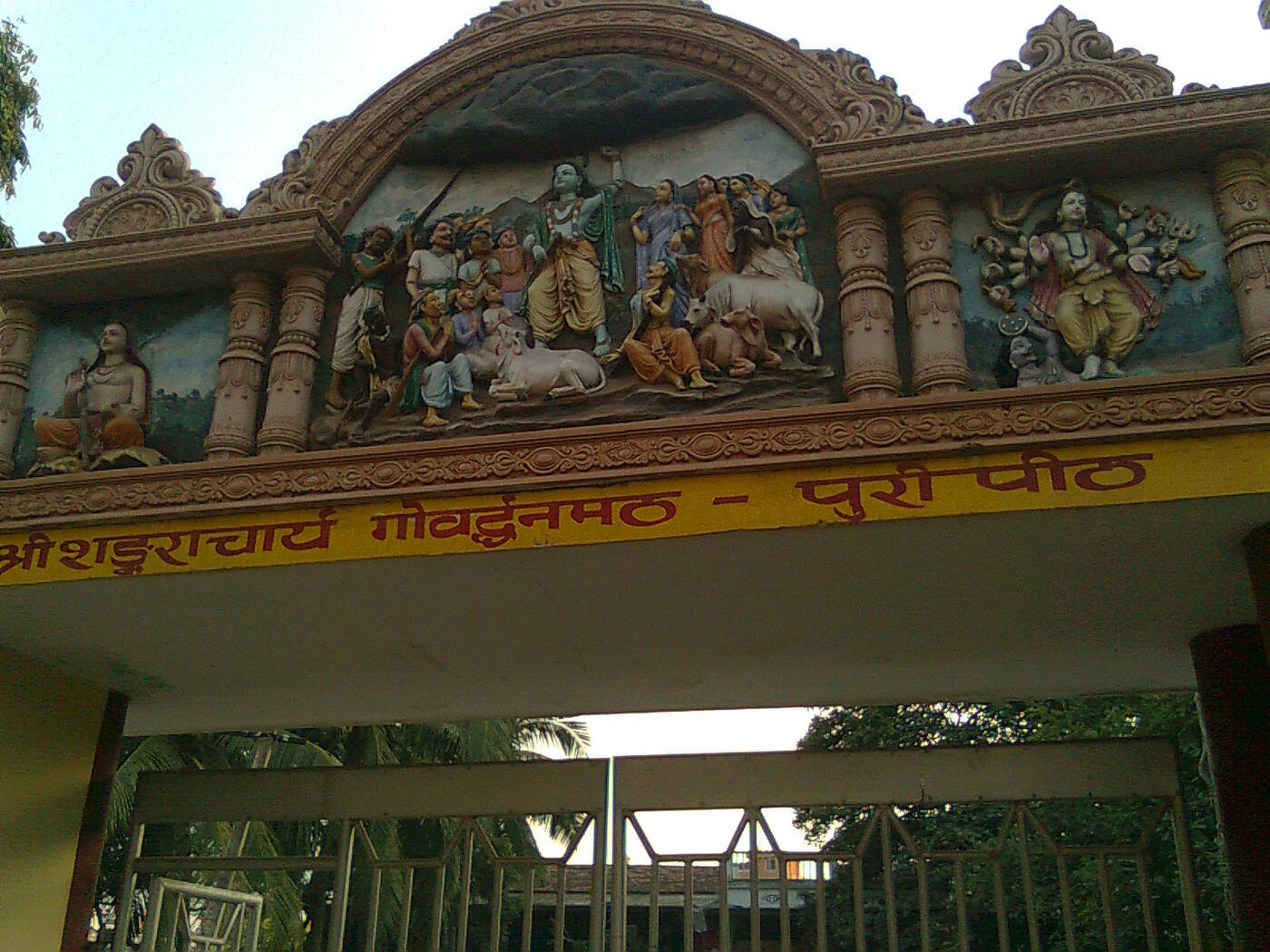
| Institutional position | Abbot (mahant) of the Govardhana Matha at Jagannatha Puri, one of the four mathas traditionally founded by Adi Shankaracharya |
| Sampradaya | Identified by Srila Bhaktisiddhanta Sarasvati Thakura and Srila Prabhupada as a tridandi-sannyasi of the Vishnu Svami (Rudra) sampradaya, not the Mayavadi ekadanda order his matha post might suggest |
| Chief works | Bhavartha-dipika (on Srimad-Bhagavatam), Subodhini-tika (on Bhagavad-gita), Atma-prakashika (on Vishnu Purana) |
At a Glance
- Almost nothing is recorded about his personal life. Even his birthplace is disputed, with four different regions proposed.
- He served for years as abbot of the Govardhana Matha in Jagannatha Puri, a monastery in the line of Adi Shankaracharya's Advaita Vedanta.
- His Bhagavatam commentary, the Bhavartha-dipika, became the standard that every later commentator, Gaudiya and non-Gaudiya alike, had to answer to.
- Sri Chaitanya Mahaprabhu called him "the spiritual master of the entire world," and reacted sharply when the scholar Vallabha Bhatta tried to set his commentary aside.
- Centuries later, Srila Prabhupada still called him simply "the original commentator" on the Bhagavatam.
A Commentator the Historical Record Barely Touches #
Very little can be said with confidence about Sridhara Swami's life, and it is better to say that plainly than to dress up guesswork as fact. Most scholarship follows the researcher P. K. Gode's 1949 study in the Annals of the Bhandarkar Oriental Research Institute. It places him somewhere between about 1350 and 1450 CE, with 1400 CE as the most commonly cited midpoint. That date comes mainly from working out which earlier writers he quotes, so he cannot be too early, and which later writers quote him, so he cannot be too late. That puts him roughly a century after Madhvacharya (traditionally 1238-1317 CE) and about a century before Sri Chaitanya Mahaprabhu (1486-1534 CE). He is not, as sometimes loosely suggested, a close contemporary of either Madhvacharya or of Jayadeva Goswami, whose Gita-govinda is generally placed a full two centuries earlier, in the twelfth century. Sources disagree even on where he was born: Odisha (specifically a village near Remuna), Gujarat, South India and Varanasi have all been proposed. A village near Remuna in the Baleshwar district of Odisha is considered most likely by most scholars who have studied the question. The fuller picture of what is and is not known about his life, along with his guru Paramananda Puri and his long years at the Govardhana Matha in Jagannatha Puri, is told on Life and Uncertain Dates.
Sannyasa at a Shankarite Monastery, Yet Not a Mayavadi #
Here the story gets genuinely interesting rather than merely uncertain. For years Sridhara Swami held the position of abbot at the Govardhana Matha, one of the four mathas descended from Adi Shankaracharya's own Advaita Vedanta order. That is exactly why some later Mayavadi sannyasis assumed he belonged to their camp. Srila Bhaktisiddhanta Sarasvati Thakura, and Srila Prabhupada after him, both stated directly that this assumption is mistaken: Sridhara Swami was in fact a tridandi-sannyasi of the Vishnu Svami sampradaya, one of the four original Vaishnava lines, and his own commentary is full of genuine, heartfelt devotion to Krishna and to Lord Nrisimha. Srila Jiva Goswami, writing generations later in his Tattva-sandarbha, went further still. He argued that Sridhara Swami used Advaita-sounding language on purpose, as a kind of bait to draw Advaita-minded readers toward bhakti: what Srila Baladeva Vidyabhusana later described, commenting on that same passage, as "meat on the end of a hook, meant to lure fish." This whole question, a Shankarite abbot with a Vaishnava heart, and what later acharyas made of that combination, is examined in full on Writing the Bhavartha-dipika.
"The Spiritual Master of the Entire World" #
Sri Chaitanya Mahaprabhu's own regard for Sridhara Swami is not something we have to guess at from silence. It is stated outright, in words Krishnadasa Kaviraja Goswami records directly in Sri Chaitanya-charitamrita. The learned Vallabha Bhatta, later famous in his own right as Vallabhacharya, founder of the Pushti-marga, told Mahaprabhu that he had written a Bhagavatam commentary surpassing Sridhara Swami's. Mahaprabhu's reply left no room for negotiation: "Sridhara Swami is the spiritual master of the entire world because by his mercy we can understand Srimad-Bhagavatam. I therefore accept him as a spiritual master." That one episode, and the sharper words that came with it, are reason enough on their own for this history to be told in full. They are recounted with exact chapter and verse on two dedicated pages: Sri Chaitanya Mahaprabhu's Own Reliance on Him and Defending Sridhara Swami's Honor.
Srila Prabhupada's Continuing Testimony #
The reverence did not stop with Mahaprabhu. Srila Prabhupada, the founder-acharya of ISKCON, refers to Sridhara Swami in his purport to Srimad-Bhagavatam 1.3.15 simply as "the original commentator on the Bhagavatam." Across numerous lectures and conversations recorded on tape, he repeats the Vallabha Bhatta story, explains Sridhara Swami's place among the four Vaishnava sampradayas, and insists, against a real misunderstanding among some Mayavadi sannyasis of his own day, that Sridhara Swami was never one of them. These statements, drawn from more than half a dozen separate lectures and purports spanning the 1970s, are gathered with citation on Srila Prabhupada's Testimony.
A Legacy No Later Commentator Could Ignore #
By the time Vishvanatha Chakravarti Thakura, Baladeva Vidyabhusana, Bhaktivinoda Thakura and Bhaktisiddhanta Sarasvati Thakura came to write their own commentaries on the Bhagavatam, Sridhara Swami's Bhavartha-dipika was not simply one predecessor's opinion to be weighed among others. It was the floor beneath the whole conversation, the text every later commentary, Gaudiya and non-Gaudiya alike, positioned itself against. Srila Jiva Goswami's own Bhagavatam commentary work in the Sandarbhas leans on it directly, and Srila Sanatana Goswami's Vaishnava-toshani assumes a reader who already knows it. How that authority took shape, and how far it reached beyond the Gaudiya Vaishnava tradition itself, into Madhva-sampradaya scholarship and beyond, is the subject of Legacy Across the Vaishnava Tradition.
Scriptural evidence
śrīdhara-svāmi-prasāde ‘bhāgavata’ jāni
jagad-guru śrīdhara-svāmī ‘guru’ kari’ māni
Word for word
śrīdhara-svāmi-prasāde — by the mercy of Sridhara Svami; bhāgavata jāni — I understand Srimad-Bhagavatam; jagad-guru — the spiritual master of the entire world; śrīdhara-svāmī — Sridhara Svami; guru kari’ māni — I accept as spiritual master.
“Sridhara Svami is the spiritual master of the entire world because by his mercy we can understand Srimad-Bhagavatam. I therefore accept him as a spiritual master.
The single most important verse on this page: Sri Chaitanya Mahaprabhu's own direct statement of Sridhara Swami's universal authority, using the word jagad-guru.
What Srila Prabhupada said
According to Sripada Sridhara Svami, the original commentator on the Bhagavatam, there is not always a devastation after the change of every Manu. And yet this inundation after the period of Cakshusha Manu took place in order to show some wonders to Satyavrata.
Srimad-Bhagavatam 1.3.15 — Lecture, unknown, Published purport
- Sri Chaitanya-charitamrita, Antya-lila 7 (vedabase.io)
- Srimad-Bhagavatam 1.3.15, Purport
- Sri Chaitanya-charitamrita, Madhya-lila 3.6, Purport
- The Glories of Sridhara Swami: A Quick Comment on a Crafty Commentator, by Satyaraja Dasa — Back to Godhead
- P. K. Gode, "Date of Sridharasvamin... Between c. A.D. 1350 and 1450," Annals of the Bhandarkar Oriental Research Institute 30 (1949)
- Wisdomlib: Shridhara Svami — definitions and bibliographic notes
- Ravi M. Gupta, The Chaitanya Vaishnava Vedanta of Jiva Goswami: When Knowledge Meets Devotion
- Stuart Mark Elkman, Jiva Gosvamin's Tattva-sandarbha
Frequently asked
When was Srila Sridhara Swami born?
Srila Sridhara Swami appeared Not recorded; scholarship places his life around 1350 to 1450 CE, most likely near 1400 CE in a village near Remuna, Odisha.
When and where did Srila Sridhara Swami disappear?
Srila Sridhara Swami disappeared Not recorded, though he is remembered for his long tenure as abbot at the Govardhana Matha, Jagannatha Puri, Odisha.
What are the main pastimes of Srila Sridhara Swami?
The pastimes covered here include: Life and Uncertain Dates, Writing the Bhavartha-dipika, Sri Chaitanya Mahaprabhu's Own Reliance on Him, Defending Sridhara Swami's Honor, Srila Prabhupada's Testimony, Legacy Across the Vaishnava Tradition.